
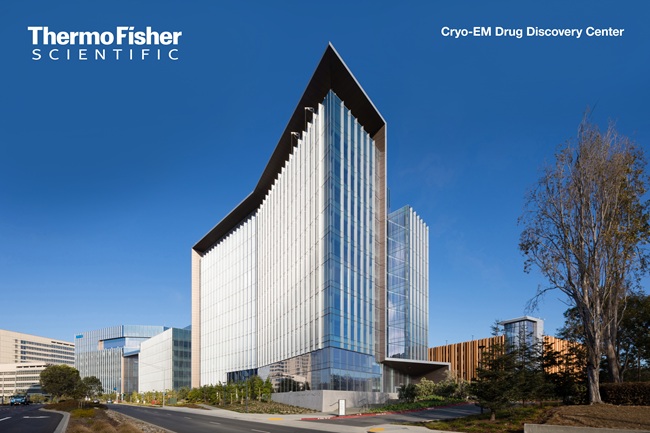
Thermo Fisher Scientific has opened a new cryo-electron microscopy drug discovery center in South San Francisco aimed at helping pharmaceutical and biotechnology companies accelerate the development of structure-guided therapies. The facility gives researchers hands-on access to advanced cryo-electron microscopy platforms, specialized sample preparation tools, and integrated data analysis workflows designed to speed up molecular-level understanding of disease targets. The move reflects Thermo Fisher Scientific’s broader strategy of embedding advanced structural biology technologies closer to major biotech innovation hubs. By lowering the barriers to cryo-electron microscopy adoption, the company is positioning itself at the center of a growing shift toward structure-guided drug discovery.
Located in the Oyster Point biotechnology corridor of South San Francisco, the new facility is designed as a collaborative environment where pharmaceutical companies, biotechnology startups, and academic researchers can work alongside Thermo Fisher Scientific specialists to translate structural insights into potential therapeutic breakthroughs. The center also builds on an earlier model developed in the United Kingdom that demonstrated how shared cryo-electron microscopy infrastructure can accelerate research timelines across multiple organizations.
Why are pharmaceutical companies increasingly turning to cryo-electron microscopy for structure-guided drug discovery?
Cryo-electron microscopy, often abbreviated as cryo-EM, has become one of the most influential technologies in structural biology over the past decade. The technique allows scientists to visualize biomolecules at near-atomic resolution by rapidly freezing biological samples and imaging them with powerful electron microscopes.
This capability has significantly changed how researchers study proteins, enzymes, and complex biological assemblies that are often difficult to analyze using traditional structural methods such as X-ray crystallography. For drug discovery teams, that difference can be critical. Understanding how a therapeutic molecule interacts with a protein target at the molecular level can dramatically improve the chances of designing effective drugs.
The pharmaceutical industry has increasingly embraced cryo-electron microscopy as the technology matured. Improvements in electron detectors, image processing algorithms, and microscope stability have turned what was once a specialized research tool into a central component of modern drug discovery workflows.
Thermo Fisher Scientific’s new facility is built around this shift. By providing access to advanced cryo-electron microscopy instrumentation and integrated analysis platforms, the center aims to shorten the time between early discovery and clinical development.
Researchers working within the facility can analyze biological targets in unprecedented detail. That structural information can guide medicinal chemists in refining molecules to improve binding, specificity, and safety. Over time, the approach reduces the need for trial-and-error screening and increases the probability that drug candidates will succeed in clinical trials.
How does Thermo Fisher Scientific’s new cryo-EM center lower barriers for biotechnology innovators?
Despite its transformative potential, cryo-electron microscopy remains a technically demanding and capital-intensive technology. High-end cryo-EM instruments can cost several million dollars, and operating them requires specialized expertise in sample preparation, imaging, and computational analysis.
For smaller biotechnology companies and academic laboratories, building an in-house cryo-electron microscopy facility is often financially unrealistic. Even large pharmaceutical companies may hesitate to commit the full resources required for a comprehensive structural biology platform.
Thermo Fisher Scientific’s strategy is to bridge that gap. The new cryo-EM drug discovery center provides shared infrastructure and expert support that allows researchers to use advanced imaging technology without making the full capital investment.
Scientists visiting the center can prepare biological samples using specialized equipment such as automated vitrification systems that rapidly freeze samples to preserve molecular structures. Once prepared, those samples can be analyzed using high-resolution cryo-electron microscopes capable of capturing thousands of images of biomolecules in different orientations.
The resulting data can then be processed using integrated software platforms that reconstruct three-dimensional molecular structures. This workflow transforms raw electron microscopy images into detailed models that researchers can use to guide drug design.
By offering both instrumentation and expertise under one roof, the facility enables pharmaceutical innovators to integrate cryo-electron microscopy into their research programs much earlier in the drug discovery process.
Why is South San Francisco becoming a strategic hub for structural biology and biotech collaboration?
The location of the cryo-electron microscopy drug discovery center is not accidental. South San Francisco has become one of the most concentrated biotechnology ecosystems in the world, often referred to as the birthplace of the modern biotech industry.
The region hosts hundreds of biotechnology companies, venture capital firms, research institutions, and pharmaceutical headquarters. This dense network of organizations creates an environment where scientific collaboration and rapid innovation can flourish.
Thermo Fisher Scientific’s decision to situate the facility in the Oyster Point area places the company at the heart of that ecosystem. Researchers from nearby biotechnology firms can access the center without traveling long distances, allowing them to integrate cryo-electron microscopy into ongoing discovery programs.
The geographic proximity also encourages collaborative research models. Pharmaceutical companies may use the facility alongside academic researchers and technology specialists, creating opportunities for knowledge exchange and joint innovation.
For Thermo Fisher Scientific, the location also strengthens its role as a technology partner to the life sciences industry. Rather than simply selling instruments, the company increasingly operates collaborative environments where customers can explore new capabilities and refine research strategies.
How does the new facility build on Thermo Fisher Scientific’s earlier cryo-EM collaborations in Europe?
The new cryo-electron microscopy drug discovery center in California builds on a collaborative model that Thermo Fisher Scientific helped establish nearly a decade ago in the United Kingdom. In 2016, the company partnered with several pharmaceutical companies to launch the United Kingdom Pharmaceutical Cryo-EM Consortium in Cambridge.
That consortium brought together pharmaceutical researchers and structural biology specialists in a shared research environment centered around cryo-electron microscopy technologies. Over time, the collaboration demonstrated that shared infrastructure could accelerate structural biology research while reducing the cost burden on individual companies.
The success of that initiative appears to have informed Thermo Fisher Scientific’s strategy for the new North American facility. The South San Francisco center is expected to include founding pharmaceutical and biotechnology members who will collaborate within the facility while leveraging Thermo Fisher Scientific’s expertise and equipment.
This consortium-style model allows participating organizations to share knowledge, develop standardized workflows, and accelerate the translation of structural insights into drug candidates.
The approach also reflects a broader trend in life sciences research, where companies increasingly collaborate on pre-competitive technologies while competing on therapeutic development and commercialization.
What does Thermo Fisher Scientific’s cryo-EM investment signal about the future of structure-based drug discovery?
The launch of the cryo-electron microscopy drug discovery center highlights a broader shift in pharmaceutical research toward structure-guided drug development.
Historically, many drug discovery programs relied heavily on high-throughput screening, where researchers tested thousands or millions of molecules against biological targets to identify potential candidates. While that approach remains important, it often requires extensive experimentation and optimization.
Structure-based methods offer a different path. By visualizing the three-dimensional architecture of disease-related proteins, scientists can design molecules specifically tailored to interact with those targets.
This rational design approach has gained momentum as structural biology technologies have improved. Cryo-electron microscopy, in particular, has enabled researchers to analyze proteins that are difficult to crystallize or otherwise study using traditional methods.
Industry data suggests that structure-guided drug development can significantly improve success rates during clinical development. Drug candidates designed with detailed structural insights may be more likely to achieve desired biological activity while minimizing unintended interactions.
Thermo Fisher Scientific’s investment therefore reflects a long-term bet on structural biology as a core pillar of pharmaceutical innovation.
As the technology becomes more accessible, cryo-electron microscopy could shift from being a specialized research capability to a routine component of drug discovery pipelines.
How might this new cryo-EM ecosystem influence competition across the drug discovery technology market?
The creation of a dedicated cryo-electron microscopy drug discovery center also has implications for the broader life sciences technology sector. Companies that provide structural biology tools, computational modeling platforms, and data analysis software are increasingly competing to support the pharmaceutical industry’s move toward structure-guided research.
Thermo Fisher Scientific already holds a significant position in this ecosystem through its portfolio of electron microscopes, detectors, and imaging software. By establishing collaborative research facilities, the company is strengthening its role not only as a technology supplier but also as an innovation partner.
This approach can deepen relationships with pharmaceutical customers. Researchers who develop workflows using Thermo Fisher Scientific instruments and software within the center may be more likely to adopt similar systems in their own laboratories.
Competitors in structural biology instrumentation and computational drug discovery may respond by expanding partnerships or launching their own collaborative research hubs.
The competitive landscape could therefore evolve toward integrated ecosystems that combine hardware, software, and scientific expertise to accelerate pharmaceutical research.
What are the key takeaways on what Thermo Fisher Scientific’s cryo-EM center means for drug discovery and industry strategy?
- Thermo Fisher Scientific is expanding its role in structural biology by providing shared cryo-electron microscopy infrastructure for pharmaceutical and biotechnology innovators.
- The new facility in South San Francisco places advanced imaging technology directly within one of the world’s most influential biotechnology ecosystems.
- Cryo-electron microscopy is becoming a central tool in structure-guided drug discovery, enabling researchers to visualize molecular interactions with unprecedented detail.
- By lowering the cost and expertise barriers associated with cryo-electron microscopy, Thermo Fisher Scientific is encouraging wider adoption of the technology across the pharmaceutical industry.
- The center builds on the collaborative model pioneered by the United Kingdom Pharmaceutical Cryo-EM Consortium, demonstrating how shared infrastructure can accelerate research progress.
- Pharmaceutical companies using structure-guided approaches may improve the probability of clinical success by designing drug candidates based on precise molecular insights.
- Thermo Fisher Scientific’s strategy strengthens its position as a long-term technology partner rather than simply an equipment vendor.
- The initiative reflects a broader industry shift toward integrated structural biology platforms that combine advanced imaging, computational analysis, and collaborative research environments.
- As cryo-electron microscopy becomes more accessible, it could reshape early-stage drug discovery pipelines across pharmaceutical and biotechnology companies.
Discover more from Business-News-Today.com
Subscribe to get the latest posts sent to your email.