




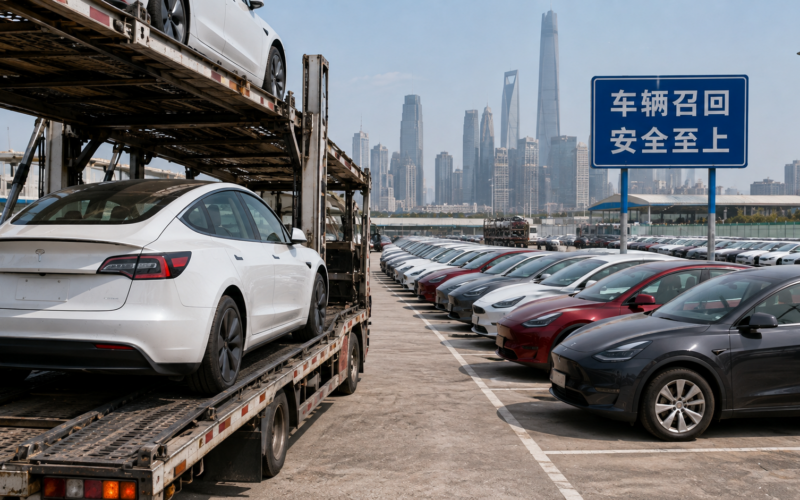
Tesla Inc. (NASDAQ: TSLA) is recalling nearly 2.98 million electric vehicles in China over concerns that occupants and rescuers may have difficulty identifying and operating emergency mechanical door releases after severe crashes, placing the company at the centre of the largest vehicle recall campaign in Chinese automotive history.
China’s State Administration for Market Regulation published Tesla’s recall filing on August 21, 2026, covering locally manufactured and imported Model 3, Model Y, Model X and Model S vehicles. Tesla will add warning labels identifying emergency mechanical releases and introduce software changes intended to lower windows after certain crashes, reducing the risk that occupants cannot quickly exit when the vehicle’s low-voltage electrical system is unavailable.
The Tesla action forms part of a wider recall involving approximately 4.3 million vehicles from nine manufacturers, including Xiaomi Corporation, Zhejiang Leapmotor Technology Co., XPeng Inc. and Zhejiang Geely Holding Group-linked brands. The regulatory intervention marks a turning point for flush and electronically operated door handles, an EV design feature popularised by Tesla that China is moving to restrict more aggressively from 2027.
Which Tesla vehicles are included in the nearly 2.98 million-unit China recall?
Tesla Shanghai and Tesla Beijing have filed two recall groups covering a combined 2,975,910 vehicles.
The largest component includes 973,156 locally manufactured Model 3 vehicles produced between March 4, 2019 and April 29, 2026, together with 1,956,713 China-made Model Y vehicles produced between November 16, 2020 and April 30, 2026.
Imported vehicles include 35,590 Model 3 cars produced between August 22, 2018 and November 20, 2019, 8,328 Model X vehicles produced between October 27, 2022 and February 13, 2026 and 2,123 Model S vehicles manufactured between January 18, 2023 and February 10, 2026.
The door-related recall is scheduled to begin on September 25. Tesla will contact affected owners through its application, text messages and email, while remedial work will be provided without charge.
China’s regulator said the emergency mechanical handles inside affected vehicles can be difficult to identify because their appearance is similar to surrounding interior trim. During a severe crash that disables the low-voltage electrical system, that lack of visibility or intuitive operation could delay occupants trying to escape and rescuers attempting to open the vehicle.

Why are electronic and concealed EV door handles becoming a global safety issue?
Flush-mounted handles have become a defining design feature on many modern electric vehicles because they improve aerodynamics and create a cleaner exterior appearance. Electronic interior controls also allow manufacturers to replace conventional mechanical handles with buttons and software-mediated door operation.
Problems can arise when a serious crash interrupts electrical power. Vehicles generally provide mechanical backup systems, but those systems may be difficult to locate, poorly marked or substantially different from the controls passengers normally use.
That difference becomes particularly important during fire, smoke, submersion or severe collision scenarios where occupants may have only seconds to leave a vehicle. Rescue personnel approaching an unfamiliar EV can face a similar problem if an external handle no longer operates normally after electrical failure.
Chinese regulators have responded by moving towards tougher design requirements, including restrictions on fully concealed door handles from 2027. The August recall indicates that authorities are unwilling to wait for new models alone and are also requiring remedies for millions of existing vehicles.
The intervention has implications beyond China because many of the affected designs are sold globally. Regulators in the United States and Europe have also been examining electronic door-access systems, meaning China’s action could intensify pressure for harmonised emergency-egress standards across major automotive markets.
How will Tesla fix the emergency door-release problem without replacing millions of doors?
The remedy illustrates one reason modern vehicle recalls do not always carry the same cost profile as older mechanical campaigns.
Tesla will install warning labels to make emergency mechanical door releases easier to identify. It will also update window-control software over the air, introducing a strategy designed to lower windows after certain accidents and thereby reduce the potential consequences of occupants being unable to operate doors normally.
Some vehicles already equipped with appropriate warning labels will not need labels installed again. Software updates can be transmitted remotely to compatible vehicles, reducing the number of owners who need to visit physical service centres.
The underlying mechanical emergency release therefore remains in the vehicle; the recall primarily seeks to make it easier to identify and to provide another potential path for occupants or rescuers during a crash.
China’s official Tesla filing also contains a separate recall involving approximately 2.74 million China-made Model 3 and Model Y vehicles over driver-attention monitoring while assisted steering is active. Tesla will add in-cabin camera monitoring through software updates to supplement steering-wheel torque detection.
Those vehicles overlap extensively with the door-handle population, so the two recall numbers should not simply be added together as though every entry represents a different Tesla.
Why is the wider 4.3 million-vehicle recall a warning for China’s entire EV industry?
Tesla may account for the majority of affected vehicles, but the recall is not fundamentally a Tesla-only issue.
Chinese manufacturers adopted concealed and electronic handles rapidly as EV competition shifted towards futuristic styling, aerodynamics and software-controlled features. Xiaomi, Leapmotor, XPeng, Geely-linked brands and other manufacturers are now addressing comparable emergency-access concerns.
That breadth changes the regulatory significance. If one manufacturer were affected, the event could be interpreted as a company-specific design failure. A recall spanning nine automakers instead suggests regulators have concluded that an industry-wide design trend created a common safety problem.
China has become the world’s largest electric-vehicle market and manufacturing base, giving its safety rules significant global influence. Features developed or normalised in China increasingly appear on export models sold across Europe, Asia and other markets.
Manufacturers may therefore begin redesigning future vehicles before equivalent rules become mandatory elsewhere. A conventional visible mechanical door handle can appear technologically unsophisticated beside a retractable electronic design, but regulators are signalling that intuitive emergency operation may now outweigh aesthetic and aerodynamic gains.
Why did Tesla shares rise despite the massive China recall?
Tesla shares closed August 21 at $362.86, up 5.14% for the session, even as details of the China recall emerged. The stock has risen sharply from $311.21 at the end of July, although it remains volatile and the latest daily gain should not be interpreted as investor approval of the recall.
The principal positive catalyst on August 21 was separate progress in Tesla’s robotaxi strategy. Nevada transportation authorities cleared the company for a potentially large deployment around Las Vegas, adding to investor expectations that autonomous mobility could eventually become a major revenue stream.
The contrasting developments reveal how Tesla’s investment narrative increasingly spans very different risk categories. A recall affecting almost three million vehicles is operationally large, but software-based remedies and inexpensive warning labels may limit direct cost compared with a hardware replacement campaign.
The regulatory risk is potentially more important than the immediate repair bill. If China, the United States and Europe converge on stricter requirements for door handles, Tesla may need to redesign one of its most recognisable vehicle features while adapting future models across several markets.
For investors, that puts the China recall in perspective. The market is currently assigning substantial value to robotaxis and autonomous technology, but regulators are simultaneously demonstrating that relatively basic functions such as opening a door after a crash can still impose design changes across millions of high-technology vehicles.
Discover more from Business-News-Today.com
Subscribe to get the latest posts sent to your email.

