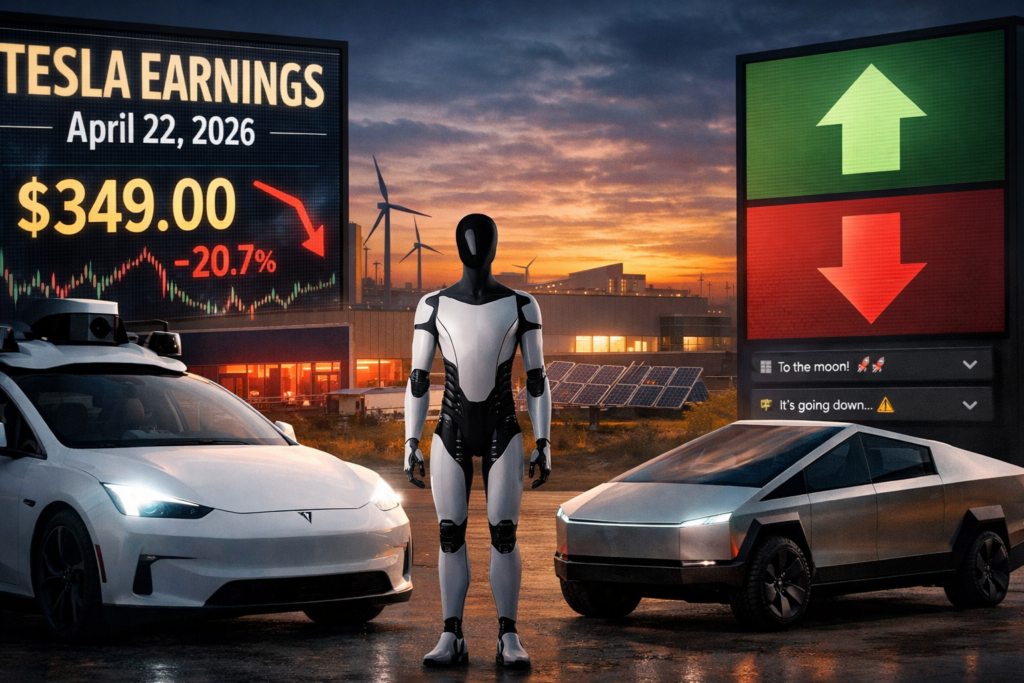
Tesla, Inc. (NASDAQ: TSLA) is heading into one of the most consequential earnings releases in its history on 22 April 2026, and the setup could not be more polarised. The company has spent the better part of two years pivoting its investment thesis away from car manufacturing and toward autonomous vehicles, humanoid robotics, and energy infrastructure, yet its core automotive business keeps putting up numbers that make that pivot harder to justify. With the stock trading around USD 349, down more than 20% year-to-date and nursing an eight-week losing streak, retail investors watching from Reddit, X, and Stocktwits are split almost evenly on whether the next 20% move is up or down. The April 22 earnings report, combined with a Cybercab production ramp that was supposed to have started this month, will go a long way toward deciding that debate.
What does Tesla actually sell in 2026, and why does the answer matter to shareholders?
Tesla was founded as an electric vehicle company, and that is still where the overwhelming majority of its revenue originates. The Model 3 and Model Y together account for nearly all vehicle deliveries, with premium models such as the Model S now being wound down entirely. In Q4 2025, Tesla discontinued Model S and Model X production at its Fremont, California factory to free floor space for an Optimus humanoid robot manufacturing line, a decision that sent immediate shockwaves through Reddit investment forums.
The pivot matters because the valuation does not make sense if Tesla is simply a car company. At a market capitalisation of approximately USD 1.31 trillion and trailing earnings per share of around USD 1.08, the stock trades at a multiple that would be absurd for a conventional automaker. Wedbush analyst Dan Ives, arguably the most prominent bull on the Street, holds a price target of USD 600 and argues the market is underestimating Tesla’s shift toward AI and automation. His bull case rests on autonomous driving services and Optimus, not vehicle gross margins.
The energy storage division is genuinely growing and deserves credit. In Q4 2025 it posted a record gross profit of USD 1.1 billion, its fifth consecutive record quarter, and it deployed 8.8 gigawatt-hours of storage in Q1 2026 alone. Revenue in the segment grew 67% year-over-year in Q1 2025. That business is real and expanding, even as the automotive segment absorbs the headlines about brand damage and delivery misses.
Why did TSLA drop 5% after Q1 2026 delivery numbers, and what do those figures actually signal?
Tesla reported Q1 2026 vehicle deliveries of 358,023 units, missing the analyst consensus of roughly 365,645 vehicles compiled by the company itself from 23 sell-side firms. The miss was not enormous in absolute terms, but the sequential context made it worse. Tesla had delivered 418,227 vehicles in Q4 2025, meaning Q1 output fell approximately 14% quarter on quarter. Seasonal patterns typically produce weaker Q1 numbers, but a drop of that magnitude still amplified pre-existing concerns about demand.
The deeper worry embedded in the delivery data is the production-to-sales gap. Tesla produced approximately 50,000 more vehicles than it sold in Q1 2026, which means inventory is building. JPMorgan analyst Ryan Brinkman flagged the risk plainly: if Tesla needs to discount further to clear that stock, automotive gross margins will come under additional pressure. Gross margin had recovered to 20.1% in Q4 2025, but Q1 will tell whether that recovery held.
For context, Model 3 and Model Y deliveries came in at 341,893 units in Q1, well below the consensus estimate of 351,179. Other models contributed 16,130 units, beating expectations. But the Model 3 and Model Y are the volume machine, and a miss there cannot be offset by niche products.
How is the Cybercab production ramp going, and what is the realistic timeline for Tesla’s robotaxi launch?
The Cybercab is a purpose-built, two-seat electric robotaxi with no steering wheel, no pedals, and inductive wireless charging. Tesla produced its first Cybercab at Gigafactory Texas in February 2026 and had targeted volume production to begin in April, which is now. The vehicle will run on Tesla’s AI4 hardware after the company confirmed that its next-generation AI5 chip platform has been pushed to mid-2027, a full year later than originally planned.
The wider robotaxi rollout is also expanding geographically. Tesla has been running a supervised and unsupervised pilot in Austin, Texas using Model Y vehicles since mid-2025. A fleet of 60 robotaxi-ready Model Ys was recently spotted staging in Phoenix, Arizona, suggesting Tesla is preparing to expand into Sun Belt cities including Dallas, Houston, Miami, Orlando, Tampa, and Las Vegas during the first half of 2026.
The regulatory picture is the largest variable. Cybercabs have no steering wheel, which means a human backup driver cannot step in if the software fails. That design choice requires full unsupervised approval from regulators, which Tesla does not yet have at scale. The National Highway Traffic Safety Administration has signalled it will reduce autonomous vehicle regulations, which is a tailwind, but approval timelines remain unpredictable. Investors should not assume Cybercabs will be commercially operating across multiple U.S. cities before the end of 2026.
What does the April 22 earnings report need to show for TSLA to recover from its 2026 lows?
The April 22 earnings print is the most important single data point for TSLA this year. Analyst estimates for Q1 EPS vary widely, ranging from USD 0.22 to USD 0.54, with a consensus around USD 0.39, up from USD 0.27 in Q1 2025. Revenue is expected to come in around USD 22.5 billion to USD 22.8 billion, representing approximately 17% to 18% growth year-over-year from USD 19.3 billion in Q1 2025.
The key lines for investors to watch are automotive gross margin, free cash flow, and whatever guidance management gives on Cybercab production volumes. Tesla has missed earnings consensus in each of the last four consecutive quarters, so the bar is already set with some scepticism baked in. Historically, Tesla earnings reports move the stock by more than 5% in either direction.
Beyond the headline numbers, investors will be listening for any signal from Elon Musk about his involvement in Washington and whether he intends to return his focus to Tesla. The company’s own 2025 annual filing acknowledged that political sentiment tied to Musk’s public profile may be weighing on brand perception and vehicle demand. Automotive revenue in Q1 2025 fell 20% year-over-year, with the company explicitly citing brand-related headwinds. Any directional clarity on that front from Musk during the April 22 call could move the stock independently of the financial results.
Why are macro conditions and tariff policy creating a specific risk for Tesla that most investors are underpricing?
Tesla is an American manufacturer but it sources components globally and sells into markets where trade policy is shifting rapidly. The company has warned that its energy storage business faces more acute tariff exposure than its automotive segment, which is a nuance that matters given how much of the bull case depends on the energy division growing its margins.
Broader market conditions have also punished TSLA alongside other high-multiple technology names in 2026. The stock dropped to a year-to-date low of USD 337.25 before recovering slightly. At a trailing price-to-earnings ratio in the hundreds, Tesla is priced as an AI and autonomy platform, not a car company. That means when risk appetite contracts and investors rotate out of speculative technology exposure, Tesla sells off with it even if the core business is stable.
The Chinese competitive threat runs in parallel. BYD and other domestic Chinese manufacturers have continued to gain ground in global EV markets, including Europe and Southeast Asia. China exported more than twice as many electric vehicles and plug-in hybrids in Q1 2026 as it did in the same period a year earlier. That pace of competitive expansion puts sustained pressure on Tesla’s non-U.S. volumes.
How does Optimus fit into the Tesla investment thesis, and is the humanoid robot story credible yet?
Optimus is Tesla’s humanoid robot, and Musk has positioned it as the company’s most important long-term product. The original target called for 5,000 units produced in 2026, with an eventual run rate of one million units per year. By early 2026, reports from supply chain sources suggested Tesla had manufactured close to 1,000 Optimus units before production slowed, and Musk himself acknowledged that early production would be “agonizingly slow.”
The Fremont factory is being converted to host an Optimus production line with a stated long-term target of one million robots per year at that facility alone. A separate 10 million-unit-per-year line is planned at Gigafactory Texas. Tesla’s strategy is to deploy Optimus units onto its own factory floors first, using internal manufacturing as a real-world testing environment before offering the robot commercially at an estimated price of USD 20,000 to USD 30,000.
The Optimus Gen 3 design was teased at a keynote by Tesla’s Optimus program lead Konstantinos Laskaris in Zurich, but a formal reveal that was expected in Q1 2026 has been delayed. Ark Invest’s Cathie Wood has argued that robotaxis will account for 88% of Tesla’s enterprise value by 2029, with Optimus adding incremental upside. Critics argue that neither product is anywhere near the production scale that thesis requires.
What is the retail investor community actually saying about TSLA right now, and where is the disagreement sharpest?
Retail sentiment on TSLA is the most divided it has been in years. On Reddit, the social sentiment score drifted to bearish levels as low as 28 out of 100 in early 2026, with r/investing and r/stocks dominated by threads examining delivery declines, margin compression, and CEO distraction. A thread titled “I Finally Sold My Tesla Shares” on r/investing drew hundreds of responses from long-term holders explaining their exits.
On Stocktwits, a different picture emerges. An ongoing poll of over 2,200 respondents shows that 57% expect the next 20% move to be higher, while 43% expect further downside. Bullish users point to Musk’s historical ability to navigate crises and argue that a bad Q1 is already priced in, with the stock set to rally if he makes positive announcements about Cybercab production and his DOGE involvement. Bearish users focus on the sustained decline in vehicle deliveries, the widening gap between the AI narrative and actual revenue, and the brand damage caused by Musk’s political positioning.
The FSD approval in the Netherlands, announced on X by Tesla, generated its own thread of activity. European regulatory progress matters because it expands the addressable market for both FSD subscriptions and a future robotaxi deployment, targeted for Europe in 2027.
Key takeaways for retail investors watching TSLA ahead of April 22
- The next confirmed catalyst is the Q1 2026 earnings report on 22 April 2026, with consensus EPS of approximately USD 0.39 and consensus revenue of approximately USD 22.7 billion. The stock has missed estimates for four consecutive quarters, so a beat would be a meaningful signal of operational stabilisation.
- Cybercab production at Gigafactory Texas was targeted to begin this month, April 2026, using AI4 hardware after the AI5 chip was delayed to mid-2027. Physical production milestones and any commercial deployment updates from Musk will be watched closely alongside the financial results.
- The Q1 delivery miss of 358,023 vehicles, below a consensus of roughly 365,645, combined with approximately 50,000 units of excess inventory, means margin pressure in the automotive segment is the most likely source of a negative earnings surprise.
- The energy storage division is a genuine bright spot. It posted record gross profit in Q4 2025 and deployed 8.8 gigawatt-hours in Q1 2026. Full-year 2025 energy storage consensus reaches 65.2 gigawatt-hours. This segment is growing faster than automotive and warrants tracking as a standalone business.
- Analyst opinion on TSLA is almost evenly split across the 43 analysts covering the stock, with 15 strong buys, 16 holds, and 10 strong sells. The average 12-month price target sits around USD 405, representing approximately 16% upside from current levels. Wedbush’s Dan Ives holds the Street-high target of USD 600.
- The three biggest execution risks are: regulatory approval for unsupervised Cybercab operation, the production ramp pace for both Cybercab and Optimus, and ongoing brand sentiment tied to Musk’s political involvement. Any adverse development on any of these fronts could extend the year-to-date decline further.
- Retail investors who believe the autonomy thesis is real but overpriced can watch the April 22 call for confirmation that automotive margins are holding and that Cybercab production has genuinely begun at meaningful scale. Those who believe the thesis is detached from the current business fundamentals will be looking at the same call for evidence that the gap between narrative and numbers is finally starting to close.
Discover more from Business-News-Today.com
Subscribe to get the latest posts sent to your email.