


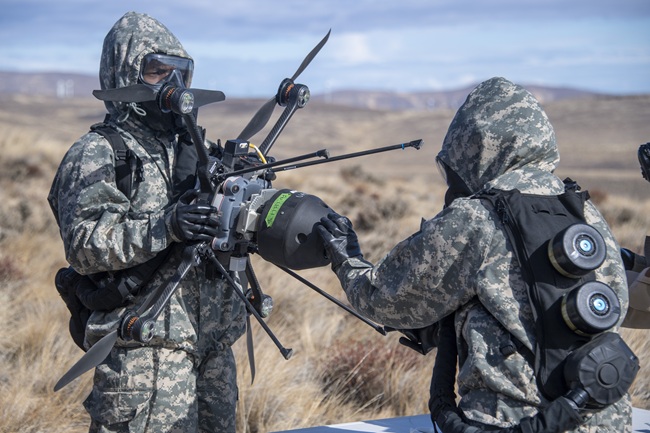
Teledyne Technologies Incorporated (NYSE:TDY) has secured an $11.2 million United States Army contract through Teledyne FLIR Defense for more than 45 advanced chemical, biological, radiological and nuclear sensor drone kits. The order is built around SkyRaider-based uncrewed aerial system kits that are designed to help soldiers detect hazardous substances from a safer distance during battlefield, security and emergency-response missions. The contract is modest compared with Teledyne Technologies Incorporated’s broader revenue base, but it is strategically important because it sits at the intersection of unmanned systems, battlefield sensing and force protection. The award also shows how the United States Army is moving specialised detection work away from exposed personnel and toward sensor-equipped drones that can enter dangerous environments first.
Why does Teledyne FLIR’s U.S. Army CBRN drone kit contract matter for battlefield sensing?
Teledyne FLIR Defense’s $11.2 million United States Army contract matters because chemical, biological, radiological and nuclear detection is one of the most hazardous mission sets in land warfare. Soldiers must identify invisible or poorly understood threats quickly, but traditional detection methods can require personnel to approach contaminated or potentially contaminated zones. By placing CBRN sensing payloads on uncrewed aerial systems, the United States Army can improve situational awareness while reducing immediate exposure for ground units.
The operational value is clear. A drone-based kit can scout suspected contamination, inspect dangerous areas, support route clearance and provide commanders with faster information before troops or vehicles move through a zone. In modern combat, speed of detection can decide whether a unit avoids a contaminated area, changes route, calls in specialist support or continues an operation with protective measures. That turns a sensor kit into a battlefield decision tool rather than a passive detection accessory.
The contract also matters because CBRN threats are not limited to conventional state-on-state warfare. They are relevant to counterterrorism, homeland defence, industrial accidents, disaster response and military operations in urban environments. That broad mission range makes the technology attractive to defence buyers because the same unmanned sensing approach can support multiple agencies and scenarios. The United States Army order may be small, but it points toward a wider market where hazardous-environment sensing becomes more automated and less manpower-intensive.
How could SkyRaider-based CBRN kits change the way soldiers detect hazardous threats?
SkyRaider-based CBRN kits could change detection workflows by allowing soldiers to separate reconnaissance from physical exposure. Instead of sending personnel toward a suspected hazard with handheld or vehicle-mounted systems, units can deploy an aerial platform to gather early readings, capture visual context and assess the affected area. That can improve tactical safety, especially in environments where the hazard is uncertain or where enemy activity may still be present.
The practical advantage is not only distance. A drone can approach difficult terrain, inspect confined outdoor areas, hover near suspected release points and transmit information to operators without requiring a full protective entry team at the first stage. This can help commanders decide whether to commit specialist CBRN units, redirect forces or keep a wider exclusion zone. The value lies in reducing uncertainty faster, because uncertainty is where bad battlefield decisions love to hide.
For the United States Army, this kind of kit can also strengthen training and standardisation. If the system is deployed across multiple units, soldiers can develop common procedures for CBRN reconnaissance, data handling, reporting and follow-up action. That matters because detection alone is not enough. The information must be usable inside command processes, safety protocols and operational planning. Teledyne FLIR Defense’s challenge will be to ensure that the drone kit improves those workflows rather than adding another complex gadget to an already overloaded soldier.
Why is the United States Army investing in unmanned systems for specialised force protection missions?
The United States Army is investing in unmanned systems for specialised missions because the battlefield has become too dangerous, too fast and too sensor-heavy for traditional exposure-based reconnaissance. Drones have already changed surveillance, targeting, logistics experimentation and route assessment. Extending them into CBRN detection follows the same logic: send the machine first when the mission is dirty, dangerous or uncertain.
Force protection is the central driver. A CBRN incident can slow a manoeuvre unit, contaminate equipment, force protective posture changes and create confusion across command channels. If uncrewed systems can detect hazards early, they can reduce the operational penalty of surprise. This is particularly valuable in high-tempo operations, where delayed detection can cascade into broader mission disruption.
The second driver is manpower efficiency. Specialist CBRN personnel are valuable and limited. Drone-based kits can help them cover more ground, assess more areas and focus human expertise where it is most needed. The goal is not to remove trained specialists from the loop. It is to give them better standoff tools and cleaner information before they make high-risk decisions. That is usually a good idea unless one enjoys running toward unknown contamination with paperwork and optimism.
What does the contract signal about Teledyne FLIR Defense’s position in military sensing?
The contract reinforces Teledyne FLIR Defense’s position as a defence sensing business built around detection, imaging and mission-specific electronics rather than large platforms alone. Teledyne FLIR Defense has long been associated with thermal imaging, surveillance systems, unmanned systems and specialised sensors. CBRN drone kits fit naturally into that portfolio because they combine payload expertise, unmanned integration and fieldable defence applications.
For Teledyne Technologies Incorporated, this is the type of contract that may not move quarterly revenue dramatically but strengthens the strategic quality of the defence portfolio. Defence customers increasingly want sensors that can be deployed on mobile, unmanned and networked systems. Companies that can package sensing capability into operationally useful kits may gain recurring opportunities as militaries upgrade drones, payloads and data-processing workflows.
The competitive point is also important. Military sensing is becoming more modular. Buyers may not want a completely new aircraft, vehicle or platform every time they add a capability. They may prefer payloads and kits that can be integrated onto existing unmanned systems. Teledyne FLIR Defense’s ability to combine sensor credibility with deployable drone configurations gives it a stronger position in that modular procurement environment.
How should investors read Teledyne Technologies stock sentiment after the U.S. Army order?
Teledyne Technologies Incorporated stock last traded at $602.27, with a market capitalisation of about $28.19 billion. The shares were down on the latest trading day, reflecting broader market pressure and company-specific movement rather than any obvious negative read-through from the United States Army order. The stock remains below its 52-week high of $693.38 and above its 52-week low of $483.02, which places it in a middle zone where investors appear to be balancing strong long-term technology exposure against valuation and earnings expectations.
For investors, the CBRN drone kit contract should be read as a strategic validation point rather than a financial catalyst. An $11.2 million order is small for Teledyne Technologies Incorporated, but it supports the company’s positioning in defence electronics, unmanned sensing and hazardous-environment detection. These are attractive niches because they connect to structural defence priorities without requiring Teledyne Technologies Incorporated to compete as a prime contractor for the largest weapons platforms.
The more important question is whether Teledyne FLIR Defense can convert this order into follow-on demand, wider unit adoption or adjacent contracts across other services and allied militaries. Investors usually care less about the first contract than about the second, third and sustainment tail that may follow. If the kits perform well and become part of recurring CBRN readiness planning, the commercial value could extend beyond the initial headline amount.
Why is CBRN detection becoming more relevant in modern defence planning?
CBRN detection is becoming more relevant because militaries are preparing for a wider spectrum of threats, including conventional conflict, hybrid warfare, sabotage, terrorism and contaminated industrial environments. The risk of chemical, biological, radiological or nuclear exposure may be low-frequency compared with everyday battlefield threats, but the consequences can be severe enough to justify specialised preparedness. Defence planners cannot afford to ignore hazards that can paralyse units, disrupt logistics or create political shock.
The war in Ukraine and conflicts in the Middle East have also reinforced the importance of drones in identifying threats before troops move. Even when the mission is not directly CBRN-related, the broader lesson is the same: commanders want more eyes, more sensors and fewer personnel exposed in the first contact layer. CBRN drone kits apply that logic to a specialised but high-consequence mission set.
There is also a homeland and civil-response dimension. Military CBRN capabilities often support emergency response after industrial accidents, suspected attacks or hazardous material incidents. A drone kit that can detect threats remotely may be useful in scenarios beyond combat. That dual-use relevance can strengthen procurement arguments because the equipment supports both military readiness and broader public safety contingencies.
What execution risks could limit the value of Teledyne FLIR’s CBRN drone kit order?
The first risk is field usability. CBRN sensing equipment must work in stressful, contaminated, windy, dusty or visually degraded environments. If the kit is difficult to operate, slow to deploy or too maintenance-intensive, its battlefield value can decline quickly. Soldiers need systems that work when conditions are ugly, not only when the demonstration area behaves like a polite laboratory.
The second risk is data interpretation. Detecting a hazard is useful only if the readings are accurate, timely and actionable. False positives can slow operations unnecessarily, while false negatives can expose troops to serious danger. Teledyne FLIR Defense must therefore ensure that sensor performance, data presentation and reporting workflows are clear enough for operational users.
The third risk is integration with doctrine and training. A new drone kit must fit into CBRN procedures, unit tactics, safety protocols and command reporting. The United States Army will need to train operators and commanders to use the system appropriately. If the kit becomes a specialised asset that only a few personnel understand, adoption may be slower. The strongest outcome would be a system that CBRN units can trust and manoeuvre commanders can understand.
Could Teledyne FLIR’s CBRN drone kits open a larger allied market opportunity?
Teledyne FLIR Defense’s CBRN drone kits could open a larger allied market opportunity if the United States Army order demonstrates practical operational value. NATO members and allied militaries are increasing spending on drones, counter-drone systems, battlefield sensors and force protection. CBRN detection may not be the loudest procurement category, but it fits neatly into the broader push for survivability and resilience.
Allied demand could come from countries worried about state-level threats, terrorism, industrial accidents or the need to protect critical infrastructure. Smaller militaries may find drone-based CBRN sensing attractive because it offers specialised capability without requiring large specialist fleets or extensive vehicle-based detection systems. The export pathway would depend on approvals, performance evidence and sustainment arrangements, but the mission need is widely understood.
The larger implication is that the defence drone market is maturing beyond reconnaissance and strike. Payloads are becoming the real differentiator. A drone without the right sensor is just an airborne camera with ambition. Teledyne FLIR Defense is trying to compete where payload quality, mission credibility and field integration matter most. That could become increasingly important as militaries move from buying drones as platforms to buying drones as mission-specific systems.
Key takeaways on what Teledyne FLIR’s U.S. Army CBRN drone kit order means for defence markets
- Teledyne FLIR Defense’s $11.2 million United States Army contract strengthens its role in unmanned hazardous-threat detection and battlefield sensing.
- The order covers more than 45 SkyRaider-based CBRN sensor drone kits designed to help soldiers detect chemical, biological, radiological and nuclear hazards from safer distances.
- The contract is financially modest for Teledyne Technologies Incorporated, but it supports the company’s strategic position in defence electronics, sensors and unmanned mission systems.
- Drone-based CBRN detection can reduce personnel exposure, accelerate hazard assessment and improve commanders’ ability to make route, safety and mission decisions.
- The United States Army’s interest reflects a wider move toward unmanned systems for dirty, dangerous and specialised force protection missions.
- Teledyne FLIR Defense could benefit if the initial order leads to follow-on procurement, sustainment work or wider adoption across allied military and emergency-response users.
- The main execution risks include field reliability, sensor accuracy, false readings, training requirements and integration with CBRN doctrine.
- The contract reinforces the idea that defence drone markets are shifting from platform procurement toward mission-specific payloads and sensor packages.
- CBRN detection is likely to remain a specialised but important readiness category as militaries prepare for hybrid threats, contaminated environments and high-consequence incidents.
- Teledyne Technologies Incorporated stock sentiment is unlikely to shift on this order alone, but the award adds another positive signal around the company’s defence sensing portfolio.
Discover more from Business-News-Today.com
Subscribe to get the latest posts sent to your email.