




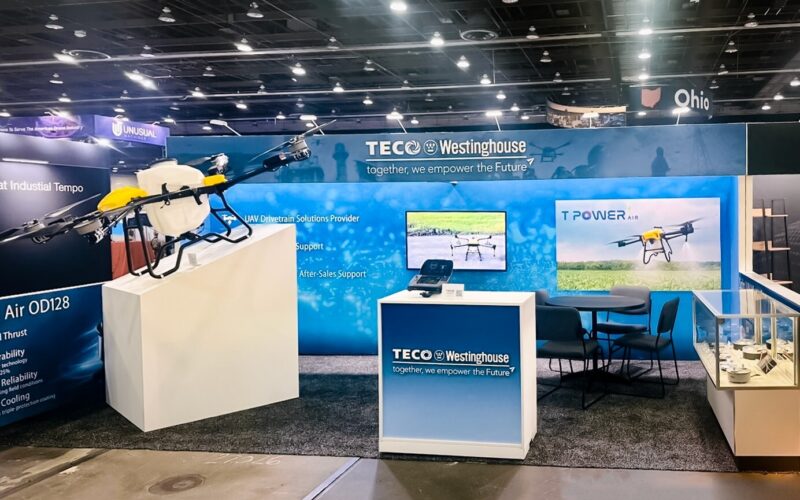
TECO Electric & Machinery Co., listed in Taiwan under TWSE:1504, has introduced high-payload commercial unmanned aerial vehicle powertrain systems and robotic joint modules in North America through its XPONENTIAL 2026 showcase in Detroit. The company is using the event to position its drone hairpin motor power system and All-in-One robotic joint module as part of a broader move from traditional electromechanical manufacturing into intelligent mobility, robotics, and industrial automation. The announcement matters because TECO Electric & Machinery is attempting to convert decades of motor and power systems expertise into higher-growth markets where endurance, torque density, reliability, and localized support are becoming decisive purchase criteria. The market context is also notable, with TECO Electric & Machinery shares recently trading around NT$72.60, above the lower end of their 52-week range but still well below the NT$127.50 high, suggesting investors are watching whether new growth platforms can offset cyclical pressure in conventional industrial segments.
Why is TECO Electric using XPONENTIAL 2026 to accelerate its North American UAV and robotics strategy?
TECO Electric & Machinery’s XPONENTIAL 2026 launch is not just a product display. It is a strategic market entry signal aimed at customers that are moving from prototype autonomy toward practical deployment in agriculture, logistics, industrial automation, and robotics. The North American unmanned systems market is becoming more demanding, not only because of performance requirements, but also because buyers increasingly want supply-chain credibility, validation pathways, technical support, and local service access.
That is where TECO Electric & Machinery’s U.S. subsidiary, TECO-Westinghouse Motor Company, becomes strategically important. By linking new UAV and robotic systems to a Texas-based service and support platform, TECO Electric & Machinery is trying to reduce one of the key adoption barriers for overseas industrial technology suppliers: the perception that support, integration help, maintenance, and after-sales responsiveness may be too distant. In high-payload commercial drone operations, downtime is not a minor inconvenience. It directly affects field operations, delivery economics, and fleet utilization.
The company’s North American strategy also reflects a broader industrial trend. Drone and robotics companies increasingly need specialized component suppliers rather than generic motor vendors. Payload capacity, heat management, torque density, energy efficiency, and electronics integration now influence whether a drone or robotic system can move from a lab environment into field economics. TECO Electric & Machinery appears to be betting that its electromechanical heritage can be repackaged for autonomy-era equipment makers.

How does TECO Electric’s high-payload UAV powertrain address the endurance problem in commercial drone operations?
The most important claim in TECO Electric & Machinery’s UAV announcement is not simply that the system is powerful. It is that the company is applying electric vehicle hairpin motor technology to commercial drone propulsion. The drone power solution integrates a 12.5 kilowatt hairpin motor with a high-power electronic speed controller, and is designed for commercial drones carrying payloads from 10 kilograms to 100 kilograms. TECO Electric & Machinery says the system can achieve maximum thrust of 76.5 kilograms per shaft, which places the product squarely in heavy-duty use cases such as agricultural spraying and logistics transportation.
The endurance angle is critical. Commercial UAV operators do not only care whether a drone can lift a payload. They care whether it can lift that payload long enough to make the mission economically useful. TECO Electric & Machinery says the system can extend flight time by about 20 percent compared with conventional brushless direct current motors. If that advantage is validated consistently in real-world operations, it could make the platform more attractive to customers trying to improve route density, reduce charging or battery-swap frequency, and increase daily asset utilization.
The company is also emphasizing motor design improvements, including a hairpin stator, permanent magnet outer-rotor architecture, and Halbach array configuration. In plain English, TECO Electric & Machinery is trying to deliver more usable torque and efficiency from a compact propulsion system. The stated 25 percent torque-density increase and peak efficiency of up to 91.8 percent are meaningful because drone design is a relentless trade-off between payload, battery weight, propulsion efficiency, heat, and structural limits. Every efficiency gain becomes more valuable as commercial drone operators push beyond demonstration flights into repeatable operations.
What does TECO Electric’s robotic joint module reveal about its automation ambitions?
The All-in-One robotic joint module is arguably the more strategically revealing product, even if the drone powertrain may attract more immediate attention. Robotic joints sit at the center of the next phase of automation because they determine how precisely and reliably machines can move in complex environments. TECO Electric & Machinery’s module integrates a brushless direct current motor, planetary gear reducer, encoder, and sensors into a single system designed for robotic arms, quadruped robots, humanoid robots, and other intelligent mobility applications.
That level of integration matters because robotics manufacturers are under pressure to simplify design cycles and improve reliability. A compact, pre-integrated joint module can reduce engineering complexity for customers that do not want to build every motion-control component from scratch. For emerging robotics companies, that could shorten development timelines. For industrial users, it could improve maintainability and reduce integration risk.
The robotics opportunity is also strategically different from the conventional industrial motor business. Traditional motors are often bought as components within established machinery supply chains. Robotic joint modules, by contrast, sit closer to system intelligence, motion control, and platform architecture. If TECO Electric & Machinery can establish credibility in this area, it could move higher in the value chain rather than competing only on manufacturing scale and component reliability. That is the interesting part of the story: TECO Electric & Machinery is not abandoning its electromechanical foundation, but trying to make that foundation more relevant to autonomy and smart automation.
Why does Green UAS certification matter for TECO Electric’s North American drone supply chain ambitions?
TECO Electric & Machinery’s plan to seek Green UAS certification by the end of 2026 is a strategically important detail because North American drone procurement is increasingly shaped by security, compliance, and trusted supply-chain expectations. Certification does not guarantee commercial success, but it can influence whether a company is considered viable for higher-specification customers, especially those operating in sensitive infrastructure, public-sector, or regulated environments.
For TECO Electric & Machinery, product validation may be as important as product performance. The company already says its UAV powertrain has been adopted by agricultural drone customers, but North American expansion will require a different level of market confidence. Commercial drone buyers in the United States and Canada are likely to assess not only thrust, efficiency, and durability, but also sourcing, documentation, service coverage, cybersecurity posture, and component traceability.
The certification pathway also creates execution risk. If certification timelines slip, or if validation reveals performance gaps under North American operating conditions, the company’s market-entry momentum could slow. But if TECO Electric & Machinery can secure certification and build early customer references, the company may gain a stronger foothold in a market where trusted suppliers are increasingly valuable. In autonomy markets, trust is not fluffy branding. It is part of the bill of materials.
How could TECO Electric’s low-rare-earth motor strategy strengthen its competitive position?
TECO Electric & Machinery’s work on a low-rare-earth version of its hairpin motor points to a deeper strategic issue: supply-chain resilience. Rare earth materials are central to many high-performance motor designs, but they are also exposed to geopolitical risk, pricing volatility, and procurement uncertainty. A lower rare-earth design could make TECO Electric & Machinery more attractive to customers seeking to reduce exposure to material constraints without sacrificing too much performance.
This matters particularly in North America, where industrial buyers are increasingly sensitive to sourcing risk. Drone makers, robotics developers, and logistics operators do not want a critical propulsion component to become vulnerable to material bottlenecks. A low-rare-earth motor strategy could therefore help TECO Electric & Machinery compete not only on engineering performance but also on strategic procurement value.
The trade-off, however, will be technical. Reducing rare-earth dependence must not materially weaken torque density, efficiency, heat management, or reliability. If TECO Electric & Machinery can maintain competitive performance while lowering material exposure, it could gain a stronger position with customers seeking long-term supply security. If performance compromises are too large, the strategy may remain more of a procurement talking point than a commercial differentiator.
What does TWSE:1504 market sentiment suggest about investor expectations for TECO Electric?
TECO Electric & Machinery’s stock context suggests investors are already giving the company some credit for growth optionality, but not a blank cheque. The shares recently traded around NT$72.60, with a 52-week range of NT$46.10 to NT$127.50. Recent market data showed positive weekly and monthly movement, including gains of more than 9 percent over the prior week and more than 7 percent over the month in one market tracker, while another showed stronger short-term momentum.
That performance needs to be interpreted carefully. A product debut at XPONENTIAL 2026 is unlikely by itself to re-rate TECO Electric & Machinery unless it translates into orders, design wins, certifications, margin expansion, or customer concentration in attractive end markets. Investors will want evidence that UAV powertrains and robotic modules can become material growth drivers rather than showcase technologies. The market has seen many industrial companies talk about robotics, electric mobility, and automation. Fewer have converted those narratives into durable earnings upgrades.
Still, the strategic direction fits the market’s appetite for industrial companies with exposure to electrification, automation, drones, and advanced manufacturing. TECO Electric & Machinery has a plausible bridge from its legacy motor expertise to these newer markets. The question is whether that bridge leads to meaningful revenue scale or remains a useful but limited adjacency.
What risks could slow TECO Electric’s move from industrial motors into UAVs and robotics?
The biggest risk for TECO Electric & Machinery is that the commercial UAV and robotics markets are promising but fragmented. Agriculture, logistics, warehouse automation, humanoid robotics, quadruped robotics, and industrial arms all have different performance requirements, certification expectations, cost structures, and customer adoption cycles. A component supplier can win technical interest across many categories without necessarily achieving deep commercial penetration in any one of them.
The second risk is competitive intensity. TECO Electric & Machinery is not entering an empty field. UAV propulsion, robotic joints, motion-control systems, and electronic speed controllers attract specialized suppliers, robotics-native companies, and vertically integrated manufacturers. Customers may prefer proven niche suppliers if TECO Electric & Machinery cannot demonstrate clear advantages in price, efficiency, durability, service, or certification.
The third risk is commercialization pace. XPONENTIAL 2026 gives TECO Electric & Machinery visibility, but exhibitions do not automatically create recurring orders. The company will need field validation, customer references, channel relationships, and localized support execution. That is why TECO-Westinghouse Motor Company’s role matters. North American buyers may be more willing to test a Taiwanese technology platform if they see credible local support behind it.
What happens next if TECO Electric succeeds in commercial UAVs and intelligent robotics?
If TECO Electric & Machinery succeeds, the company could gradually shift investor perception from a traditional industrial motor manufacturer toward a broader intelligent power systems supplier. That would not mean abandoning its legacy business. It would mean using that legacy as the engineering base for higher-value applications in autonomy, smart mobility, and advanced industrial automation.
The drone powertrain could become a foothold in commercial UAV platforms where payload, endurance, and efficiency are decisive. The robotic joint module could open a pathway into machines that require compact, reliable, integrated motion systems. Together, the two products suggest a company trying to follow industrial demand into more software-enabled and autonomy-driven equipment categories, even if TECO Electric & Machinery itself remains primarily an electromechanical player.
The next proof points are straightforward. Investors and industry buyers should watch for Green UAS certification progress, North American customer announcements, volume adoption beyond agriculture, margin commentary, and evidence that robotic joint modules are being designed into real platforms rather than displayed as technology demonstrations. For now, TECO Electric & Machinery has presented a credible expansion narrative. The harder part, as always, is turning torque into traction.
Key takeaways on TECO Electric’s UAV and robotics expansion strategy in North America
- TECO Electric & Machinery is using XPONENTIAL 2026 to reposition itself from a conventional motor manufacturer toward a supplier of intelligent power and motion systems for drones and robotics.
- The high-payload UAV powertrain targets commercial drone use cases where payload capacity, flight endurance, and propulsion efficiency directly affect operating economics.
- The claimed 20 percent flight-time improvement over conventional brushless direct current motors could become commercially meaningful if validated consistently in field deployments.
- The All-in-One robotic joint module suggests TECO Electric & Machinery wants to move closer to integrated motion-control systems, not just standalone motor components.
- TECO-Westinghouse Motor Company gives the North American strategy more credibility by offering localized service and support capacity.
- Green UAS certification could become an important gatekeeper for higher-specification North American drone supply chains.
- The low-rare-earth motor strategy may help TECO Electric & Machinery address procurement risk and geopolitical supply-chain concerns.
- TWSE:1504 has shown recent stock momentum, but the shares remain well below their 52-week high, leaving room for upside only if execution improves confidence.
- The main risks are market fragmentation, intense component competition, certification delays, and the gap between product showcases and commercial order scale.
- The strategic story is credible, but the next phase must be measured through customer wins, certification milestones, and revenue contribution rather than exhibition visibility alone.
Discover more from Business-News-Today.com
Subscribe to get the latest posts sent to your email.


