

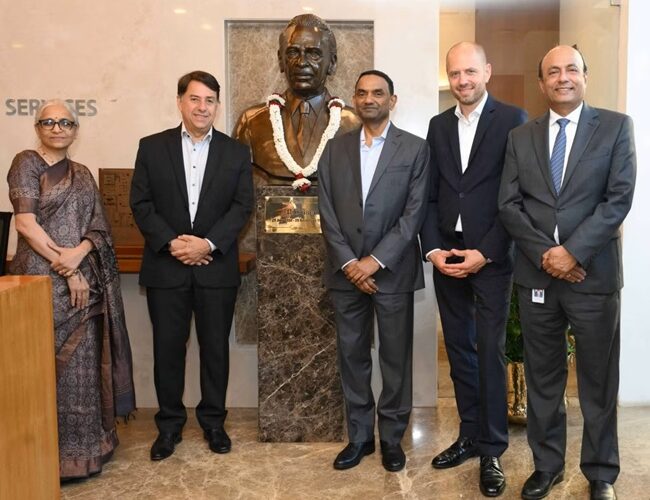
Tata Consultancy Services (TCS) and Siemens Energy AG have expanded their long-running technology relationship through two Memorandums of Understanding covering industrial artificial intelligence, digital operations, energy systems, and AI-ready data centre infrastructure. Tata Consultancy Services Limited is listed on BSE under 532540 and NSE under TCS, while Siemens Energy AG trades in Germany under ENR. The agreements also involve Siemens Energy India Limited, which will support Tata Consultancy Services Limited’s HyperVault AI data centre business in India. The move lands at a strategically sensitive moment for Tata Consultancy Services Limited, whose shares remain far below their 52-week high, and for Siemens Energy AG, whose stock has sharply outperformed over the past year as electrification, grid demand, and energy infrastructure scarcity have become central investment themes.
Why is the TCS and Siemens Energy AI partnership strategically important for industrial transformation?
The expanded partnership between Tata Consultancy Services Limited and Siemens Energy AG is not just another IT services agreement wearing an artificial intelligence badge. The structure of the collaboration points to a deeper shift in how industrial companies are trying to modernise core operations while also solving the infrastructure bottlenecks created by AI adoption. Siemens Energy AG brings power generation, electrification, grid technology, and industrial domain knowledge, while Tata Consultancy Services Limited brings artificial intelligence, cloud, engineering, data platforms, and enterprise technology delivery.
That combination matters because industrial artificial intelligence is more difficult to scale than office automation or customer-service chatbots. Factories, power systems, turbines, grids, and manufacturing environments need AI systems that understand physical assets, operational risk, uptime requirements, safety constraints, and legacy equipment. A predictive analytics model that works in a software dashboard is useful; a predictive analytics system that can influence maintenance cycles, reduce downtime, improve manufacturing throughput, and integrate with operational technology is more valuable, and much harder to execute.
For Siemens Energy AG, the partnership gives access to a large-scale technology partner that can support global IT services while also helping embed advanced analytics, generative artificial intelligence, intelligent automation, digital twins, smart manufacturing, and vision systems into operational workflows. For Tata Consultancy Services Limited, the agreement strengthens its positioning in the higher-value end of enterprise AI, where clients are not merely buying applications but asking for transformation across factories, connected enterprises, infrastructure assets, and data centre ecosystems.

How does Siemens Energy support make HyperVault more relevant in India’s AI data centre race?
The most strategically interesting part of the agreement is Siemens Energy India Limited’s role in supporting HyperVault, the AI data centre business of Tata Consultancy Services Limited. The data centre market is no longer only about land, cooling, connectivity, and rack space. For AI workloads, especially high-density training and inference environments, the central constraint is becoming dependable power. In plain English, AI does not just need chips. It needs electricity, and plenty of it.
This is where Siemens Energy India Limited’s involvement could become meaningful. AI-ready data centres require resilient power systems, grid integration, electrification design, digital monitoring, and potentially lower-carbon infrastructure models. By connecting HyperVault with Siemens Energy India Limited’s capabilities in power generation, electrification systems, grid technologies, digital solutions, and software platforms, Tata Consultancy Services Limited is trying to address one of the hardest execution risks in AI infrastructure before it becomes a margin problem.
India is emerging as a major AI and sovereign data infrastructure market, but the opportunity will be constrained by grid readiness, power reliability, land approvals, cooling needs, and capital intensity. HyperVault can only become strategically credible if Tata Consultancy Services Limited can show that it understands those physical infrastructure realities. The partnership with Siemens Energy India Limited gives Tata Consultancy Services Limited a stronger energy infrastructure narrative, which may help differentiate HyperVault from conventional colocation providers and pure-play data centre operators.
What does this agreement reveal about Tata Consultancy Services Limited’s shift beyond traditional IT services?
Tata Consultancy Services Limited has long been viewed as a scale-driven IT services company, but the Siemens Energy AG partnership highlights a more deliberate push into engineering-led, infrastructure-adjacent, artificial intelligence-enabled transformation. This distinction matters for investors because the traditional IT services model has faced pressure from slower discretionary technology spending, pricing scrutiny, automation-led productivity gains, and client caution across major global markets. The market is no longer rewarding headcount scale the way it once did. It wants proof that large IT services companies can move into higher-value, platform-based, industry-specific, and AI-linked revenue streams.
The Siemens Energy AG relationship gives Tata Consultancy Services Limited a live industrial use case across energy technology, manufacturing modernisation, enterprise operations, and AI infrastructure. That is more useful than a generic AI capability statement because it connects digital transformation to a sector where operational reliability is mission-critical. If Tata Consultancy Services Limited can convert the MoUs into sustained programmes, the company could strengthen its credibility in industrial AI, energy technology services, and data centre enablement.
There is also a portfolio logic here. HyperVault creates a potential bridge between infrastructure, cloud, sovereign data, AI workloads, and enterprise services. Tata Consultancy Services Limited can theoretically sell advisory, engineering, cloud migration, application modernisation, model deployment, cybersecurity, data management, and managed services around the same infrastructure stack. That does not make execution easy, but it does make the opportunity larger than a simple data centre lease model.
Why does Siemens Energy AG gain from a deeper artificial intelligence and IT services alliance with TCS?
For Siemens Energy AG, the attraction is different but equally strategic. The company sits at the centre of energy transition, grid expansion, electrification, power systems, and industrial resilience. These markets are growing, but they also carry complexity. Siemens Energy AG must support customers dealing with decarbonisation pressure, grid congestion, renewable integration, industrial electrification, and rising demand from power-hungry digital infrastructure.
A deeper partnership with Tata Consultancy Services Limited can help Siemens Energy AG modernise internal systems while also sharpening its customer-facing digital capabilities. Digital twins, predictive maintenance, advanced analytics, and intelligent vision systems are not cosmetic upgrades in this sector. They can influence plant uptime, asset performance, manufacturing efficiency, quality control, service cycles, and lifecycle economics. For an energy technology company, better digital operations can become a competitive advantage if they reduce execution friction and improve customer outcomes.
The partnership also reinforces India’s importance in Siemens Energy AG’s global growth map. India is simultaneously a manufacturing market, energy infrastructure market, digital services hub, and data centre growth geography. By working with Tata Consultancy Services Limited and Siemens Energy India Limited, Siemens Energy AG gets a stronger route into the convergence of AI infrastructure and power systems. That convergence may become one of the most investable infrastructure themes of the next decade.
How should investors read Tata Consultancy Services Limited and Siemens Energy AG stock sentiment after the partnership?
The market context around the two companies is strikingly different. Tata Consultancy Services Limited closed at around ₹2,444.70 on April 28, 2026, leaving the stock close to its 52-week low of ₹2,346.20 and far below its 52-week high of ₹3,630.50. The stock has been under pressure in recent months, reflecting broader investor caution toward Indian IT services, weak discretionary spending signals, and uncertainty over how quickly artificial intelligence will become a revenue accelerator rather than a margin disruptor.
That makes the Siemens Energy AG partnership strategically useful, but not automatically valuation-changing. Investors will want evidence of contract conversion, revenue contribution, margin profile, and HyperVault execution milestones. The stock market has heard plenty of AI stories from technology services companies. What it now wants is proof that artificial intelligence can create durable growth, not just prettier slide decks. Tata Consultancy Services Limited has the scale, client access, and engineering bench to compete, but the share price suggests investors are still demanding evidence.
Siemens Energy AG is in a different position. The stock has risen strongly over the past year and recently traded near its 52-week high, supported by investor appetite for grid, electrification, and power infrastructure exposure. That creates a higher expectations bar. For Siemens Energy AG, the partnership with Tata Consultancy Services Limited supports the narrative that energy infrastructure is becoming digitally intelligent, but the company must still manage delivery risk, supply chain pressure, margin discipline, and customer execution across complex projects.
What execution risks could limit the impact of the TCS and Siemens Energy partnership?
The biggest risk is that the partnership remains broad in language but slow in commercial conversion. Memorandums of Understanding can signal strategic intent, but investors and customers will ultimately judge the collaboration by signed contracts, deployed systems, measurable efficiency gains, and repeatable offerings. The more expansive the partnership sounds, the more important it becomes to define specific deliverables.
Industrial AI also carries integration risk. Operational technology environments are often fragmented, legacy-heavy, and sensitive to downtime. Connecting factory systems, enterprise platforms, digital twins, predictive analytics, and intelligent automation is not a plug-and-play exercise. Data quality, cybersecurity, governance, workforce adoption, and accountability for AI-driven decisions will all matter. In industrial settings, a bad model is not just inconvenient. It can be expensive.
HyperVault adds a second layer of execution complexity. AI data centres are capital-intensive and depend on power availability, equipment procurement, cooling architecture, utilisation rates, customer commitments, and regulatory approvals. Siemens Energy India Limited’s support can help with the energy infrastructure side, but Tata Consultancy Services Limited will still need to prove that HyperVault can be built at scale, operated reliably, and monetised without diluting returns.
Could this partnership become a template for AI-ready industrial infrastructure deals?
The broader implication is that AI partnerships are moving from software-only collaborations into hybrid deals that combine data, engineering, power systems, infrastructure, and operational technology. That is where the Tata Consultancy Services Limited and Siemens Energy AG agreement becomes more interesting than a standard digital transformation announcement. It reflects the reality that enterprise AI adoption is becoming physical. The bottleneck is no longer just model capability. It is power, resilience, integration, governance, and industrial applicability.
If the partnership works, it could become a reference model for how IT services companies, energy technology firms, and infrastructure operators collaborate around AI-ready industrial systems. Other technology services companies may need similar alliances with power equipment manufacturers, grid technology providers, engineering firms, or utilities. Likewise, energy technology companies may increasingly need digital partners that can convert asset expertise into software-enabled operating models.
The competitive signal is clear. Artificial intelligence is pushing Tata Consultancy Services Limited closer to infrastructure and pushing Siemens Energy AG deeper into digital operations. That overlap may be where the next wave of enterprise technology spending sits. The companies are effectively betting that the AI economy will not be built only in cloud consoles, but also in substations, factories, campuses, control rooms, and data centre power systems. Not glamorous, perhaps, but very bankable if executed well.
Key takeaways on what the TCS and Siemens Energy AI partnership means for technology, energy, and data centre markets
- Tata Consultancy Services Limited is using the Siemens Energy AG partnership to strengthen its move from traditional IT services into industrial artificial intelligence, engineering-led transformation, and AI infrastructure.
- Siemens Energy AG gains a large-scale technology partner that can support digital operations, factory modernisation, analytics, automation, and global IT transformation.
- Siemens Energy India Limited’s role in HyperVault is strategically important because power reliability is becoming one of the biggest constraints in AI-ready data centre development.
- The partnership gives Tata Consultancy Services Limited a stronger answer to investor concerns that artificial intelligence could disrupt IT services faster than it creates new revenue.
- HyperVault could become more differentiated if Tata Consultancy Services Limited can combine data centre infrastructure with cloud, AI, sovereign data, cybersecurity, and managed services.
- Siemens Energy AG’s market momentum reflects investor appetite for electrification and grid infrastructure, but the company now faces high expectations on execution and profitability.
- The collaboration may become a template for future AI infrastructure partnerships that combine technology services, energy systems, industrial operations, and data centre engineering.
- The main risk is execution drift, as MoUs need to translate into signed programmes, measurable efficiencies, deployed AI systems, and revenue visibility.
- Industrial AI adoption will depend on data quality, cybersecurity, operational technology integration, workforce adoption, and the ability to prove reliability in mission-critical environments.
- For the wider market, the deal reinforces a simple but powerful shift: AI infrastructure is no longer just about chips and cloud capacity. It is increasingly about power, grids, factories, and physical resilience.
Discover more from Business-News-Today.com
Subscribe to get the latest posts sent to your email.