
Taiwan is seeking to build a vast force of aerial and maritime drones under a proposed NT$210 billion, approximately $6.6 billion, procurement programme as the United States urges Taipei to make any potential Chinese military operation prohibitively difficult.
American Institute in Taiwan Director Raymond Greene said at a drone-industry forum in Taichung on July 2, 2026, that Taiwan should deploy dense networks of unmanned systems in the air, on the sea and below the surface. Raymond Greene argued that drones could strengthen deterrence, protect Taiwan and reduce the likelihood of a conflict spreading across the Indo-Pacific.
The intervention comes as Taiwan’s government and opposition parties compete over separate drone-financing proposals. President Lai Ching-te’s administration wants a special budget of up to NT$210 billion covering domestic surveillance drones, attack drones and small unmanned surface vessels through the end of 2031. The opposition Kuomintang has proposed a higher NT$240 billion ceiling but wants the expenditure handled through annual government budgets.
The dispute is therefore no longer principally about whether Taiwan requires drones. Both major political camps acknowledge that unmanned systems have become essential to modern warfare. The harder disagreement concerns how quickly Taiwan should purchase them, how the programme should be financed and whether domestic manufacturers can produce the required volumes without sacrificing reliability.
Why is the United States urging Taiwan to create a dense network of unmanned systems?
Raymond Greene described drones as a transformative opportunity for Taiwan’s security and for cooperation between the Taiwanese and American defence industries. Raymond Greene said the use of unmanned systems in Ukraine had demonstrated how a smaller defender could impose significant costs on a larger attacking force.
Taiwan faces an unusual defensive challenge. China possesses a considerably larger navy, air force, missile force and industrial base. Taiwan cannot realistically match the People’s Liberation Army platform for platform, particularly in expensive categories such as combat aircraft, destroyers and long-range missile systems.
The emerging strategy is therefore based on asymmetric defence. Taiwan is attempting to acquire large numbers of mobile, relatively inexpensive and difficult-to-detect weapons that could survive initial attacks and continue operating if major bases, runways or command centres were damaged.
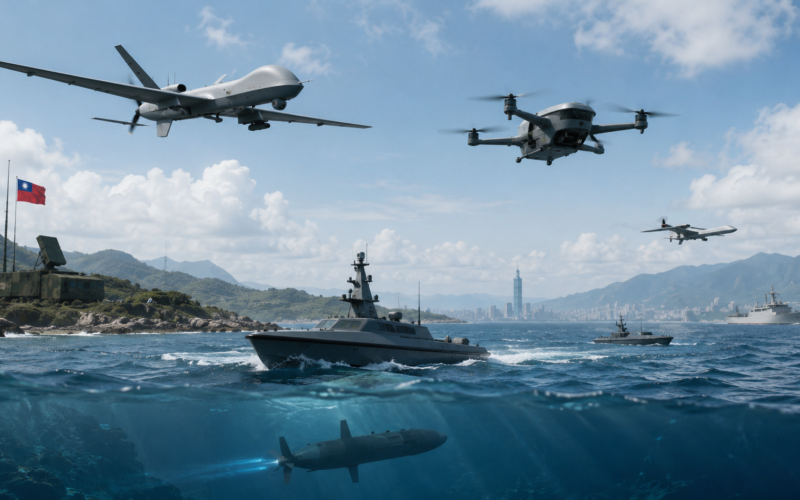
Aerial drones could monitor coastal areas, track troop movements and attack ships or landing forces. Unmanned surface vessels could patrol surrounding waters, carry sensors or deliver explosive payloads. Subsurface systems could complicate naval operations by creating additional threats near ports, beaches and possible amphibious routes.
The objective is not necessarily to defeat every Chinese platform individually. It is to create so many dispersed threats that military planners in Beijing cannot confidently predict how quickly an operation would succeed or how costly it would become.
Raymond Greene’s remarks also connect Taiwan’s security with a wider industrial strategy. The United States and Taiwan want supply chains that are less dependent on Chinese components, particularly for motors, communications equipment, cameras, batteries and navigation systems used in unmanned vehicles.

What would Taiwan purchase under the proposed NT$210 billion domestic drone programme?
Taiwan’s Executive Yuan approved the draft special legislation on June 18 and sent it to the Legislative Yuan for consideration. The plan would provide funding from August 2026 until December 31, 2031, for domestically manufactured unmanned defence systems.
The proposed procurement includes 1,446 coastal surveillance and reconnaissance drones, approximately 208,200 coastal attack drones and 1,320 small one-way unmanned surface vessels. The numbers show that the programme is intended to create mass rather than concentrate only on a small fleet of highly sophisticated aircraft.
Coastal reconnaissance drones would help military units observe ships, vehicles and movements near possible landing areas. The much larger category of coastal attack drones would provide expendable systems capable of striking targets after launch rather than returning to their operators.
The maritime component would add small vessels designed to travel toward hostile ships or other naval targets. Similar systems have demonstrated that relatively low-cost unmanned vessels can force larger warships to alter routes, maintain greater distance from coastlines or devote substantial resources to defence.
Taiwanese Premier Cho Jung-tai has presented the programme as both a national-security measure and an industrial-development project. The government wants domestic supply, local production and independent maintenance so that Taiwanese forces do not become dependent on foreign shipments during a crisis.
Long-term procurement could give manufacturers enough visibility to invest in factories, testing facilities and specialised workers. However, the programme’s success will depend on whether the government can translate headline quantities into production schedules, military requirements and dependable delivery contracts.
Why are Taiwan’s ruling and opposition parties fighting over drone funding methods?
The political dispute emerged after Taiwan’s opposition-controlled Legislative Yuan approved only about two-thirds of President Lai Ching-te’s proposed NT$1.25 trillion special defence package in May.
Lawmakers authorised funding connected with weapons purchased from the United States but excluded substantial amounts intended for domestically produced drones, missiles and supporting systems. President Lai Ching-te responded by promising to pursue separate legislation, supplementary appropriations or increases in the ordinary defence budget.
The administration’s NT$210 billion proposal is one result of that effort. The government argues that a special budget would protect the programme from annual uncertainty and allow companies to plan production across several years.
The Kuomintang has introduced a competing proposal with a maximum expenditure of NT$240 billion over six years. Its plan would cap annual spending at NT$40 billion and place financing through the ordinary government budget rather than the separate special-budget mechanism preferred by the administration.
This distinction has practical consequences. Special budgets can provide dedicated, multi-year resources outside ordinary annual expenditure, but opposition lawmakers argue that regular appropriations provide stronger legislative supervision and fiscal discipline.
The existence of two large proposals nevertheless reveals an unusual area of strategic agreement. The Kuomintang and the Democratic Progressive Party disagree sharply over relations with China, defence spending and the conduct of President Lai Ching-te’s government, but both now support major investment in drones.
Taichung Mayor Lu Shiow-yen, a senior Kuomintang figure, said at the July 2 forum that political parties should cooperate in developing the drone industry. The remaining confrontation is likely to focus on the source of funds, procurement oversight and how much control the legislature should retain over annual expenditure.
Can Taiwan manufacture more than 200,000 attack drones without relying on China?
Scale will be one of the programme’s greatest challenges. Producing more than 200,000 attack drones would require dependable access to motors, batteries, controllers, communications components, optics, navigation equipment and explosives integration.
Commercial drone supply chains have historically depended heavily on Chinese manufacturing. That creates an obvious national-security problem for Taiwan because China would be the adversary in the conflict these systems are intended to deter.
Taiwan must therefore establish suppliers that can manufacture critical components locally or obtain them from trusted international partners. The government has referred to this goal as creating a non-Chinese, or non-red, supply chain.
Taiwan possesses important advantages. Its economy has advanced capabilities in semiconductors, electronics, precision manufacturing and communications. Companies can potentially adapt civilian technologies for military applications more quickly than countries without an established electronics ecosystem.
The challenge is that high-volume military production differs from prototype development. A drone demonstrated successfully at an exhibition may still face difficulties involving weather resistance, secure communications, electronic interference, maintenance and integration with military command systems.
Quantity must also be matched by training and doctrine. Taiwan will need operators, maintenance personnel, storage sites and procedures for distributing drones before facilities are attacked. Units must understand how to coordinate reconnaissance, targeting and strike missions without creating communications congestion.
The procurement programme could fail strategically if large quantities are purchased but stored centrally, become obsolete quickly or cannot operate in contested electronic environments. Taiwan will need a continuing upgrade process because drone technology and counter-drone systems are evolving rapidly.
How would drones complicate a possible Chinese blockade or amphibious operation?
China has several possible methods of applying military pressure against Taiwan. These include missile attacks, an air and naval blockade, the seizure of smaller offshore islands or a full amphibious invasion.
A drone-heavy defence could create problems across each scenario. Surveillance drones could monitor ships enforcing a blockade and provide targeting information to coastal missile units. Unmanned surface vessels could threaten naval formations or logistics ships operating around Taiwan.
During a possible invasion, large numbers of attack drones could target landing craft, vehicles, troop concentrations and equipment being unloaded on beaches or at ports. Even if individual drones carried small payloads, repeated strikes could delay operations and disrupt the movement of supplies.
This is particularly important because an amphibious assault would require China to transport enormous quantities of fuel, ammunition, food, vehicles and personnel across the Taiwan Strait. The attacking force would remain vulnerable while crossing the water and establishing positions ashore.
Drones could also enable Taiwanese units to continue fighting after losing conventional communications or air support. Small teams equipped with portable systems may be harder to locate than aircraft operating from fixed bases.
Unmanned systems are not a complete defence. China possesses sophisticated electronic-warfare capabilities, air defences and its own rapidly expanding drone fleet. Communications signals can reveal operators, satellite-navigation signals can be disrupted and inexpensive drones can be destroyed by specialised countermeasures.
Taiwan’s strategy must consequently combine drones with missiles, mines, mobile air defence, hardened communications and resilient civilian infrastructure. The value of the drone network lies in adding thousands of additional problems that an attacker must solve, not in replacing every conventional defensive capability.
Why has the Ukraine war changed Taiwan’s assessment of asymmetric defence?
The Ukraine war demonstrated that unmanned systems can influence operations across land, sea and air even when one side possesses a much larger conventional military.
Small aerial drones have been used to locate artillery targets, attack vehicles, monitor trenches and disrupt supply routes. Long-range unmanned aircraft have struck targets far behind front lines, while maritime drones have threatened Russian naval vessels and forced changes in how ships operate.
Taiwanese officials and American advisers have studied those lessons closely. Taiwan shares Ukraine’s need to offset a larger opponent, but its geography creates important differences.
Ukraine has land borders through which partners can deliver weapons and supplies. Taiwan is an island and could face maritime and air isolation during a conflict. Taiwan therefore needs weapons, spare parts and production capability positioned before a blockade begins.
Taiwan also has less strategic depth. Major ports, military facilities, energy infrastructure and population centres are concentrated within a relatively small area. China could attempt to strike many of those sites during the opening phase of a confrontation.
These constraints explain the emphasis on large quantities and dispersed storage. Taiwan needs systems capable of being moved, concealed and launched without relying on a limited number of vulnerable bases.
President Lai Ching-te has described the development of asymmetric capabilities as a race against time. Taiwan’s concern is that a defence programme extending through 2031 must still produce useful capability during the intervening years rather than delivering most systems near the programme’s conclusion.
Could the drone programme strengthen deterrence without accelerating cross-strait tensions?
Taiwan and the United States present the programme as defensive. Their argument is that China will be less likely to use force when the probability of rapid success is low and expected military losses are high.
China views Taiwan as part of its territory and has not renounced the use of force to achieve unification. Beijing opposes United States military cooperation with Taipei and regularly describes American arms support as interference in China’s internal affairs.
A large Taiwanese drone programme could therefore produce two competing effects. It may strengthen deterrence by making military action more difficult, but it could also encourage China to expand counter-drone systems, electronic warfare and surveillance around Taiwan.
The political environment inside Taiwan will matter as well. Defence projects gain greater credibility when they survive changes of government and receive support across political parties. A programme repeatedly blocked, redesigned or underfunded may send the opposite message.
The emergence of competing government and Kuomintang drone proposals suggests that a durable compromise may be possible. Both sides could agree on strategic quantities and domestic-production objectives while retaining stronger reporting, auditing and annual performance reviews.
The strongest deterrent would not be the announcement of a multibillion-dollar budget. It would be a functioning network of drones, trained personnel, dispersed infrastructure and manufacturers capable of replacing losses during a prolonged crisis.
Taiwan’s next decision is therefore less about accepting or rejecting the drone strategy. The central issue is whether the political system can finance and implement that strategy quickly enough to change Beijing’s calculations.
What are the key takeaways from Taiwan’s proposed $6.6 billion drone programme?
- American Institute in Taiwan Director Raymond Greene said on July 2, 2026, that Taiwan should establish dense networks of aerial, surface and subsurface drones to strengthen deterrence and make a potential military conflict substantially more difficult.
- Taiwan’s Executive Yuan has proposed spending up to NT$210 billion, approximately $6.6 billion, between August 2026 and December 2031 on domestically manufactured unmanned systems for coastal surveillance, attack and maritime defence.
- The government programme would cover 1,446 coastal reconnaissance drones, approximately 208,200 coastal attack drones and 1,320 small one-way unmanned surface vessels, creating a strategy based heavily on volume and dispersal.
- President Lai Ching-te’s administration introduced the separate proposal after the opposition-controlled Legislative Yuan excluded domestically produced drones and missiles from significant parts of an earlier NT$1.25 trillion special defence package.
- The Kuomintang has proposed its own NT$240 billion drone programme, but it wants annual spending through the ordinary government budget rather than the dedicated special-budget structure sought by the Democratic Progressive Party administration.
- Both major political camps now support large-scale drone investment, suggesting that the most important disputes concern financing, legislative oversight, production schedules and procurement accountability rather than the strategic value of unmanned systems.
- Taiwan must reduce dependence on Chinese-made motors, batteries, communications equipment and other components because a drone force intended for a conflict with China cannot rely safely on supply chains controlled by China.
- Drones could complicate a blockade or amphibious assault, but they must be combined with missiles, mines, air defence, secure communications, trained personnel and dispersed logistics to create a credible and resilient deterrent.
Discover more from Business-News-Today.com
Subscribe to get the latest posts sent to your email.