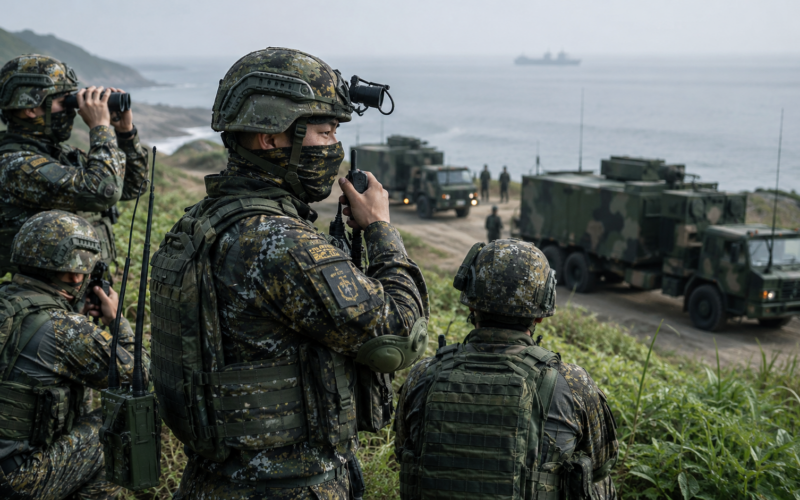
Taiwan will begin a five-day military exercise on June 22, 2026, designed to test how quickly its armed forces can move from peacetime monitoring to active wartime operations if a routine Chinese military deployment suddenly becomes an attack. The Immediate Combat Readiness Exercise will continue until June 26 and involve personnel, equipment, command systems and logistical units operating under more realistic conditions.
Taiwan announced the drill after detecting 21 Chinese military aircraft near the island, including J-16 fighter jets, KJ-500 airborne early-warning aircraft and Y-20 aerial refuelling aircraft. Taiwan’s Ministry of National Defense said 19 of the aircraft operated southwest of Taiwan and extended into the Western Pacific during long-distance training.
The exercise does not mean Taiwan has confirmed that a Chinese attack is imminent. It is part of Taiwan’s annual military training and reflects a strategic concern that the People’s Liberation Army could use frequent patrols, exercises or maritime deployments to conceal preparations for a real operation.
The drill will test command and control, joint military coordination, logistical sustainment and the ability to deploy priority units rapidly. It also forms part of a broader shift towards unscripted exercises intended to expose weaknesses before Taiwan’s larger Han Kuang military and civil-resilience exercises in August.
Why is Taiwan training for a Chinese exercise to become an actual attack without warning?
China conducts frequent air and naval operations around Taiwan, including joint combat-readiness patrols, long-distance aircraft missions and exercises involving warships, fighters and support aircraft.
Taiwan’s central concern is that repeated Chinese activity can blur the distinction between routine pressure and preparations for conflict. If military deployments become normal, warning indicators may be harder to interpret and Taiwan may have less time to decide whether to mobilise forces.
A Chinese exercise could potentially place aircraft, ships and missile units in operational positions before an attack order is issued. Taiwan would then need to identify the change quickly and protect aircraft, command centres, ports, communications and missile systems before they were targeted.
The Immediate Combat Readiness Exercise is intended to test that transition. Units will practise moving from ordinary readiness to wartime deployment without relying on lengthy preparations or a predictable schedule.
Taiwan’s Ministry of National Defense said the exercise would involve actual personnel operating on real terrain with operational equipment and real-time implementation. This approach is intended to replace ceremonial demonstrations with training that places commanders and units under practical pressure.
The objective is not to recreate every possible invasion scenario. It is to determine whether different branches of the armed forces can receive orders, move equipment, maintain communications and continue operating when the strategic situation changes suddenly.
The drill also tests whether lower-level commanders can act when central communications are disrupted. Modern conflicts have demonstrated that forces dependent on continuous instructions from headquarters can become ineffective if command networks are damaged.

What does the latest surge in Chinese aircraft activity reveal about pressure on Taiwan?
Taiwan reported 21 Chinese military aircraft near the island on June 21. The formation included J-16 multirole fighters, KJ-500 airborne early-warning and control aircraft, and Y-20 aerial refuelling aircraft.
The combination is strategically important because it supports longer and more complex missions. J-16 fighters can conduct air-to-air and strike operations, while the KJ-500 provides surveillance, coordination and command support. A Y-20 tanker can extend the distance and duration of combat-aircraft deployments.
Nineteen aircraft operated southwest of Taiwan and moved into the Western Pacific for what Taiwan described as long-distance maritime training. That route allows Chinese forces to practise operating beyond the narrow waters closest to the Chinese coast.
Taiwan said it deployed appropriate forces to monitor and respond. Such responses can involve aircraft, naval vessels, coastal radar and missile units, although Taiwan does not always disclose operational details.
China considers Taiwan part of its territory and has not renounced the use of force to establish control. Taiwan’s democratically elected government rejects Beijing’s sovereignty claim and argues that the island’s future must be decided by its people.
Beijing generally describes its military operations as legitimate training and a response to Taiwanese separatism or foreign involvement. Taiwan characterises the same activity as coercion intended to exhaust its forces, intimidate the population and weaken resistance.
The frequency of Chinese operations creates a resource challenge. Taiwan must monitor each deployment without reacting so aggressively that it wastes aircraft hours, fuel, maintenance capacity and personnel.
How will the Immediate Combat Readiness Exercise test Taiwan’s military systems?
The five-day exercise will focus on how Taiwan’s armed forces organise and sustain operations during the early phase of a crisis.
Command mechanisms will be tested to determine whether information can move quickly between military headquarters and frontline units. Joint operations require the army, navy, air force, missile forces and support organisations to share targeting, surveillance and logistical information.
The exercise will also examine priority deployment. Taiwan must decide which units should move first, which infrastructure requires immediate protection and how reserves, ammunition, fuel and maintenance support will be positioned.
Logistical sustainment is particularly important because Taiwan is an island. A blockade or missile campaign could restrict the arrival of fuel, spare parts, food and other supplies.
Military units therefore need dispersed stocks and alternative transport routes. A weapons system that cannot be refuelled, repaired or supplied with ammunition may quickly lose operational value regardless of its technical capability.
The exercise may also expose communications vulnerabilities. China possesses cyber, electronic-warfare and missile capabilities that could disrupt military networks, satellite links and civilian telecommunications.
Taiwan needs forces capable of continuing operations when digital systems are unavailable or unreliable. Commanders may be required to use alternative communications, pre-planned instructions and decentralised decision-making.
The value of the exercise will depend on whether failures are recorded honestly. Highly controlled exercises can produce attractive demonstrations while concealing weaknesses. Realistic drills are more useful when units encounter delays, conflicting orders and logistical shortages.
Why is Taiwan placing greater emphasis on realistic and unscripted military training?
Taiwan has gradually moved away from exercises built around public demonstrations and predetermined outcomes.
Earlier drills were sometimes criticised for giving units extensive preparation time and following scripts that did not reflect the confusion of modern warfare. Taiwan’s recent training has used shorter notice, changing positions and less predictable instructions.
On June 10, Taiwan conducted a coastal defence exercise near Taichung that simulated attacks against an invading force across several positions. The drill included domestically produced Thunderbolt-2000 rocket systems, United States-made Paladin artillery, anti-tank weapons and mortars.
The exercise created a coastal engagement zone intended to demonstrate how Taiwan could target forces attempting to land on the western side of the island.
Taiwan’s strategy increasingly emphasises mobility and dispersion. Large, fixed military installations may be vulnerable to missiles, drones and surveillance, while mobile launchers can relocate and continue operating.
The armed forces are also studying lessons from Ukraine and the Middle East. Those conflicts have demonstrated the importance of drones, electronic warfare, resilient communications, rapid repairs and the ability to replace expensive weapons with larger numbers of lower-cost systems.
Realistic training also supports deterrence. China is more likely to face high costs if Taiwan can disperse forces, survive initial attacks and continue coordinated operations.
Deterrence does not require Taiwan to match China weapon for weapon. It requires sufficient capability to convince Beijing that an attack would be prolonged, expensive and uncertain.
How does the five-day exercise connect with Taiwan’s Han Kuang war games in August?
The Immediate Combat Readiness Exercise is an early part of Taiwan’s wider 2026 training programme.
A joint defence exercise is expected in July before Han Kuang Exercise No. 42 begins in August. Han Kuang is Taiwan’s principal annual military exercise and tests responses to invasion, blockade, missile attacks and other wartime scenarios.
The 2026 Han Kuang programme is expected to operate alongside urban-resilience, reserve-mobilisation and civilian air-defence exercises. This reflects Taiwan’s recognition that military forces cannot defend the island without functioning civilian institutions.
Civil authorities may need to maintain hospitals, electricity, water, communications, food distribution and transport during attacks. Local governments must also manage shelters, evacuations and emergency information.
Taiwan has scheduled regional air-defence exercises during August in southern, central, offshore, eastern and northern areas. The drills will be conducted at different times and locations to test public-warning and response procedures.
The integration of military and civilian exercises reflects a whole-of-society defence strategy. Taiwan wants government agencies, businesses and residents to understand their roles before a crisis occurs.
However, civilian participation requires careful communication. Authorities must build preparedness without creating unnecessary fear or treating every Chinese military movement as evidence that war is inevitable.
Han Kuang will provide a larger test of whether lessons from the June drill have been absorbed. Problems involving deployment, communication or logistics identified this week can be addressed before the August exercises.
Could Taiwan’s defence-budget dispute weaken the value of its military exercises?
Taiwan’s military modernisation is taking place during a serious political dispute over defence spending.
President Lai Ching-te requested a supplementary defence package valued at approximately NT$1.25 trillion, equivalent to nearly $40 billion. Taiwan’s opposition-controlled parliament approved about NT$780 billion, or roughly two-thirds of the government’s request.
The approved package supported several United States weapons purchases, but lawmakers removed or reduced funding for parts of the domestic programme, including drones and missiles.
The opposition Kuomintang argued that sections of the original proposal lacked sufficient detail and could create transparency or corruption risks. The governing Democratic Progressive Party said the reductions could weaken Taiwan’s ability to respond to China.
President Lai Ching-te has said the administration will continue seeking funding through legislation or future annual budgets. The government aims to raise defence spending from around 3 percent of gross domestic product towards 5 percent by 2030.
The debate is not simply about the total amount spent. Taiwan must balance expensive imported systems with domestically produced weapons, ammunition, maintenance, personnel and civil-resilience investment.
Large purchases can attract political attention, but operational readiness depends on less visible spending such as spare parts, fuel stocks, communications, training and hardened facilities.
Exercises can reveal these gaps, but correcting them requires sustained funding. A drill may identify a need for additional drones, repair teams or ammunition depots, yet those lessons will have limited value if the necessary budget is unavailable.
The political challenge is maintaining scrutiny without creating delays that weaken preparedness.
Why are HIMARS, drones and mobile weapons central to Taiwan’s defence strategy?
Taiwan is investing in systems designed to survive an initial attack and target forces approaching the island.
United States-made High Mobility Artillery Rocket Systems can move quickly, launch precision rockets and relocate before being targeted. Taiwan tested HIMARS during live-fire training earlier in June.
Mobile coastal missiles can threaten naval vessels, while drones can provide surveillance, identify targets and conduct attacks. Smaller unmanned systems may also replace some missions that would otherwise require expensive aircraft.
Taiwan’s geography shapes this strategy. Mountainous terrain, urban areas and a limited number of suitable landing zones can create obstacles for an invading force.
Taiwan aims to use these features to delay and disrupt operations rather than rely only on conventional battles between large platforms.
The strategy also depends on stockpiles. Mobile launchers need sufficient ammunition, secure communications and trained crews. Drones require replacement parts, batteries and systems capable of operating under electronic interference.
China’s military is substantially larger and can launch missiles from the mainland. Taiwan’s objective is therefore to preserve enough combat power after the first strikes to prevent a rapid victory.
The Immediate Combat Readiness Exercise will test the transition required to make that strategy credible. Weapons stored in depots or concentrated at bases may be vulnerable. Units must move quickly and avoid revealing predictable deployment patterns.
What could Taiwan’s military preparations mean for the United States and regional allies?
The United States does not maintain formal diplomatic relations with Taiwan but remains its most important international arms supplier and security partner.
Washington is legally committed to providing Taiwan with defensive capabilities, while maintaining strategic ambiguity over whether United States forces would intervene directly during a conflict.
Taiwan’s preparedness influences that calculation. A stronger and more resilient Taiwanese military could delay a Chinese operation and create more time for international political or military responses.
Japan would also be affected by a Taiwan crisis because its southwestern islands are close to Taiwan and major United States bases operate from Japanese territory.
Commercial shipping and aviation routes through the Taiwan Strait and surrounding waters are important to regional and global trade. Conflict could disrupt semiconductor exports, energy deliveries and supply chains extending far beyond East Asia.
Taiwan produces a large share of the world’s advanced semiconductors. That economic importance does not guarantee military intervention, but it increases the international cost of instability.
Regional governments generally support maintaining peace and oppose unilateral changes to the status quo. They also seek to avoid actions that could be interpreted as recognising Taiwanese independence or provoking Beijing.
The June exercise will therefore be watched as both a military event and a political signal. Taiwan wants to demonstrate readiness without suggesting that it intends to initiate conflict.
What remains uncertain as Taiwan begins its five-day readiness exercise?
The first uncertainty is whether China will respond with additional aircraft, warships or public criticism.
Beijing frequently increases military activity following Taiwanese political statements, United States arms announcements or foreign visits. It had not announced a direct response to the June 22 exercise at the time of publication.
The second uncertainty concerns the level of operational disruption used during the drill. The value of the exercise will depend on whether units face realistic communications failures, shifting orders and logistical pressure.
The third concerns what information Taiwan will release. Defence authorities may publicise selected activities while keeping deployment routes and vulnerabilities confidential.
The fourth is whether lessons from the exercise lead to budget or organisational changes before Han Kuang in August.
The fifth is how Taiwan’s population interprets the drills. Public confidence can support deterrence, while excessive anxiety or political polarisation can weaken resilience.
The exercise does not indicate that conflict is certain. It reflects Taiwan’s assessment that the warning time available during a crisis may be shorter than in previous decades.
What are the key takeaways from Taiwan’s five-day combat readiness exercise?
- Taiwan will conduct an Immediate Combat Readiness Exercise from June 22 to June 26, 2026, testing whether its armed forces can move rapidly from routine peacetime readiness into active wartime deployment.
- The exercise is built around the concern that China could transform one of its frequent patrols or military drills into a real attack before Taiwan receives a long or unambiguous warning.
- Taiwan reported 21 Chinese military aircraft near the island, including J-16 fighters, KJ-500 early-warning aircraft and Y-20 refuelling aircraft supporting longer and more complex operations.
- Nineteen Chinese aircraft operated southwest of Taiwan and extended into the Western Pacific, while Taiwan deployed forces to monitor the mission and respond under established procedures.
- The exercise will test joint command, rapid deployment, battlefield preparation, communications and logistical sustainment using actual personnel, operational equipment, real terrain and real-time implementation.
- Taiwan is shifting towards more realistic and less scripted training after earlier exercises were criticised for excessive preparation, predictable scenarios and insufficient pressure on commanders and frontline units.
- The drill precedes the Han Kuang exercises in August, which will combine military operations with reserve mobilisation, regional air-defence drills and broader whole-of-society resilience testing.
- Taiwan’s readiness programme faces political and financial constraints after the opposition-controlled parliament approved roughly two-thirds of the government’s proposed supplementary defence budget.
Discover more from Business-News-Today.com
Subscribe to get the latest posts sent to your email.