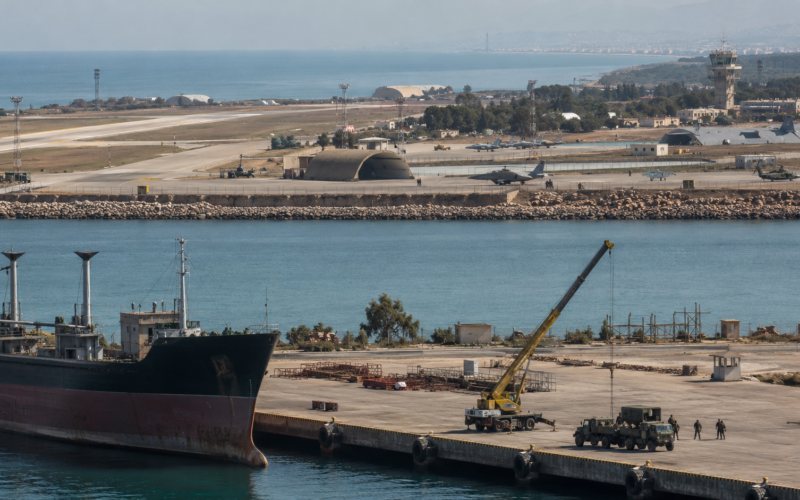
Syria and Russia have reached a landmark agreement that fundamentally changes Moscow’s military footprint on the Syrian Mediterranean coast, ending 18 months of negotiations over the future of the Tartous naval facility and Hmeimim air base after the fall of Bashar al-Assad.
Under the memorandum announced on August 9, Syria will assume management of facilities designated for civilian use, including Hmeimim Airport and the fourth commercial berth at Tartous Port. Military facilities currently associated with Russia will be reorganised as joint Syrian-Russian training and qualification centres, with the transition required to be completed within no more than three months.
The agreement does not amount to a complete Russian withdrawal from Syria. It does, however, mark a major retreat from the privileged military arrangement Moscow enjoyed under Assad, when Tartous and Hmeimim functioned as Russia’s principal operational footholds in the eastern Mediterranean and Middle East. The Syrian Foreign Ministry described the memorandum as the most significant development since negotiations over the bases began roughly a year and a half ago.
The strategic importance extends beyond military real estate. Damascus is simultaneously rebuilding relations with the United States, Europe and Gulf governments while signalling that it could sharply reduce Russian oil imports. Washington has also been pressing Syria to reduce Moscow’s remaining influence, making the new base arrangement part of a much larger contest over Syria’s economic, military and diplomatic direction after Assad.
What exactly will change at Russia’s Tartous naval facility and Hmeimim air base under the new Syria agreement?
The most consequential change is the division between facilities that Syria considers civilian and those that will retain a military function under a new joint structure.
Damascus says it will take over Hmeimim Airport facilities designated for civilian use and progressively integrate them into Syria’s civilian administration. At Tartous Port, Syria will directly control Pier No. 4, associated warehouses and other commercial facilities that had previously been operated or sought by Russian entities.
The remaining military installations will no longer operate under the same model of exclusive Russian basing. Syrian authorities say the sites will instead become joint training and qualification centres intended to preserve cooperation between the countries while strengthening Syrian sovereignty over the coastal facilities.
The three-month implementation deadline gives the agreement unusual immediacy. Rather than leaving the future of the Russian presence open for prolonged negotiation, Damascus expects the administrative and military restructuring to become effective before the end of 2026 if the timetable is followed.
Russia had not immediately issued a detailed public response to the memorandum when the agreement was announced. That silence leaves several operational questions unresolved, including the eventual number of Russian personnel, what equipment Moscow can retain and whether Russian naval vessels will continue receiving regular access to Tartous.

Why are Tartous and Hmeimim so important to Russia’s military power in the Mediterranean?
Tartous has served Soviet and Russian maritime interests for decades and became particularly important after Moscow intervened militarily in Syria in 2015 to support Bashar al-Assad’s government during the civil war.
The naval facility gave Russia a Mediterranean maintenance and replenishment point that supported ships operating far from permanent bases on Russian territory. Moscow’s military intervention also transformed Hmeimim into a major air hub from which Russian aircraft conducted combat operations across Syria.
Under an agreement reached during the Assad era in 2017, Russia received a free 49-year lease covering the Tartous naval facility, demonstrating the extraordinary privileges Moscow enjoyed when Damascus depended heavily on Russian military protection. The deal was part of an arrangement that appeared designed to secure a Russian military presence in Syria for decades.
Assad’s removal in December 2024 transformed that calculation. The government that replaced him had fought against the regime Russia spent years defending, while Assad himself fled to Russia and received asylum. Moscow suddenly had to negotiate with leaders who had little reason to preserve the old agreements unchanged.
Rather than expel Russia immediately, however, Syria’s new leadership pursued a more transactional strategy. President Ahmad al-Sharaa maintained high-level relations with Vladimir Putin and visited Moscow while negotiations over the two bases continued, indicating that Damascus wanted to recover sovereignty without necessarily destroying its relationship with Russia.
Does the agreement mean Russia is losing its military bases in Syria completely?
Not completely, and that distinction matters.
The Syrian announcement does not describe an immediate expulsion of Russian troops or a complete termination of bilateral military cooperation. Instead, it converts the military facilities into joint training and qualification centres, suggesting some Russian personnel and military activity can remain under arrangements giving Damascus a much larger role.
What appears to be disappearing is the old model in which Russia effectively possessed long-term military enclaves that operated with exceptional autonomy under agreements negotiated with Assad.
The Associated Press characterised the agreement as ultimately ending the sites’ role as conventional Russian military outposts, while Syria itself uses the more diplomatic formulation of “reorganising” Russia’s presence. Those descriptions are compatible if the bases cease functioning as predominantly Russian operational installations but continue hosting Russian instructors or other personnel within Syrian-controlled joint centres.
The precise military balance will only become clear after implementation. The number of Russian aircraft remaining at Hmeimim, the status of naval access at Tartous and the command structure of the training centres will determine whether the arrangement represents a modest downsizing or a much deeper strategic withdrawal.
For now, the safest conclusion is that Russia is retaining a narrower defence relationship but losing much of the exclusive basing structure that made Syria central to Moscow’s Mediterranean military strategy.
Why did Syria negotiate with Russia for 18 months instead of simply ordering Moscow to leave?
Damascus had powerful reasons to avoid an abrupt rupture.
Russia remains a permanent member of the United Nations Security Council, an important supplier of commodities and a country with longstanding institutional relationships across Syria’s military and government structures. Even after Assad’s removal, completely severing relations would have deprived the new leadership of diplomatic and economic options at a time when the Syrian state was attempting to rebuild after years of war.
Syria has also remained dependent on Russian supplies in important sectors. Reuters reported in July that around 85% of imported Syrian wheat for the 2025-26 season came from Russia and Russian-occupied Crimea, while Russian crude oil became an increasingly important source of energy for the country.
That economic dependence gave Moscow leverage even after it lost its former ally in Damascus.
At the same time, Syria’s new leaders possessed leverage of their own because Russia could no longer assume the old military leases would be honoured unchanged. The lengthy negotiations therefore allowed Damascus to progressively narrow Moscow’s privileges without creating an immediate strategic confrontation.
The resulting memorandum appears to reflect that bargain. Syria recovers control of civilian infrastructure and greater authority over the military sites, while Russia avoids the humiliation and strategic cost of being expelled completely.
What happened to Russia’s plan for a commercial logistics hub at Tartous Port?
The new arrangement also complicates Moscow’s ambitions to expand its commercial role at Tartous.
Reuters reported in July that Russian-linked organisations wanted to establish a commercial logistics hub at Pier No. 4, with planned initial cargo volumes of around 250,000 tonnes per month. The proposed facility was intended to handle commodities including Russian wheat, animal feed, vegetable oil, timber, steel and other goods, while supporting a regular maritime route between Russia’s Novorossiysk port and Syria.
That plan was part of a broader attempt by Moscow to preserve influence through trade even if its military presence became smaller. Russian actors envisaged Tartous developing into a distribution centre serving not only Syria but potentially neighbouring markets including Iraq, Jordan and Gulf countries.
The August memorandum makes clear that Pier No. 4 and its associated facilities will be controlled by the Syrian state. Syria’s General Authority for Ports and Customs will manage those commercial sites, meaning any Russian business activity must operate under Syrian jurisdiction rather than as an extension of a Russian-controlled military zone.
That represents an important change in bargaining power. Russia may still participate commercially, but Damascus is asserting that ownership of the strategic infrastructure and final authority over operations belong to Syria.
How does the Tartous-Hmeimim deal fit Syria’s growing political relationship with the United States and Europe?
The base agreement cannot be separated from Syria’s broader diplomatic realignment.
Since Assad’s fall, Damascus has strengthened relations with the United States, European governments and Arab countries that had previously isolated the Syrian regime. Washington has already removed most of the broad sanctions imposed during the Assad era, while France has restored high-level political engagement with Damascus.
The remaining major United States sanctions issue is Syria’s longstanding designation as a state sponsor of terrorism. Donald Trump informed Congress on July 8 of his intention to remove Syria from that list, triggering a statutory review period.
Washington has increasingly signalled that it wants Syria to distance itself from Russia as part of this emerging relationship. Reuters reported that the United States has encouraged Damascus to use trusted Western commercial partners during reconstruction, while Congress directed the Pentagon to assess options for reducing Russian influence and securing the departure of Russian forces from Tartous and Hmeimim.
The new base arrangement does not deliver a complete Russian exit, but it moves in the direction Washington has advocated by reducing Moscow’s autonomous military position.
Damascus, however, appears determined not to become exclusively aligned with either side. Preserving joint military centres allows Syria to maintain relations with Moscow while expanding ties with the United States and Europe, giving the new government greater room to negotiate among competing powers.
Why is Syria also considering a major reduction in Russian oil imports?
The military restructuring comes only days after evidence emerged that Syria could also reduce Russia’s economic leverage through energy.
Reuters reported on August 4 that Damascus had indicated during discussions with Washington that it was prepared to sharply reduce Russian crude imports. Russian oil shipments to Syria had increased by about 75% in 2026 to roughly 60,000 barrels per day, making Moscow the country’s dominant crude supplier.
Syrian officials have argued that this dependence reflects necessity rather than political preference. With sanctions still limiting access to alternative suppliers and financial channels, Russian crude provided a practical source of energy for a country struggling to rebuild infrastructure and economic activity.
Damascus is now seeking alternatives. Syria has held discussions involving Western energy companies and signed agreements aimed at reviving domestic gas production, indicating that diversification of oil and gas supply is becoming an important part of its broader economic strategy.
A simultaneous reduction in Russian military autonomy and oil dependence would represent a much wider shift than either development considered separately. Moscow would remain an important partner, but Syria would become less structurally dependent on Russia for both national security and basic energy supplies.
Could Russia compensate for losing military privileges by expanding trade and reconstruction ties?
Moscow has strong incentives to do exactly that.
Russia’s position in Syria after Assad increasingly depends on demonstrating that it can provide economic benefits rather than relying primarily on military protection. Wheat, energy, shipping, construction and industrial cooperation therefore become more important as Damascus reduces Moscow’s privileged defence footprint.
The proposed Tartous logistics project illustrated this strategy. Russian organisations were attempting to create a commercial corridor capable of distributing goods through Syria and into neighbouring markets, potentially anchoring Russia economically even if the military deployment contracted.
Syria may welcome some of that trade while insisting on greater national control. The new memorandum demonstrates that Damascus is not rejecting Russian participation outright but wants arrangements structured around Syrian sovereignty and regulatory authority.
That could produce a relationship fundamentally different from the Assad period. Russia would compete for contracts and influence rather than relying on privileged access secured through military dependence.
The outcome will also depend on whether Western and Gulf investors provide credible alternatives. If reconstruction financing, energy supplies and infrastructure investment arrive from other partners, Damascus will have more freedom to reduce reliance on Russia without creating severe economic disruption.
What does the deal mean for Vladimir Putin’s wider strategy in Africa and the Mediterranean?
The Syrian bases gave Russia something geography makes difficult to replace: a permanent military staging point on the eastern Mediterranean.
Tartous supported Russian naval operations, while Hmeimim provided aviation and logistics capability connecting Russian forces with activities across the Middle East and Africa. After Assad’s fall, Russian personnel and equipment movements through Syria were closely watched because the bases also supported wider deployments beyond the country.
A reduced presence does not eliminate Russia from the Mediterranean, but it limits operational freedom.
Joint training centres would operate very differently from bases over which Moscow enjoyed extensive control. Aircraft deployments, naval access and logistics activity may increasingly depend on Syrian approval, reducing Russia’s ability to treat the facilities as autonomous strategic assets.
Moscow could compensate by relying more heavily on facilities elsewhere, including relationships in North Africa, but no replacement offers exactly the same combination of location, existing infrastructure and long-established Russian military familiarity.
The strategic impact will therefore depend heavily on the final operating rules negotiated during the three-month transition.
What are the key takeaways from the Syria-Russia agreement over Tartous and Hmeimim?
Syria and Russia have reached a memorandum after around 18 months of negotiations that fundamentally reorganises Moscow’s presence at the Tartous naval facility and Hmeimim air base.
Syria will assume control of facilities designated for civilian purposes, including Hmeimim Airport infrastructure and Pier No. 4 at Tartous Port, bringing those assets progressively under Syrian civilian administration.
Russian military facilities will be transformed into joint Syrian-Russian training and qualification centres, meaning Moscow is not being expelled completely but will no longer enjoy the same model of exclusive military basing established under Bashar al-Assad.
The transition must be completed within three months, providing a relatively rapid timetable for implementing one of the most significant changes to Syria-Russia relations since Assad was overthrown in December 2024.
The new arrangement also places commercial facilities at Tartous under Syrian jurisdiction, complicating earlier Russian plans to establish a large logistics hub at Pier No. 4 capable of handling roughly 250,000 tonnes of goods per month.
The agreement comes as Damascus strengthens relations with the United States, Europe and Arab governments while Washington presses for reduced Russian influence in Syria.
Syria has separately indicated that it could sharply reduce Russian oil imports, which currently account for roughly 60,000 barrels per day, suggesting Moscow’s economic leverage could decline alongside its military privileges.
Russia nevertheless retains important economic and diplomatic relationships with Damascus, making the agreement better understood as a rebalancing of influence rather than a complete geopolitical divorce.
Why the Tartous-Hmeimim deal may mark the real end of Russia’s Assad-era dominance in Syria
The most important feature of the August agreement is not that Russian personnel may remain in Syria. The larger change is that Moscow is being forced to operate under a fundamentally different political relationship with Damascus.
During the Assad era, Russia’s military presence reflected Syrian dependence. Moscow intervened decisively to preserve the government, gained long-duration basing privileges and developed Tartous and Hmeimim into strategic assets supporting Russian power across the Mediterranean and beyond. The fall of Assad removed the political foundation supporting that arrangement, and the new memorandum begins replacing it with a structure in which Syria exercises far greater control over the same territory.
Damascus has resisted the temptation to choose a simple pro-Russian or anti-Russian position. Instead, it is reclaiming infrastructure, expanding Western ties, courting Gulf investment and exploring alternatives to Russian energy while still preserving commercial and defence relationships with Moscow. That approach gives Ahmad al-Sharaa’s government bargaining flexibility as competing powers seek influence over Syria’s reconstruction.
For Vladimir Putin, retaining joint training centres is substantially better than losing access altogether, but it is not equivalent to preserving the bases Russia possessed under Assad. The final strategic value of Tartous and Hmeimim will depend on whether Moscow can continue regularly deploying naval vessels and aircraft or whether every major operation increasingly requires Syrian approval.
The three-month transition will therefore be the period to watch. If Syrian authorities genuinely take administrative control while Russia reduces its permanent operational footprint, August 9 may ultimately be remembered as the point when Moscow’s post-2015 military architecture in Syria ceased to exist in its original form. Russia will remain a player in Syria, but increasingly as one external partner competing for influence rather than the indispensable military patron that once dominated Damascus.
Discover more from Business-News-Today.com
Subscribe to get the latest posts sent to your email.