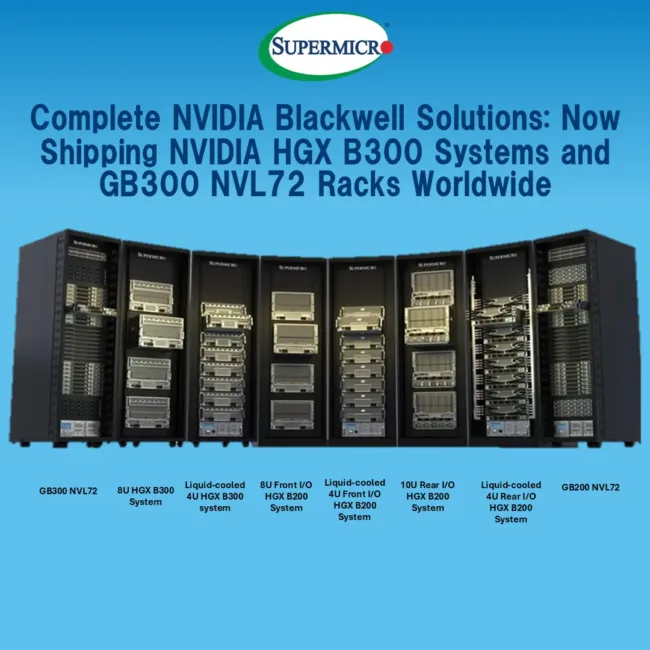
Super Micro Computer, Inc. (NASDAQ: SMCI) shares were up 2.86% intraday on September 12, trading around $45.21 as of 11:37 a.m. ET amid strong market reaction to the company’s announcement of global deliveries for its NVIDIA Blackwell Ultra systems. The San Jose-based enterprise, a Total IT Solution Provider for AI, Cloud, Storage, and 5G/Edge, confirmed that it has begun high-volume shipments of NVIDIA HGX B300 systems and GB300 NVL72 racks, positioning Supermicro at the forefront of plug-and-play AI infrastructure solutions.
Why did Supermicro stock rally on the NVIDIA Blackwell Ultra announcement?
Investors responded positively to Supermicro’s ability to deliver pre-validated, system- and rack-level solutions capable of rapid deployment. Unlike conventional AI infrastructure rollouts, these offerings are engineered for plug-and-play operation at day-one scale, addressing a critical pain point for enterprises racing to establish AI factories. The combination of pre-validated hardware, high-performance cooling solutions, and integrated infrastructure software reduces deployment risk and accelerates time-to-online—factors that have historically driven institutional investor confidence in Supermicro.

Charles Liang, president and CEO of Supermicro, emphasized that the company’s Data Center Building Block Solutions (DCBBS) are designed to tackle the complexities of large-scale AI deployments. “Supermicro has the best track record of fast and successful deployments of new NVIDIA technologies,” Liang noted, highlighting the company’s expertise in integrating advanced GPU hardware with optimized system and rack engineering. This reassurance likely fueled the intraday spike in SMCI shares.
What features distinguish Supermicro’s NVIDIA Blackwell Ultra systems from previous-generation AI infrastructure?
The NVIDIA Blackwell Ultra portfolio includes a complete suite of over 10 SKUs, including the HGX B300 systems and GB300 NVL72 racks, engineered for dense FP4 compute workloads. These systems provide up to 50% greater inferencing performance and 50% more HBM3e memory compared with the prior-generation NVIDIA Blackwell. The GPU power envelope for Blackwell Ultra reaches 1400W per unit, with high-bandwidth networking and flexible air or liquid cooling configurations that support data center-scale operations.
Supermicro’s portfolio integrates direct liquid cooling (DLC) technology alongside advanced air cooling, ensuring thermal efficiency in high-density deployments. By coupling these cooling innovations with infrastructure software—including NVIDIA AI Enterprise, NVIDIA Blueprints, and NVIDIA NIM—the company enables enterprises to deploy fully integrated AI platforms that minimize setup time and operational complexity.
How does Supermicro’s plug-and-play approach benefit enterprise AI customers?
Data centers adopting Supermicro’s DCBBS can achieve rapid deployment for AI factory environments of any scale. Each system is pre-validated at the rack and system level, with integrated power and thermal management solutions. Customers can implement NVIDIA Quantum-X800 InfiniBand or NVIDIA Spectrum-X Ethernet fabrics at up to 800 Gb/s bandwidth, enabling exaFLOPS-scale computations. The GB300 NVL72 rack-scale solution delivers 1.1 exaFLOPS dense FP4 compute performance, while HGX B300 systems provide up to 144 petaFLOPS of FP4 compute and 270 GB of HBM3e memory per GPU—metrics that underline the transformative potential for AI workloads spanning multimodal inference, agentic AI, and real-time reasoning applications.
Beyond raw compute, the Supermicro DCBBS package provides comprehensive services for on-site deployment, cluster cabling, power delivery, and thermal integration. The DLC-2 liquid cooling technology reduces data center footprint by up to 60%, cuts water consumption by 40%, and lowers overall TCO by an estimated 20%, reflecting both sustainability benefits and cost efficiency. These features cater to AI-intensive enterprises where scaling compute capacity often creates operational bottlenecks.
What historical trends contextualize Supermicro’s AI infrastructure push?
The AI compute market has witnessed exponential growth since the adoption of large-scale generative AI models in 2022–2024. Companies deploying NVIDIA Hopper and subsequent GPU architectures experienced substantial delays in scaling their data centers due to complex cabling, power constraints, and thermal limitations. Supermicro’s strategy of pre-validating systems and offering modular, rack-scale solutions builds on decades of high-performance computing (HPC) experience, effectively bridging the gap between raw GPU innovation and enterprise-ready AI deployment.
By contrast, competitors relying solely on chip-level offerings or less-integrated solutions have often faced slower time-to-online and higher operational overhead, particularly for multi-rack or cluster-level deployments. Supermicro’s current portfolio positions it uniquely to capture both early adopters of generative AI infrastructure and traditional HPC clients looking to modernize at scale.
What do analysts and institutional investors think about Supermicro’s Blackwell Ultra rollout?
Market sentiment indicates cautious optimism. Early analyst notes suggest that SMCI’s ability to deliver turn-key NVIDIA Blackwell Ultra solutions globally is a competitive differentiator in a sector where infrastructure complexity can slow adoption. Institutional flows reflect this sentiment: foreign institutional investors increased positions in SMCI post-announcement, while domestic institutions showed mixed activity. Options trading and AI-focused ETFs also displayed heightened activity, highlighting broader interest in AI hardware plays.
Some analysts have noted potential risks, including supply chain bottlenecks for GPUs and memory modules, and the challenge of integrating large-scale racks into existing data center footprints. Nevertheless, the strategic value of reducing deployment friction is widely recognized, and many investors interpret the current stock rally as a reflection of the market pricing in Supermicro’s differentiated AI infrastructure capabilities.
How does Supermicro compare to peers in the AI infrastructure market?
Compared with other AI infrastructure providers, Supermicro emphasizes system- and rack-level validation, high-density FP4 compute, and integrated services—elements that are not universally offered by competitors such as Dell Technologies, HPE, or Lenovo. Its focus on energy efficiency through direct liquid cooling, alongside flexible plug-and-play deployment, gives it an edge for enterprises seeking to rapidly scale AI factories. These innovations support workloads ranging from multimodal AI inference to agentic AI orchestration, areas increasingly critical in financial services, healthcare, automotive, and generative AI research.
What is the future outlook for Supermicro and its AI strategy?
Looking ahead, the company is expected to expand Blackwell Ultra deployments across multiple global regions, targeting both hyperscale cloud providers and enterprise AI customers. Analysts anticipate further product refinements, potentially including expanded GPU configurations, denser memory arrays, and enhanced software integration for AI orchestration. As AI compute demand continues to accelerate, Supermicro’s plug-and-play approach could help mitigate deployment delays and improve adoption metrics, reinforcing its role as a leading Total IT Solution Provider.
Supermicro’s AI infrastructure strategy also dovetails with broader industry trends emphasizing energy efficiency, sustainability, and operational simplicity. By offering fully validated, system-to-rack-scale solutions, the company reduces friction in AI deployment, enabling enterprises to scale without the usual technical and logistical hurdles. This integrated approach is likely to remain a cornerstone of SMCI’s growth trajectory as AI adoption proliferates across sectors.
How are investors reacting to Supermicro stock after NVIDIA Blackwell Ultra shipments and what do FII/DII flows indicate?
Supermicro stock (NASDAQ: SMCI) gained 2.86% on September 12, reflecting bullish investor sentiment following the NVIDIA Blackwell Ultra shipment announcement. Foreign institutional flows have been positive, while domestic institutional investors remain mixed, reflecting selective confidence in the company’s execution. Options trading activity has increased, particularly in AI-focused instruments, signaling market recognition of Supermicro’s AI infrastructure leadership. Analysts largely maintain a “Buy” rating, emphasizing that effective delivery of plug-and-play AI solutions could translate into meaningful revenue growth in FY26.
Discover more from Business-News-Today.com
Subscribe to get the latest posts sent to your email.