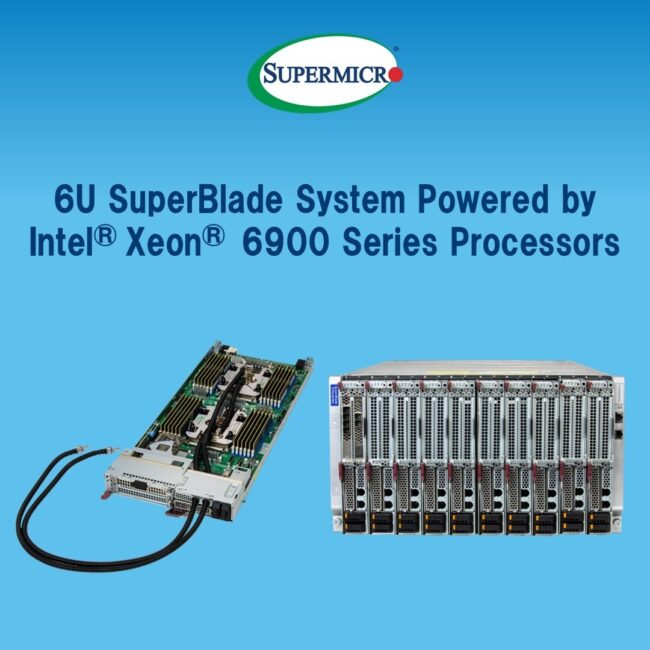
Super Micro Computer, Inc. (NASDAQ: SMCI), trading as Supermicro, has launched its newest high-density blade platform, the 6U SuperBlade SBI-622BA-1NE12-LCC, powered by dual Intel Xeon 6900 series processors. The platform supports both air and direct liquid cooling configurations, positioning it to meet the compute and efficiency demands of hyperscale AI and high-performance computing environments.
The move marks a strategic escalation in Supermicro’s modular server infrastructure play, as the company targets data centers modernizing toward rack-level compute density, low total cost of ownership, and AI-native thermal efficiency.
Why is Supermicro doubling down on liquid-cooled, high-core blade architectures for AI and HPC?
Supermicro’s 6U SuperBlade is designed to reduce physical footprint and cable complexity while maximizing compute per rack, per watt, and per square foot. With support for up to 10 liquid-cooled blades per enclosure, each housing two Intel Xeon 6900 CPUs offering up to 128 P-cores apiece, a single rack can deliver up to 25,600 high-performance cores. This combination of blade density and thermally optimized design signals an industry pivot toward space- and power-efficient server deployments as AI workloads outgrow traditional rackmount solutions.
Critically, the use of direct liquid cooling (including CPU-only and full CPU/DIMM/VRM cold plates) elevates the platform beyond conventional air-cooled systems. Liquid-cooled configurations will likely appeal to enterprise and government AI clients facing floor space constraints and rising power costs, as seen in climate modeling, life sciences, and financial modeling environments.
Supermicro is not just making a thermal bet—it is fundamentally re-architecting how modular compute is delivered and managed in the AI age. The shared power, networking, and management infrastructure reduces complexity at scale, while hot-swap capabilities ensure operational continuity in large deployments.
How does the 6U SuperBlade architecture change the economics of AI data centers?
The platform’s value proposition centers on lower total cost of ownership through three primary vectors: reduced cabling (by up to 93 percent), space efficiency (up to 50 percent less than traditional 1U servers), and shared chassis-level resource pooling for power and networking. These advantages significantly lower both capital expenditure and operational energy costs.
In tandem, the blade’s power capping and remote management capabilities signal a maturing focus on compute governance. Administrators can cap blade-level power consumption, manage workload allocation, and perform BIOS or OS-level interventions remotely via Serial over LAN or KVM, which are key for managing thermal constraints in high-density AI deployments. The inclusion of dual 25G Ethernet switches with 100G uplinks provides robust internal bandwidth while minimizing physical network infrastructure. The strategic integration of up to three PCIe 3.0 x16 slots per blade enables flexible acceleration options—allowing enterprises to mix and match InfiniBand, GPUs, or other accelerators depending on workload needs.
What are the risks and execution hurdles to Supermicro’s liquid-cooled AI blade strategy?
While the thermal and density advantages are clear, the transition to liquid-cooled infrastructure imposes significant planning and capex requirements for data center operators. Facilities must be designed or retrofitted to support liquid cooling loops, hot-swap coolant manifolds, and chassis-level serviceability. This means that despite the performance advantages, widespread adoption may initially be limited to greenfield sites or next-gen HPC buildouts with flexible thermal planning.
Further, enterprises with entrenched air-cooled server strategies or limited in-house IT staff may balk at the operational learning curve. Supermicro’s chassis management module (CMM) reduces some of this burden, but it still demands a certain threshold of operational maturity.
Execution risk also lies in the supply chain. With Intel Xeon 6900 processors pushing TDPs of up to 500W per socket, blade-level thermal performance depends heavily on the reliability of liquid cooling components, especially for full-stack (CPU, memory, VRM) cold plate configurations.
Which markets and competitors will be watching this most closely?
This SuperBlade launch will be of particular interest to integrators and hyperscalers building high-density inference or simulation clusters, especially in sectors such as climate science, manufacturing design, financial services, genomics, and autonomous systems. Liquid-cooled server adoption is also trending upward in government compute tenders—suggesting Supermicro’s solution could gain traction in AI-driven defense and intelligence programs.
On the competitive front, Supermicro’s blade strategy directly targets markets traditionally dominated by Hewlett Packard Enterprise (HPE) with its Cray and Apollo lines, as well as Dell Technologies’ modular PowerEdge portfolio. However, Supermicro’s early and aggressive liquid-cooling posture may help it leapfrog rivals slower to commit to rack-scale thermal reengineering.
Moreover, the platform’s flexibility—supporting up to 3TB DDR5 RDIMM or 1.5TB of DDR5 MRDIMM per blade, along with PCIe 5.0 NVMe and M.2 SSDs—allows it to straddle the memory bandwidth and storage IOPS requirements that define modern AI training and inferencing needs.
How is investor sentiment tracking Supermicro’s broader AI infrastructure evolution?
Shares of Super Micro Computer, Inc. (NASDAQ: SMCI) have surged in 2025 alongside other AI infrastructure plays, fueled by investor appetite for scalable, low-latency, energy-efficient compute platforms. The company’s modular SuperBlade and GPU-optimized rackmounts have seen strong uptake among cloud providers and vertical AI clients, reinforcing the view that Supermicro is more than a commodity server assembler.
Analysts have noted that Supermicro’s tighter integration of power, cooling, and management layers—combined with U.S.-based manufacturing scale—positions the company favorably in AI and national infrastructure RFPs. If the 6U SuperBlade achieves meaningful deployment traction in the first half of 2026, it could cement Supermicro as a reference architecture provider in liquid-cooled data centers.
That said, the stock is not without risk. Execution missteps in delivery timelines, component reliability, or post-sales support for complex liquid-cooled deployments could dent credibility. Competitors may also undercut pricing or accelerate their own liquid-cooling roadmaps to narrow the window of advantage.
Key takeaways: What Supermicro’s 6U liquid-cooled SuperBlade signals for data center infrastructure
- Supermicro has launched a 6U high-density SuperBlade supporting up to 25,600 cores per rack using Intel Xeon 6900 CPUs
- The system enables both air and direct liquid cooling, with flexible support for memory- and GPU-intensive AI workloads
- Shared chassis infrastructure significantly reduces cabling, space, and operational costs while improving TCO
- Remote power capping, management, and blade monitoring features are designed for modern AI thermal governance
- Strong positioning in energy-intensive HPC sectors and public-sector compute projects could boost market adoption
- Competitive implications include increased pressure on Dell Technologies and Hewlett Packard Enterprise to accelerate liquid-cooled product lines
- Data center retrofitting and coolant infrastructure readiness remain gating factors for broader adoption
- Investor sentiment remains positive, but execution risk in large-scale liquid-cooled deployments must be closely watched
Discover more from Business-News-Today.com
Subscribe to get the latest posts sent to your email.