



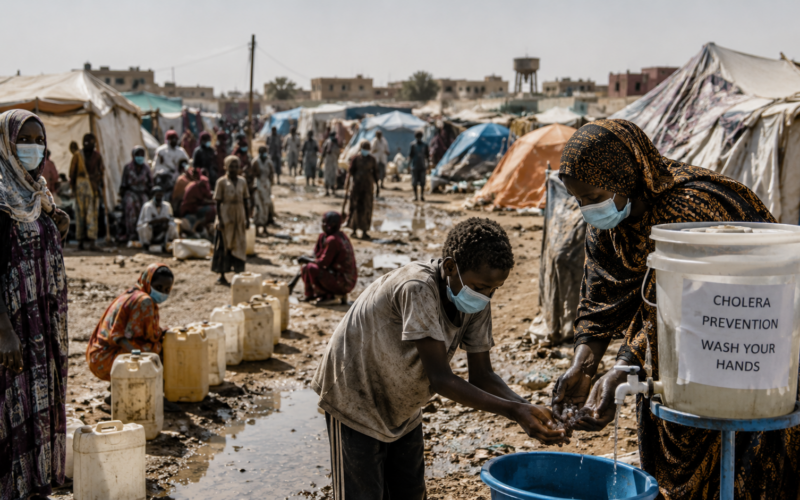
Sudan is facing a rapidly worsening cholera emergency after an outbreak declared on June 27, 2026, spread through several parts of the country, particularly Darfur and Kordofan. The World Health Organization has warned that the combination of armed conflict, population displacement, damaged water systems and seasonal rainfall could accelerate transmission.
The reported case-fatality rate has reached 13.7%, an exceptionally high level for a disease that can usually be treated successfully when patients receive oral rehydration, intravenous fluids and timely medical care. A case-fatality rate of that magnitude indicates that many patients are reaching treatment too late, cannot reach functioning facilities or are living in areas where basic medicines and clean water are unavailable.
The outbreak is unfolding within what international health authorities describe as the world’s largest humanitarian emergency. More than 33 million people in Sudan require assistance, 21 million need health services and an estimated 11.5 million have been forcibly displaced since fighting escalated in April 2023.
Particular concern surrounds El Obeid, the capital of North Kordofan, where health facilities are overwhelmed and access for humanitarian agencies remains severely restricted. The city has endured siege-like conditions, drone attacks, fuel shortages and worsening water scarcity while the Sudanese Armed Forces and the Rapid Support Forces contest surrounding territory.
Why is Sudan’s 13.7% cholera case-fatality rate causing exceptional concern?
Cholera is an acute diarrhoeal infection caused by consuming food or water contaminated with the bacterium Vibrio cholerae. The disease can cause severe watery diarrhoea, vomiting and rapid dehydration, potentially killing an untreated patient within hours.
The disease is also highly treatable. Most patients can recover through the prompt use of oral rehydration solution, while severe cases require intravenous fluids and, in some circumstances, antibiotics. In well-organised treatment centres with early access to care, the case-fatality rate should remain below 1%.
Sudan’s reported rate of 13.7% is therefore more than a statistical indicator. It points to a breakdown in access, surveillance, referral systems and clinical capacity. Patients may be travelling long distances through insecure territory, arriving after severe dehydration has developed or being treated in facilities without adequate supplies.
The national figure may also conceal large differences between locations. In areas where health services remain partially functional, patients may receive treatment quickly. In besieged towns, displacement settlements and rural areas cut off by fighting, even basic rehydration supplies may be difficult to obtain.
A high case-fatality rate can also suggest that infections are being undercounted. Mild and moderate cases may never enter official surveillance systems, while deaths are more likely to be recorded when families seek emergency assistance. That imbalance can raise the calculated fatality rate, but it does not make the underlying situation less serious.
The speed at which cholera causes dehydration makes access delays particularly dangerous. A patient who might recover with inexpensive treatment can deteriorate rapidly if transport is unavailable, roads are blocked or a nearby clinic has stopped operating.

How are Sudan’s war and mass displacement accelerating the cholera outbreak?
Sudan’s conflict has created many of the conditions in which cholera spreads most easily. Millions of people have been forced from their homes, often moving into overcrowded settlements where drinking water, sanitation, waste disposal and healthcare are inadequate.
The war has damaged or closed hospitals, clinics, pumping stations and electricity systems. Fuel shortages make it more difficult to operate generators, transport water, run ambulances and deliver medical supplies. Damage to communications infrastructure further delays disease reporting and emergency coordination.
Displaced families may depend on shallow wells, temporary water points, rivers or supplies delivered by tanker. When sewage contaminates those sources, cholera can spread rapidly through communities that have few alternatives.
The movement of people also makes containment more difficult. Families fleeing fighting may carry the infection into new settlements or across state borders before symptoms become severe. Cholera symptoms can develop within hours or several days after exposure, allowing transmission chains to expand across multiple locations.
Humanitarian organisations face severe access constraints in Darfur and Kordofan. Convoys can be delayed by fighting, administrative restrictions, damaged roads or threats to aid workers. That prevents treatment materials, chlorine, laboratory supplies and water-sanitation equipment from reaching the areas where they are most urgently required.
The crisis extends beyond cholera. Malnutrition weakens immune systems and leaves children and adults less able to withstand severe dehydration. Food insecurity, interrupted vaccination programmes and outbreaks of other infectious diseases place additional pressure on the same limited health facilities.
Why could Sudan’s rainy season turn local cholera clusters into a broader epidemic?
Seasonal rainfall can worsen cholera transmission by flooding latrines, carrying sewage into wells and contaminating surface-water sources. In communities without protected water systems, a single period of heavy rain can expose large numbers of people to unsafe drinking water.
Flooding can also destroy roads and bridges used by humanitarian teams. A village that is accessible during dry conditions may become isolated for days or weeks once rivers rise and unpaved routes become impassable.
The danger is especially high in informal displacement sites. These settlements are often established quickly on land without adequate drainage, sanitation or waste-management systems. Pools of contaminated water can remain close to tents and communal areas after storms.
Rainfall can create a misleading contradiction. Water becomes more visible and abundant, but the supply available for drinking may become less safe. Families facing shortages may have little choice but to use contaminated sources.
The start of the rainy season also coincides with heightened risks from malaria, dengue and other water-related or mosquito-borne diseases. Clinics must therefore respond to several health threats at the same time, increasing the possibility that cholera patients will face delayed diagnosis or treatment.
A broader outbreak would place neighbouring countries under additional pressure. Sudanese refugees and returnees have crossed into Chad, Egypt, South Sudan, Ethiopia, Libya and the Central African Republic since the conflict began. Weak surveillance or overcrowded border facilities could allow infections to move across national boundaries.
Why has El Obeid become the central warning point in Sudan’s health crisis?
El Obeid is strategically important because it serves as the capital of North Kordofan and a transport hub connecting central Sudan with Darfur and other western regions. Control of the city and the routes surrounding it has become a major military objective.
Civilians in El Obeid have endured siege-like conditions for approximately 18 months. Repeated drone attacks have damaged markets, fuel stations, vehicles and water infrastructure, while insecurity has made it dangerous for residents to leave or humanitarian agencies to enter.
The United Nations documented at least 15 drone strikes in El Obeid and surrounding areas between June 6 and June 28, 2026. At least 45 civilians were killed and 41 were injured, although the actual casualty count may be higher.
Fuel shortages have compounded the damage. Water-pumping systems, hospital generators and transport services all depend on fuel. When supplies decline, residents may lose access to safe water at the same time that hospitals lose the capacity to treat waterborne disease.
Tens of thousands of people fleeing violence elsewhere in Kordofan have also entered the city, increasing demand for food, shelter, healthcare and sanitation. The arrival of displaced populations does not cause cholera, but overcrowding and inadequate services increase the speed at which contaminated water can transmit the disease.
International officials have warned that El Obeid could face a humanitarian catastrophe resembling the crisis that developed in El Fasher, North Darfur. El Fasher endured a prolonged siege before being captured by the Rapid Support Forces in 2025, with mass displacement and extensive civilian casualties reported.
The comparison reflects concern about the interaction between military encirclement and public-health collapse. Cholera becomes more difficult to control when residents cannot move safely, aid deliveries are blocked and essential infrastructure is repeatedly attacked.
What resources are required to prevent Sudan’s cholera outbreak from spreading further?
The immediate priority is rapid access to oral rehydration solution, intravenous fluids, antibiotics for appropriate severe cases and functioning cholera treatment centres. These interventions are inexpensive compared with many medical treatments, but they must be available close to affected communities.
Health agencies also need reliable surveillance. Suspected cases must be identified quickly, samples tested where possible and clusters mapped so that treatment and water-sanitation teams can target the most affected locations.
Clean water is central to containment. Emergency measures include chlorinating water sources, repairing pumps, distributing purification products and establishing protected water points. Safe waste disposal and functional latrines are equally important because treatment alone cannot stop repeated exposure.
Community communication is another critical layer. Residents need clear information about recognising symptoms, preparing oral rehydration solution, treating drinking water, washing hands and seeking medical help immediately.
Vaccination can support outbreak control, particularly in high-risk areas, but oral cholera vaccines cannot substitute for water, sanitation and treatment. Campaigns also require secure access, cold-chain capacity, trained personnel and enough doses to reach targeted communities.
The scale of Sudan’s broader emergency creates a funding challenge. The 2026 humanitarian response plan seeks billions of dollars to assist vulnerable populations, while the health response requires hundreds of millions of dollars to reach only a portion of those needing care.
Local organisations and community networks are carrying much of the response in locations inaccessible to international agencies. These groups often possess the strongest knowledge of neighbourhood conditions, but they also face shortages of money, supplies and protection.
How does the Sudan cholera outbreak expose the wider collapse of civilian systems?
The outbreak is not an isolated medical event. It reflects the cumulative failure of water, healthcare, transport, electricity, food supply and civilian protection systems after more than three years of war.
Sudan entered 2026 with 33.7 million people requiring humanitarian assistance, representing more than half of the country’s population. Approximately 21 million people need health support, but humanitarian health partners are targeting only 6.6 million because of access and funding limitations.
More than 21 million people have faced high levels of acute food insecurity. Malnutrition, particularly among children, increases vulnerability to infection and makes recovery from severe diarrhoeal disease more difficult.
The conflict has also damaged health institutions directly. Hospitals and clinics have been attacked, looted or occupied, while health workers have been killed, detained or displaced. Facilities that remain open frequently operate with shortages of personnel, vaccines, medicines and equipment.
Disease surveillance has weakened at the same moment that displacement has increased. That means outbreaks may be detected later, reported less completely and treated with fewer resources than would be available during peacetime.
Cholera therefore acts as an indicator of deeper institutional collapse. The bacterium spreads through contaminated food and water, but the scale of mortality is determined by whether governments, communities and humanitarian organisations can provide safe water and rapid treatment.
Sudan’s exceptionally high fatality rate shows how a preventable and treatable disease can become deadly when conflict removes the systems required to control it.
Could a humanitarian pause materially change Sudan’s cholera trajectory?
A humanitarian pause would not end the underlying conflict, but it could allow treatment supplies, water equipment and aid workers to reach communities that are currently inaccessible.
Safe corridors could permit medical evacuations, repair teams and vaccination workers to enter high-risk locations. They could also allow civilians to leave areas where water systems have collapsed or health facilities are no longer functioning.
The effectiveness of any pause would depend on compliance by both the Sudanese Armed Forces and the Rapid Support Forces. Localised agreements would have limited value if convoys continued to face attacks or administrative obstruction elsewhere along their routes.
A pause would also need to include protection for civilian infrastructure. Repairing a pumping station offers little lasting benefit if the facility is subsequently attacked or deprived of fuel.
International pressure has so far failed to produce a durable nationwide ceasefire. The cholera outbreak adds urgency because disease transmission does not remain confined to front lines or territory controlled by one side.
Without improved humanitarian access, the likely response will remain fragmented. Aid teams may contain individual clusters while new infections appear in settlements and towns where surveillance is weak.
The immediate public-health objective is to lower the fatality rate, interrupt contaminated water supplies and prevent additional states from recording large outbreaks. Achieving those goals will require medical resources, secure access and restraint by the warring parties.
What are the key takeaways from Sudan’s cholera outbreak and humanitarian emergency?
- Sudan’s cholera outbreak was declared on June 27, 2026, and had killed at least 114 people while infecting more than 1,300 across several states, with Darfur and Kordofan among the principal areas of concern.
- The reported case-fatality rate of 13.7% is exceptionally high because cholera mortality should remain below 1% when patients have early access to oral rehydration, intravenous fluids and organised clinical treatment.
- Armed conflict has damaged hospitals, water systems, roads, electricity networks and fuel supplies, creating conditions that both accelerate cholera transmission and prevent patients from reaching effective treatment before severe dehydration develops.
- The rainy season could expand the outbreak by flooding sanitation facilities, contaminating wells and surface water, isolating communities and increasing pressure on clinics already responding to malnutrition and other infectious diseases.
- El Obeid has emerged as a central risk area because siege-like conditions, repeated drone strikes, water shortages, population displacement and restricted humanitarian access have weakened the city’s ability to contain a waterborne epidemic.
- More than 33 million people in Sudan require humanitarian assistance, 21 million need health services and approximately 11.5 million have been forcibly displaced since the conflict escalated in April 2023.
- Containing the outbreak will require secure humanitarian access, clean water, sanitation repairs, treatment centres, disease surveillance, community communication and protection for health workers and civilian infrastructure across affected regions.
Discover more from Business-News-Today.com
Subscribe to get the latest posts sent to your email.