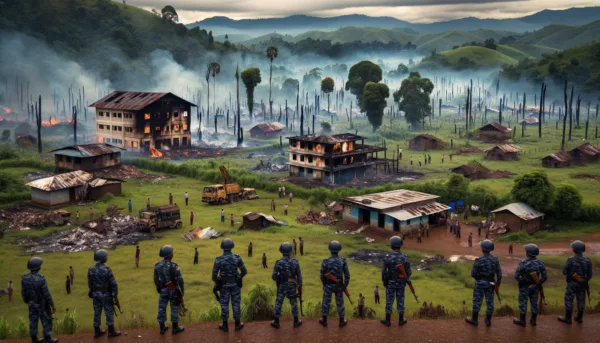



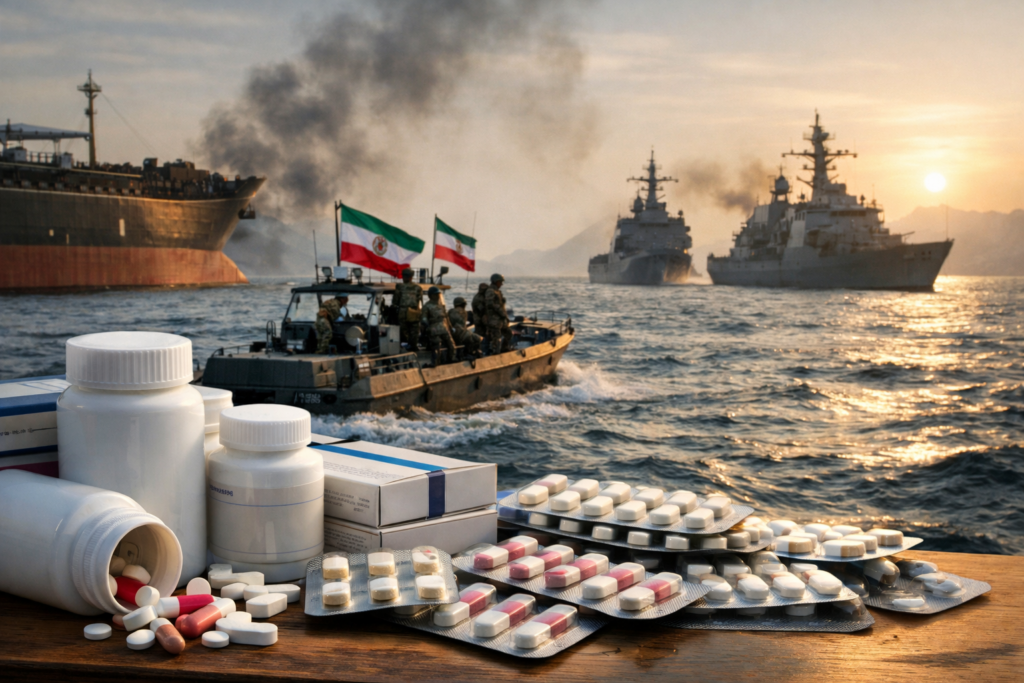
The effective closure of the Strait of Hormuz since early March 2026, following United States and Israeli military strikes on Iran and subsequent Iranian retaliatory action, is exposing structural vulnerabilities in global pharmaceutical supply chains that extend well beyond the Gulf region. Industry analysts, supply chain executives, and public health experts are warning that the disruption threatens the availability and affordability of generic medicines in the United States, which relies on India for nearly half of all generic drug prescriptions filled in the country.
India, the world’s largest exporter of generic pharmaceuticals and widely referred to as the pharmacy of the world, is directly exposed to the closure through two distinct pathways. The country depends on the Strait of Hormuz for approximately 40 percent of its crude oil imports, and that crude oil feeds directly into the petrochemical inputs used throughout pharmaceutical manufacturing. Additionally, chemical raw materials produced in China and destined for Indian drug manufacturers are frequently consolidated at logistics hubs in Dubai and across the United Arab Emirates before onward shipment to Indian factories, routing that is now severely disrupted.
The Islamic Revolutionary Guard Corps officially declared the strait closed on 2 March 2026. Tanker traffic has since dropped to near zero, with more than 150 ships anchoring outside the strait to avoid the risk of attack. The United Kingdom Maritime Trade Operations Centre reported ten attacks on ships as of 8 March 2026, with five crew members killed on two vessels. Brent crude oil prices surpassed 100 United States dollars per barrel on 8 March 2026 for the first time in four years, rising to a peak of 126 dollars per barrel.
How does the Strait of Hormuz closure affect the production of generic drugs in India?
India’s pharmaceutical manufacturing sector is deeply integrated with Gulf energy and logistics infrastructure in ways that are not immediately visible to end consumers. Crude-derived intermediates including naphtha and methanol are refined into solvents, reagents, and packaging materials used to manufacture active pharmaceutical ingredients, excipients, and sterilization agents. With petrochemical traffic through the Strait of Hormuz now at a near standstill, production costs for Indian drug manufacturers are rising sharply.
Steve Blough, chief supply chain strategist at Infios, a supply chain execution software firm, stated that disruptions around the Strait of Hormuz could quickly ripple into global pharmaceutical supply chains and eventually affect United States consumers. Blough noted that fuel costs affect the costs of everything but that generics face the tightest margin pressure because their profit margins are already thin. Air cargo rates from India for pharmaceutical shipments have reportedly increased by between 200 and 350 percent for some routes as manufacturers and distributors seek faster alternatives to halted sea freight.
Raw material price increases across India’s pharmaceutical sector are already measurable. Industry data compiled for the week of 9 to 14 March 2026 showed amoxicillin trihydrate prices rising 45 percent, paracetamol active pharmaceutical ingredient prices climbing 26 percent, diclofenac sodium prices up between 25 and 30 percent, and ciprofloxacin prices increasing between 20 and 30 percent compared to December 2025 levels. Pharmaceutical solvents including isopropyl alcohol and acetone have also risen by between 20 and 30 percent as petroleum-linked input costs escalate. The Federation of Pharma Entrepreneurs in India has formally requested intervention from the National Pharmaceutical Pricing Authority, seeking permission for price increases under the Drug Prices Control Order 2013.
The Indian rupee has depreciated to approximately 92.3 rupees per United States dollar in 2026, compounding cost pressures for manufacturers that source key starting materials from European suppliers and price their export contracts in dollars. Approximately 40,000 to 45,000 Indian shipping containers are stranded in international waters or at ports, affecting export cargo worth an estimated 1 to 1.5 billion United States dollars, with 80 percent already in transit when the closure took effect.
Which generic medicines are most vulnerable to supply disruption caused by the Hormuz closure?
Most pharmaceutical manufacturers and distributors currently hold 30 to 60 days of buffer inventory, which means the first two to four weeks of the closure may feel manageable to patients and pharmacists. However, supply chain analysts warn that shortages will start to surface if the strait remains effectively closed beyond that window.
The medicines most at risk once buffer stocks are depleted are high-volume everyday generics where supply chains are already tight and operating margins leave little room to absorb cost shocks. These include common antibiotics such as amoxicillin, blood pressure medications such as metoprolol, diabetes treatments including metformin, cholesterol-lowering statins, and over-the-counter analgesics. Mark Hahn, former dean of the University of Las Vegas medical school and a specialist in hematology, noted that generic drugs represent approximately 90 percent of all prescriptions filled in the United States, making the sector’s supply chain resilience a matter of public health significance.
Hahn identified specific petroleum-derived pharmaceutical ingredients at risk from sustained crude oil supply disruption. Glycerin, a common medication ingredient derived from petroleum, faces direct exposure to Gulf supply chain stress. Acetaminophen, one of the most widely consumed medicines globally, is traditionally manufactured from phenol, a chemical derived from petroleum refining. Disruptions to petrochemical feedstock availability therefore affect not just packaging and logistics costs but the fundamental chemistry of drug production.
The United States Pharmacopeia has previously reported that over 58 percent of key starting materials for United States-approved active pharmaceutical ingredients are sole-sourced from a single country, predominantly China or India. This concentration magnifies upstream vulnerability when Gulf energy inputs are disrupted, because there are limited alternative supply chains available to absorb the shock at scale.
How are Dubai and Gulf logistics hubs central to pharmaceutical supply chains running through the Strait of Hormuz?
Dubai and the broader United Arab Emirates serve as critical transshipment and consolidation points within the global pharmaceutical supply chain, a role that has been severely disrupted by the Strait of Hormuz closure and associated instability across the region. Chemical inputs produced in China are routinely consolidated by distributors in Dubai before being shipped onward to Indian pharmaceutical manufacturers. Even pharmaceutical shipments that travel directly from China to India often depend on petrochemical energy supplies that originate in the Gulf.
Major airports in the region including Dubai International Airport, Abu Dhabi International Airport, and Hamad International Airport in Doha have faced closures and disruptions following Iranian strikes in response to the United States and Israeli military operations. Dubai and Doha are among the world’s most significant air cargo hubs, linking Europe with Asia and Africa. Airlines including Emirates and Etihad, along with logistics firms such as DHL, routinely handle temperature-sensitive pharmaceutical shipments through these hubs that must be kept within a narrow temperature range to remain safe and effective.
Wouter Dewulf, a professor at the Antwerp Management School, cited industry data showing that over a fifth of global air cargo, the primary mode of transport for critical and life-saving medicines and vaccines, is exposed to Middle East disruption. Executives in the pharmaceutical logistics sector have cautioned that alternative cold-chain corridors, meaning temperature-controlled transport routes used for sensitive medicines, cannot be established overnight and are not always available for all product categories.
Some Europe-to-Asia pharmaceutical cargo that would typically transit through Dubai or Doha airports is being rerouted through China or Singapore. Sea routes have not been a practical alternative for urgent shipments due to longer journey times and the closure of the Strait of Hormuz itself. Prashant Yadav, senior fellow for global health at the Council on Foreign Relations, noted that stocks of short shelf-life, temperature-sensitive medicines are usually maintained at approximately three months, with cancer drugs including monoclonal antibodies among the categories at highest risk from extended logistics disruptions.
What government and diplomatic responses are addressing pharmaceutical and supply chain risks from the Hormuz closure?
United States President Donald Trump has pressed NATO allies and China to assist in protecting international shipping and reopening the Strait of Hormuz to commercial transit. United States Treasury Secretary Scott Bessent confirmed on 16 March 2026 that the United States is allowing Iranian tankers to transit the strait to supply countries including India, a measure intended to partially offset the impact of the closure on countries dependent on Gulf energy supplies.
The International Energy Agency took the unprecedented step of announcing the release of 400 million barrels of oil from strategic reserves, a response to the scale of the supply disruption. The Congressional Research Service, in an analysis published for the United States Congress, identified the disruption as a matter of congressional concern given its potential impact on global oil and gas prices, pharmaceutical and food supply chains, and broader United States economic and strategic interests.
On 5 March 2026, Iran’s Islamic Revolutionary Guard Corps announced that the closure would apply only to vessels from the United States, Israel, and their Western allies, a partial clarification that left the practical effect on most commercial shipping uncertain. By 13 March 2026, Iran had approved the passage of a Turkish vessel through the strait, and two Indian-flagged gas carriers and a Saudi oil tanker carrying 1 million barrels for India were also permitted to pass, suggesting selective and negotiated access rather than a blanket commercial reopening.
Within the United States, the Strategic National Stockpile remains a backstop for critical medicines in the event of acute shortage. Pharmacist Katie Perry, owner of Germantown Pharmacy in Germantown, Ohio, told CNBC that conditions at the dispensing level remain calm and that redundancy built into procurement systems during the Covid-19 pandemic has improved resilience. Kathleen Jaeger of the generic drug industry in the United States relayed that patients should not be living in fear of a supply panic in the near term.
How does the broader Hormuz crisis context involving Red Sea and Suez Canal disruptions compound pharmaceutical supply risks?
The pharmaceutical supply chain disruption caused by the Strait of Hormuz closure is compounded by the simultaneous resumption of Houthi attacks on Red Sea shipping, which reversed fragile gains made following an October 2025 ceasefire. For the first time in modern history, both of the Middle East’s primary maritime corridors are simultaneously blocked. The Red Sea route to Europe, which had been operating at 49 percent of pre-crisis capacity, is again disrupted. Ships that would ordinarily pass through the Suez Canal are being diverted around Africa’s Cape of Good Hope, adding ten to twenty days to transit times between Asia and Europe and further compressing pharmaceutical shelf-life margins.
Jebel Ali Port in Dubai, the largest container port in the Middle East and a critical transshipment hub for pharmaceuticals across the Middle East, East Africa, and South Asia, is experiencing congestion from diverted vessels. QatarEnergy declared force majeure on all liquefied natural gas shipments on 4 March 2026 following Iranian attacks on the Ras Laffan facilities in Qatar, disrupting energy supplies that feed into European and Asian industrial production including pharmaceutical manufacturing feedstocks.
Asian chemical producers dependent on Gulf naphtha, a key petrochemical feedstock, report 70 to 80 percent feedstock exposure through the Strait of Hormuz, and several producers have declared force majeure. Craig Geskey, vice president of strategic solutions at Traffix, a logistics and transportation management firm, stated that if Strait of Hormuz disruptions force continued vessel rerouting, the initial ocean freight impact may take ten to fourteen days to manifest but the real pressure typically hits within two to five weeks as diverted containers arrive in clusters, terminal congestion rises, and drayage demand outpaces truck and equipment availability.
Non-pharmaceutical healthcare goods including sterile packaging, medical plastics, and laboratory reagents are also affected, as the polymers and resins used in their manufacture rely on Gulf-origin hydrocarbons. The compounding effect of energy cost increases, freight rate surges, currency depreciation, and logistics disruption is creating what industry observers in India are describing as a perfect storm for the pharmaceutical manufacturing sector.
Key takeaways on what the Strait of Hormuz closure means for global pharmaceutical supply chains and generic drug availability
- The Islamic Revolutionary Guard Corps declared the Strait of Hormuz closed on 2 March 2026 following United States and Israeli military strikes on Iran, halting approximately 20 percent of global daily oil supply and severely disrupting the petrochemical feedstocks and logistics infrastructure on which India’s pharmaceutical manufacturing sector depends.
- India, which supplies nearly 40 to 50 percent of all generic drug prescriptions filled in the United States and accounts for approximately 40 percent of global generic pharmaceutical supply, depends on the Strait of Hormuz for around 40 percent of its crude oil imports, exposing its pharmaceutical production to rising feedstock costs, solvent shortages, and freight disruption simultaneously.
- Most pharmaceutical distributors hold 30 to 60 days of buffer inventory, providing a near-term cushion, but analysts warn that shortages of high-volume generics including common antibiotics, blood pressure medications, diabetes drugs, and analgesics could surface if the strait closure extends beyond that window.
- Air cargo rates from India for pharmaceutical shipments have risen by between 200 and 350 percent for some routes, Dubai and Doha airport disruptions are forcing rerouting of cold-chain pharmaceutical cargo through China and Singapore, and the simultaneous Houthi-driven closure of the Red Sea corridor has eliminated practical sea freight alternatives without adding significantly longer transit times around the Cape of Good Hope.
- The United States government has deployed the International Energy Agency strategic reserve release of 400 million barrels, permitted Iranian tanker transits to India, and deployed United States Navy vessels in the region; India is drawing on buffer raw material stocks; and the pharmaceutical industry is requesting National Pharmaceutical Pricing Authority intervention on price controls, but no comprehensive resolution to the underlying maritime crisis has been reached as of 16 March 2026.
Discover more from Business-News-Today.com
Subscribe to get the latest posts sent to your email.