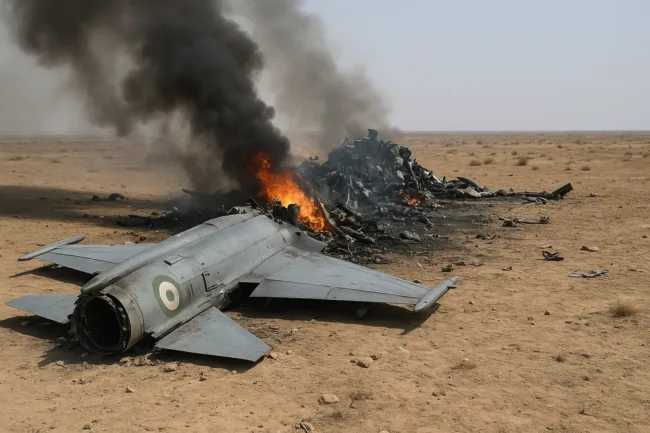


A Spanish F-18 fighter jet operating as part of a North Atlantic Treaty Organization air-policing mission shot down a suspected Russian drone after it entered Romanian airspace early on August 16, escalating an increasingly dangerous pattern of unmanned aircraft incursions along NATO’s eastern frontier. Romanian defence authorities said the drone entered the country from neighbouring Moldova before being intercepted near the southeastern city of Galați and destroyed safely over an unpopulated area.
The drone was detected by Romanian surveillance systems at approximately 4:44 a.m., around 24 kilometres north of Galați. A Spanish Air and Space Force F-18 conducting NATO air-policing duties established radar contact with the target and received permission to engage. Romanian authorities said the aircraft destroyed the drone at 5:01 a.m., with fragments believed to have fallen between two villages without causing reported casualties.
Romania has not formally identified the drone’s origin pending investigation, but NATO spokesperson Colonel Martin O’Donnell said preliminary indications suggested that it was Russian. That distinction is important because the incident was not simply another discovery of wreckage after a Russian attack on neighbouring Ukraine. A NATO fighter operated by Spain actively intercepted and destroyed an aircraft inside the sovereign airspace of another NATO member.
The August 16 interception represents the fourth drone shot down over Romania this year following three consecutive interceptions by Romanian F-16 fighters in July. It also comes only days after Romanian military divers destroyed two Gerbera-type drones found drifting in the Black Sea close to the strategically important Neptun Deep offshore gas development, demonstrating how the Ukraine conflict is creating overlapping security risks across Romanian airspace, coastal waters and critical infrastructure.
What happened when the suspected Russian drone entered Romanian airspace near Galați?
Romanian radar systems detected the unmanned aircraft entering national airspace from the direction of Moldova at around 4:44 a.m. on Sunday. The incursion occurred north of Galați, a major Romanian city close to both Moldova and Ukraine and an area that has repeatedly found itself exposed to the spillover effects of Russian attacks against Ukrainian infrastructure.
A Spanish F-18 participating in NATO’s air-policing mission was already operating within Romania’s integrated air-defence structure. After establishing radar contact with the drone, the fighter received authorisation to engage the target and destroyed it approximately 17 minutes after the initial detection.
Romania’s Ministry of National Defence said the interception was carried out safely. Debris was believed to have fallen in an uninhabited area between two villages, reducing the risk that the defensive action itself could cause casualties or property damage on the ground.
The sequence illustrates how Romania’s response to unidentified drones has changed dramatically. For much of the Ukraine war, Romanian forces tracked incursions, scrambled aircraft and searched for fragments after drones entered or crashed on Romanian territory. By the summer of 2026, however, the country had moved toward systematically destroying aircraft judged to be violating its airspace and posing a sufficient risk.
Why is a Spanish NATO F-18 shooting down the drone more significant than Romania acting alone?
The nationality of the fighter aircraft gives the August 16 incident additional strategic significance. Spain has deployed combat aircraft to Romania under NATO’s collective air-policing structure, meaning Spanish pilots are helping protect Romanian skies as part of an alliance mission rather than merely training alongside Romanian forces.
NATO air policing is a permanent peacetime mission designed to maintain the integrity of Allied airspace. Fighter aircraft and supporting crews remain available around the clock to detect, identify and respond to suspicious or unauthorised aircraft, with NATO countries routinely deploying forces to reinforce allies whose geographical position creates greater exposure to potential threats.
The interception therefore offers a practical demonstration of collective defence below the threshold of a conventional military attack. Romania detected the intrusion, NATO’s integrated command structure responded and an aircraft provided by Spain carried out the interception. That is precisely the kind of burden-sharing NATO has sought to strengthen across its eastern members since Russia launched its full-scale invasion of Ukraine in February 2022.
The episode also shows that NATO’s Eastern Flank response is becoming increasingly multinational at the tactical level. It is no longer unusual for aircraft from Western or Southern European allies to police airspace thousands of kilometres from their home bases. As drone incursions become more frequent, those rotations are moving from deterrence and reassurance missions toward real-world defensive engagements.
Why does NATO believe the drone shot down over Romania may have been Russian?
Romanian authorities initially avoided attributing the drone to any country and said the identification process remained under investigation. NATO, however, indicated that preliminary evidence suggested the aircraft appeared to be Russian.
The context surrounding the intrusion strengthens that assessment. Russia was conducting another major overnight wave of missiles and drones against Ukraine at approximately the same time, including attacks on Kyiv and the industrial city of Kryvyi Rih. Romania has repeatedly experienced airspace violations during Russian strikes on Ukrainian targets located close to the Danube and Black Sea regions.
The route is also notable. Romanian authorities said the drone entered from Moldova, the small non-NATO country located between Romania and Ukraine. A drone displaced from its intended flight path by navigation problems, electronic warfare or operational circumstances could therefore cross multiple national boundaries before reaching Romanian territory.
Attribution nevertheless requires technical evidence. Investigators can examine recovered fragments, propulsion systems, electronics, warhead components and manufacturing characteristics to determine the drone type and potentially establish its operator. Romania has previously identified wreckage from earlier incursions as belonging to Shahed-type drones used extensively by Russian forces.
How has Romania gone from tolerating drone incursions to shooting down four aircraft in 2026?
The August 16 interception reflects a profound shift in Romanian air-defence policy. During the earlier years of the Ukraine conflict, repeated Russian drone incursions generated frustration because Romanian aircraft could monitor suspected threats without always being legally or operationally positioned to destroy them.
Romania changed that framework in 2025 when parliament adopted legislation allowing military forces to neutralise or destroy drones that illegally enter national airspace and present an assessed danger to people, property or national security. Destruction was defined as a last resort after identification, attempted contact, interception and other procedures where circumstances permitted.
That legal foundation became increasingly important as incursions continued. In May 2026, a Russian drone crashed into an apartment building in Galați and injured two civilians, dramatically demonstrating that stray or malfunctioning unmanned aircraft were no longer merely a theoretical border-security concern.
The operational response hardened further in July. Romanian F-16 pilots shot down three drones during three consecutive days of violations, with authorities subsequently identifying Russian connections to the incidents and sharply condemning Moscow. The August 16 interception brings the number of drones destroyed in Romanian airspace this year to four.
This pattern suggests Romania has crossed an important threshold. The question is no longer primarily whether its military has the authority to engage an intruding drone, but how frequently that authority will have to be exercised as Russian and Ukrainian long-range drone operations expand around the Black Sea region.
Why are Galați, the Danube Delta and Romania’s Black Sea coast becoming NATO security hotspots?
Romania occupies one of the most strategically exposed positions on NATO’s Eastern Flank. It shares hundreds of kilometres of border with Ukraine, sits opposite Russia across the Black Sea and borders Moldova, while its Danube Delta lies immediately beside Ukrainian territory that has repeatedly been targeted by Russian forces.
Ukraine’s Danube ports have become especially important because they provide an alternative export route for grain and other commodities when Black Sea shipping is disrupted. Russian forces have consequently targeted port infrastructure along the river, sometimes only a short distance from Romanian territory.
That geography gives Romania little margin for error. Drones attacking Ukrainian targets can approach Romanian airspace within minutes, while wreckage from intercepted or malfunctioning aircraft can fall across the border. Surveillance systems must distinguish between aircraft merely approaching Romanian territory and those that actually cross into sovereign airspace.
The Black Sea adds another layer of risk. Romania, Bulgaria and Turkey have already established cooperation to clear mines drifting through commercial shipping routes, while Romanian authorities are increasingly confronting unmanned aircraft and other military debris near offshore infrastructure.
Romania’s growing offshore energy ambitions make these threats economically important as well as militarily significant. The Neptun Deep natural gas project, jointly developed by OMV Petrom and Romgaz, is expected to transform Romania’s gas production position when it starts operating. Two unidentified Gerbera-type drones discovered near the project earlier in August were deliberately destroyed by Romanian military divers after officials concluded they could threaten shipping and work around the development.
How does the August 16 interception fit into a wider surge of drone incidents across NATO territory?
Romania is not confronting the problem in isolation. Drone incursions have increasingly affected NATO countries along a broad arc stretching from the Black Sea to the Baltic region, forcing the alliance to refine rules for interception and determine when unidentified aircraft should be destroyed.
Only two days before the Romanian incident, an Italian fighter operating under NATO command shot down a drone that violated Latvian airspace. Italian Eurofighters and Turkish F-16s were involved in the response, illustrating the same multinational model now operating over Romania.
Eastern NATO members have also strengthened radar coverage, combat-air patrols and ground-based counter-drone systems as unmanned aircraft become one of the most persistent spillover risks from the Ukraine war. The difficulty lies partly in economics. Sending sophisticated fighter aircraft to intercept comparatively inexpensive drones can protect civilian populations but creates an obvious cost imbalance.
That challenge is encouraging investment in layered air-defence systems capable of combining fighters, missiles, electronic warfare and specialised counter-drone equipment. Fighters remain critical when the nature or trajectory of an approaching aircraft is uncertain, but cheaper ground-based methods may be preferable when small unmanned systems become routine threats.
For NATO, the strategic challenge is to make interception predictable without allowing defensive actions to create uncontrolled escalation. An aircraft entering Allied airspace must be challenged when it represents a danger, but every shootdown involving a suspected Russian system also carries diplomatic and military implications.
Could repeated Russian drone incursions into Romania trigger NATO Article 5?
The increasing frequency of incidents inevitably raises questions about NATO’s collective-defence commitment under Article 5, but an airspace violation does not automatically trigger collective military action. NATO members assess the circumstances, intent, damage and threat associated with an incident before determining an appropriate alliance response.
Article 5 treats an armed attack against one NATO member as an attack against all, but the treaty leaves considerable room for political judgment about what constitutes such an attack and how members respond. An accidental drone crossing during a strike against Ukraine is fundamentally different from a deliberate attack ordered against Romanian territory.
That distinction becomes more complicated when repeated violations continue despite diplomatic warnings. Even if individual incidents are described as accidental or unintended, a persistent pattern places civilians at risk and forces NATO members to expend military resources protecting their territory.
Romania’s current approach appears designed to manage that escalation problem without sacrificing sovereignty. Rather than treating each violation as a reason for broader confrontation, authorities are intercepting drones individually while documenting their origin, coordinating with NATO and maintaining diplomatic pressure on Russia.
The August 16 event nevertheless pushes the issue another step forward because an allied Spanish aircraft conducted the engagement. Should similar incidents become routine, NATO may need to establish an increasingly standardised approach covering detection, attribution, interception and diplomatic consequences across its entire Eastern Flank.
What are the key takeaways from the Spanish F-18 shootdown of a suspected Russian drone over Romania?
- A Spanish Air and Space Force F-18 operating on a NATO air-policing mission destroyed a drone that entered Romanian airspace from Moldova early on August 16.
- Romanian surveillance systems detected the drone at approximately 4:44 a.m. north of Galați, while the Spanish fighter established radar contact and destroyed the aircraft at 5:01 a.m.
- Romania has not formally attributed the drone while technical investigations continue, but NATO said preliminary indications suggested that the aircraft appeared to be Russian.
- The interception represents the fourth drone shot down over Romania in 2026, following three consecutive engagements by Romanian F-16 fighters during July.
- The incident demonstrates NATO’s multinational air-defence system operating in practice, with a Spanish fighter directly protecting the sovereign airspace of Romania rather than merely participating in an exercise.
- Romania’s approach to incursions has hardened since parliament passed legislation in 2025 permitting threatening drones to be destroyed and a Russian drone later struck an apartment building in Galați in May 2026, injuring two civilians.
- The latest shootdown comes amid broader drone pressure across NATO’s Eastern Flank, including a separate interception by an Italian NATO fighter over Latvia on August 14.
- Repeated drone incidents around Romania are increasingly intersecting with strategic infrastructure risks in the Black Sea, including shipping routes and the Neptun Deep offshore gas development.
Why could Romania’s latest drone shootdown mark a new phase for NATO’s Eastern Flank defence?
The significance of the August 16 interception lies less in the destruction of a single unmanned aircraft than in the system that destroyed it. Romanian radar detected the intrusion, an aircraft supplied by Spain under NATO air policing acquired the target and alliance procedures allowed the threat to be neutralised within minutes. Collective air defence, often discussed in terms of treaties and military exercises, was functioning as an operational reality.
That development matters because drone incursions are becoming too frequent to be treated as isolated accidents. Romania has moved from recovering fragments and issuing protests to destroying four drones in a matter of weeks, while Latvia and other Eastern Flank countries face similar challenges. Each additional incident increases pressure on NATO to make clear that its borders remain defensible without allowing limited airspace violations to trigger uncontrolled military escalation.
The economic dimension should not be underestimated either. Romania sits beside critical Danube trade corridors and is developing Black Sea gas resources expected to strengthen European energy security. Protecting Romanian territory increasingly means protecting ports, shipping lanes, offshore infrastructure and communities as well as conventional military installations.
The central question after August 16 is therefore not whether NATO can shoot down an intruding drone. It demonstrably can. The harder question is whether repeated incursions are becoming a durable feature of the Ukraine war, forcing the alliance to maintain permanent high-cost defensive readiness along hundreds of kilometres of frontier. If the frequency continues rising, the Spanish F-18 engagement near Galați may be remembered less as an unusual interception and more as evidence that NATO’s Eastern Flank has entered a new phase of day-to-day active air defence.
Discover more from Business-News-Today.com
Subscribe to get the latest posts sent to your email.