




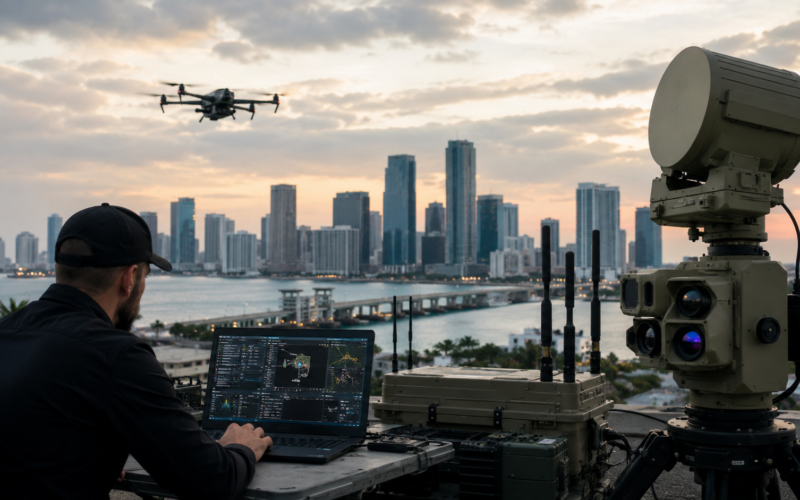
Miami-based defence technology company Space-Eyes has agreed to go public through a merger with McKinley Acquisition Corporation (Nasdaq: MKLY), in a transaction valuing the combined business at approximately $638 million, according to the companies’ joint announcement on July 31, 2026. The combined entity is expected to trade on Nasdaq under the ticker CUAS, a symbol that mirrors the counter-unmanned aerial systems category central to Space-Eyes’ commercial pitch. Eric Trump, recently identified as the third-largest private investor in Space-Eyes, will serve as a strategic adviser to the combined business and has already helped introduce board candidates. The transaction is expected to deliver up to $251.7 million in gross proceeds, comprising cash in McKinley’s trust and a planned private investment in public equity, with completion targeted for the fourth quarter of 2026 and subject to regulatory and shareholder approvals. The central tension for institutional investors is straightforward: the deal capitalises a roughly 35-person research-and-development company with approximately $1 million in annual revenue at a valuation more commonly associated with a Pentagon incumbent, and the gap between listing price and revenue base must be closed through contract conversion that has not yet occurred.
What is Space-Eyes and why does its counter-drone and geospatial intelligence pitch attract defence investors now?
Space-Eyes describes itself as an artificial intelligence company focused on counter-drone technology, geospatial intelligence and maritime domain awareness for government and agency customers. Founded in 2001 and based in Miami, the company employs approximately 35 people and has historically operated as a research-and-development business rather than a scaled defence vendor. Its technology stack centres on satellite-derived data and machine-learning models applied to maritime activity, trade flows, port monitoring and drone detection, which are use cases that map directly to current western defence and homeland-security procurement priorities.
The commercial pitch sits at the intersection of two adjacent budget lines. Counter-drone systems have moved from a specialist niche to a mainstream procurement category as low-cost unmanned aerial threats have been demonstrated in Ukraine, the Red Sea and along the United States southern border. Maritime domain awareness, the discipline of monitoring shipping, sanctions evasion, illicit fishing and threats to subsea infrastructure, has similarly moved up the priority list for navies and coast guards responding to shadow-fleet activity and undersea cable incidents. Space-Eyes is positioning itself against both catalysts simultaneously, which explains why sponsors and advisers appear willing to underwrite a valuation that current revenue does not support.

How does the McKinley Acquisition Corp SPAC structure shape Space-Eyes’ capital position at listing?
McKinley Acquisition Corporation is a Cayman Islands-incorporated blank-cheque company sponsored by Belay Global and based operationally in Needham, Massachusetts. It completed its initial public offering in August 2025, raising $150 million in gross proceeds through the sale of 15 million units at $10.00 each, and disclosed a mandate to target operating businesses with enterprise values between $500 million and $2 billion across sectors including advanced artificial intelligence and space technology. The Space-Eyes combination sits comfortably inside that target range and represents McKinley’s first announced business combination since its listing.
The disclosed transaction is expected to provide the combined company with up to $251.7 million in gross proceeds, drawn from cash held in McKinley’s trust account and a planned private investment in public equity, or PIPE, financing. That headline figure is a ceiling rather than a floor. SPAC completions in the current market environment routinely see meaningful redemption activity from public shareholders exercising rights to redeem their trust shares at approximately $10.00, and the eventual cash delivered to Space-Eyes will depend on how many public holders elect to remain invested at closing. The PIPE component provides some redemption resilience, but the exact PIPE size, investor identity and pricing terms will materially determine whether the combined entity emerges with the balance-sheet capacity implied by the $251.7 million ceiling or something appreciably smaller.
Clear Street LLC is acting as lead financial adviser and placement agent on the transaction, with Alexander Capital acting as co-adviser and placement agent. For investors reading the deal mechanics, the placement-agent structure signals that PIPE marketing remains an active workstream rather than a closed subscription, which is consistent with the fourth-quarter 2026 completion target.
Why does the $638 million headline valuation compare so sharply against Space-Eyes’ current revenue base and near-term pipeline?
The valuation gap is the single most important number in the deal. Reporting sources familiar with the transaction indicate that Space-Eyes currently generates approximately $1 million in annual revenue and is in the process of negotiating contracts worth approximately $35 million over a five-year period. Even if all $35 million in negotiated contracts convert, the annualised run-rate would remain in the single-digit millions, and the $638 million combined business valuation would still price the business at multiples typical of a scaled defence software vendor with recurring government revenues rather than an early-commercialisation research house.
Business News Today analysis suggests that investors underwriting the deal are pricing an option on catalyst-driven contract wins rather than a discounted cash-flow view of current operations. That option is not without foundation. The Pentagon and allied ministries are actively reprogramming money toward drone detection, geospatial intelligence and autonomous systems, and comparable small-vendor peers have converted early prototype work into eight- and nine-figure contract awards inside a single procurement cycle. However, the same asymmetry works in reverse. If Space-Eyes’ negotiated pipeline slips, if procurement decisions favour incumbents such as the large systems integrators, or if a change in the political environment reduces the strategic value of its adviser network, the current valuation offers little downside protection.
The reported $638 million figure describes the combined business value at closing, which includes the equity issued to Space-Eyes shareholders and the trust cash rolling into the new entity. Third-party SPAC trackers have separately noted an implied enterprise value closer to $370 million, which nets out expected trust cash. The two numbers are not contradictory, but investors should be clear which reference they are using when comparing Space-Eyes to peers.
Why does Eric Trump’s strategic adviser role matter for Space-Eyes’ contract ambitions and governance profile?
Eric Trump is described as the third-largest private investor in the original Space-Eyes entity and will assume a strategic-adviser role in the combined public company. He has already helped introduce potential board candidates, and the company has publicly framed his contribution as one of introductions, intelligence and adviser-level network access rather than any operational or executive role. In a statement accompanying the deal, Trump described the technology as critical for national safety.
For the commercial thesis, adviser access to Washington procurement networks is genuinely useful in a market where relationships shape the shortlist for early contract awards. Foundation, another Eric Trump-backed defence venture, has separately been identified as winning Pentagon contracts, and the Trump brothers’ New America Acquisition I Corporation SPAC filing for a $300 million initial public offering targeting domestic manufacturing, aerospace and critical minerals suggests a coordinated family strategy of defence-adjacent capital deployment. Investors will read the Space-Eyes appointment against that pattern.
For the governance thesis, the same relationship attracts scrutiny. Space-Eyes’ target customer base includes United States federal agencies whose procurement decisions run through an administration led by the adviser’s father. Business News Today analysis is that the governance question is unlikely to prevent contract awards, but it may compress the range of institutional investors willing to hold the stock, particularly public pension funds and asset managers with formal exclusion policies around political-adjacent exposure. That in turn can affect trading liquidity, index eligibility over time, and the multiple the market is prepared to apply to whatever revenue emerges.
What competitive positioning does Space-Eyes claim in counter-drone and maritime domain awareness, and where are the constraints?
The competitive landscape for counter-drone and maritime intelligence spans four broad tiers. Established defence primes offer counter-unmanned aerial systems as part of larger integrated packages. Specialist counter-drone vendors sell modular hardware-plus-software stacks. Geospatial data providers licence satellite imagery and analytics to government customers. Machine-learning specialists layer detection and classification models over third-party data feeds. Space-Eyes’ pitch sits closer to the fourth category, with the applied use case anchored to counter-drone and maritime awareness.
Being a software-and-analytics layer on top of third-party data has advantages and constraints. On the positive side, it allows a small headcount to serve high-value use cases without carrying the capital intensity of satellite ownership or hardware manufacturing. On the constraint side, it exposes the business to renegotiation risk with upstream data providers, and to competition from customers such as national geospatial agencies that maintain in-house model development. Sustained differentiation will depend on whether Space-Eyes can demonstrate detection or classification performance that cannot be replicated with off-the-shelf tools, and whether its adviser and customer relationships translate into repeatable procurement wins rather than one-off engagements.
What execution milestones will determine whether Space-Eyes justifies its post-listing valuation as ticker CUAS?
Between now and the fourth-quarter 2026 completion target, four milestones will materially reshape the investment case. First, the SPAC will file a definitive proxy or registration statement that discloses the full deal terms, PIPE size, PIPE pricing, lock-up structure and updated financial disclosures on Space-Eyes. Second, redemption activity by McKinley public shareholders will determine the cash actually delivered at closing. Third, Space-Eyes’ progress in converting its $35 million negotiated contract pipeline into signed and disclosed awards will validate or undermine the revenue trajectory implied by the valuation. Fourth, the composition of the post-listing board, including any Eric Trump-introduced candidates, will inform the governance framing that institutional holders apply.
Beyond the transaction close, the durable proof points are contract awards, revenue recognition against those awards, gross margin on delivered services, and the pace at which Space-Eyes moves from research-and-development spending to commercial operating leverage. A sustained rerating of the CUAS listing is unlikely to occur on adviser announcements alone, and would require operating evidence that the $638 million valuation reflects earnings capacity rather than access.
The deal is a credible platform. The valuation is a demanding one. The next twelve months of disclosure will determine which of those two observations dominates the trading narrative.
Key takeaways for investors watching Space-Eyes and McKinley Acquisition Corp
- Space-Eyes has agreed to go public via a merger with McKinley Acquisition Corporation (Nasdaq: MKLY), valuing the combined business at approximately $638 million and targeting a fourth-quarter 2026 close.
- The combined entity is expected to trade on Nasdaq under the ticker CUAS, mirroring its counter-unmanned aerial systems positioning.
- The transaction is expected to deliver up to $251.7 million in gross proceeds from trust cash and a planned PIPE financing, with the actual cash delivered dependent on public-shareholder redemptions.
- Space-Eyes is a roughly 35-person Miami-based company generating approximately $1 million in annual revenue and negotiating contracts worth approximately $35 million over five years.
- Eric Trump, the third-largest private investor in the original Space-Eyes entity, will act as a strategic adviser and has helped introduce board candidates.
- The $638 million combined business value and a separately noted approximately $370 million implied enterprise value reflect different reference points, with the difference driven principally by trust cash rolling into the new entity.
- Clear Street LLC is lead financial adviser and placement agent, with Alexander Capital as co-adviser and placement agent, indicating that PIPE marketing remains active.
- The commercial thesis rests on counter-drone and maritime domain awareness demand backed by rising western defence budgets, while the governance thesis will be scrutinised by institutional holders with political-exposure policies.
- Near-term catalysts include the definitive proxy filing, PIPE terms, redemption levels at closing and any disclosed contract conversions from the negotiated pipeline.
- Sustained rerating post-listing will require documented revenue growth and margin evidence rather than adviser announcements or category tailwind commentary alone.
Discover more from Business-News-Today.com
Subscribe to get the latest posts sent to your email.


