

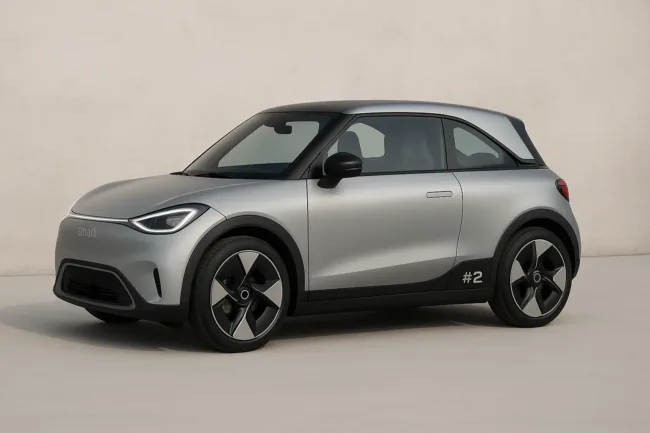
smart, the premium electric vehicle brand backed by Mercedes-Benz AG and Zhejiang Geely Holding Group, has formally announced the development of the smart #2, a next-generation all-electric two-seater set to debut globally in late 2026. The move marks a strategic return to the A-segment, the niche that smart originally defined with its first-generation fortwo, while expanding the brand’s portfolio into the ultra-compact city car category.
The smart #2 will be designed by Mercedes-Benz and built on an entirely new in-house electric platform optimized for ultra-compact architectures. According to the company, the vehicle will cater to urban drivers seeking advanced mobility solutions with minimalist environmental impact. Launch markets include China, Europe, and other selected global regions.
The announcement follows the successful internal feasibility review of “project: two,” smart’s exploratory initiative to reimagine its most iconic vehicle in the context of evolving EV platforms, stricter emissions targets, and changing urban infrastructure.
Why is smart returning to the ultra-compact two-seater segment it originally pioneered?
Nearly three decades after smart’s first city car debuted, the relaunch of an all-electric two-seater taps into both brand legacy and present-day market gaps. The smart fortwo, introduced in 1998, was an emblem of micro-mobility and urban innovation. More than two million customers have driven smart’s original models, creating a deeply loyal customer base across Europe and Asia.
Now, amid rising global congestion, new zero-emission zone policies, and a growing appetite for second-car EVs in city environments, smart believes the time is right to re-enter the two-seater market with a fully electrified, digitally enhanced product. The smart #2 is expected to bring updated software architecture, driver assistance, and sustainability features into a form factor that urban planners and climate-conscious consumers increasingly favor.
Smart’s return to the A-segment also fills a notable vacuum, as many legacy automakers have shifted focus away from ultra-compacts due to thin margins and regulatory constraints. The electric reboot could offer a leaner cost structure and better economics if production volumes and cross-market demand align.
What platform and design innovations will the new smart #2 bring to the EV market?
According to the official statement, the smart #2 will ride on a new proprietary EV architecture designed in-house by smart’s global R&D division. This marks a departure from the Geely SEA platform used in the smart #1 and #3 crossover models. The bespoke architecture is being engineered specifically for ultra-compact vehicles, which face unique challenges related to battery packaging, ride comfort, and urban safety compliance.
Design for the smart #2 is being handled by Mercedes-Benz Design, ensuring continuity in premium aesthetics across the brand’s evolving EV portfolio. While exact specifications have not been disclosed, the company has confirmed that the new platform will feature category-first technology solutions, although those details are still under wraps.
Global CEO Mr. Tong Xiangbei acknowledged the technical difficulty of engineering a high-performance electric two-seater, noting that compact architecture poses more design constraints than larger vehicles. He credited shareholder support for enabling the brand to build new production and development capabilities.
How does the smart #2 fit into the broader global product portfolio and rollout strategy?
The smart #2 will join a growing product family that includes the smart #1, #3, and the recently launched #5, a mid-size electric SUV with hybrid variants planned for China. Together, these vehicles are part of smart’s repositioning as a premium intelligent electric automotive brand with global reach. The #2 stands out as both a return to the brand’s roots and an expansion into a less saturated niche with renewed urban relevance.
In terms of launch sequencing, the #2 is currently in the final stages of design and development, with production slated to take place in China. The official premiere is scheduled for late 2026, and market availability will begin shortly thereafter in China, Europe, and a limited set of additional global markets.
smart’s broader product rollout aligns with its “China-Europe Dual Home” strategy, emphasizing co-development and co-marketing across its two largest geographies. This strategy has helped smart navigate the regulatory and cultural complexities of operating in both the world’s largest EV market and its most mature premium segment.
What does this reveal about smart’s post-2019 transformation under Mercedes-Benz and Geely?
Since becoming a 50-50 joint venture between Mercedes-Benz AG and Zhejiang Geely Holding Group in 2019, smart has undergone a complete transformation of its brand, product line, and business model. Between 2019 and 2024, the brand successfully completed its initial five-year strategic objectives, transitioning from a single-model European offering to a global multi-model EV platform.
By anchoring R&D and production in China while maintaining German design oversight, smart has repositioned itself as a dual-market EV contender with aspirations to scale across 40+ countries. Its growing product lineup—from agile city cars to midsize SUVs—reflects a strategy to serve diverse urban mobility needs, while preserving smart’s core DNA of premium minimalism and intelligent design.
Global CMO Mandy Zhang underscored this transformation by linking the smart #2 to the legacy of the original fortwo, calling the new model a modern reinterpretation of a vehicle that once symbolized urban culture. Zhang positioned the relaunch as a blend of “cutting-edge technology” with “iconic concept” continuity.
What are analysts and institutional investors saying about smart’s strategic direction?
While smart is not publicly traded, institutional observers tracking the EV sector view the #2 launch as a strategic differentiator. Analysts suggest that few brands are positioned to profitably pursue the A-segment in a fully electric format, citing engineering costs, limited global demand, and low unit economics. However, smart’s vertically integrated approach and access to Geely’s supply chain give it structural advantages many pure-play EV startups lack.
Moreover, smart’s ability to balance product nostalgia with modern compliance and digital services is seen as a brand equity lever—especially in European markets where the original fortwo still holds iconic status.
In China, the move also positions smart favorably in a highly competitive but increasingly stratified EV market, where ultra-compacts could regain relevance among younger consumers, budget-sensitive urban drivers, and shared mobility operators.
Institutional sentiment appears cautiously optimistic, with the model’s success likely hinging on production scale, pricing precision, and connectivity integration.
What are the next steps in development and market launch for the smart #2?
With final design and development now underway, smart is expected to begin validation testing and regulatory filings over the next 12–18 months. Industry watchers will be monitoring how the smart #2 balances driving range, safety ratings, and infotainment features in a size-constrained platform.
The premiere is targeted for late 2026, potentially aligned with one of the major international auto shows, followed by phased launches in mainland China, Germany, France, and other select global markets.
Smart’s leadership has hinted at upcoming reveals around drivetrain, range, and digital ecosystem integration, but has not yet confirmed pricing or production targets.
Discover more from Business-News-Today.com
Subscribe to get the latest posts sent to your email.