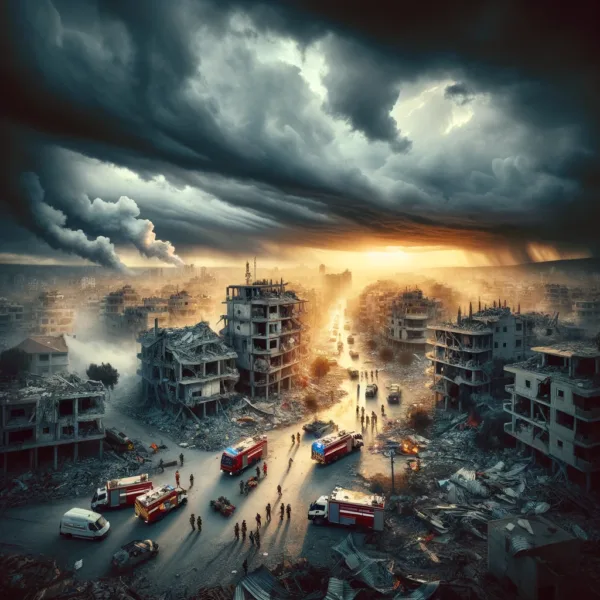
The spectre of World War 3 is no longer a fringe hashtag or a social media meme. As of 1 March 2026, it is the defining question being asked in foreign ministries, military command centres, and public squares from London to Beijing. In the early hours of 28 February 2026, the United States and Israel launched a massive, coordinated military operation against Iran, killing the Islamic Republic’s supreme leader, eliminating the uppermost layer of its military command, and igniting retaliatory strikes across six countries in the Gulf region simultaneously. Within hours, the United Nations Security Council was in emergency session. Within hours more, the hashtag #WorldWar3 was trending globally across X, formerly known as Twitter, and Instagram. The question being asked is no longer whether the Middle East is at war. It is whether that war can be contained before it pulls in Russia, China, Europe, and the broader international community in ways that tip a regional conflict into something the world has not seen since 1945.
What did the United States and Israel strike in Iran on 28 February 2026, and how large was Operation Epic Fury?
The joint operation, codenamed Operation Epic Fury by the United States Department of Defense and Roaring Lion by the Israel Defense Forces, was launched at 9:45 a.m. local time in Iran on 28 February 2026. The operation targeted Iranian military infrastructure across Tehran, Isfahan, Qom, Karaj, and Kermanshah. Strikes hit Islamic Revolutionary Guard Corps command and control facilities, air defence installations, ballistic missile production sites, naval assets, and military airfields across Iran.
The Israel Defense Forces deployed approximately 200 fighter jets, including Lockheed Martin F-35s and Boeing F-15s, striking approximately 500 targets in what the Israel Defense Forces described as the largest operation in the history of the Israeli Air Force. The United States deployed Lockheed Martin F-22 stealth fighters, F-35 aircraft, and Boeing KC-135 and KC-46 aerial refuelling tankers to the region. Two United States Navy carrier strike groups supported the campaign: the USS Gerald R. Ford in the Eastern Mediterranean Sea and the USS Abraham Lincoln in the North Arabian Sea. Fourteen guided-missile destroyers armed with Standard Missile 3 interceptors were deployed across the Mediterranean and the broader Middle East. United States Army Terminal High Altitude Area Defense and Patriot Advanced Capability-3 missile defence systems were also positioned across the theatre.
United States Central Command described Operation Epic Fury as the largest regional concentration of American military firepower in a generation — a phrase that, to many observers tracking the World War 3 debate, carries unmistakable historical weight.
United States President Donald Trump announced the operation via social media, stating that the objective was to eliminate imminent threats posed by the Iranian regime, destroy Iran’s missile manufacturing capacity and naval capabilities, and ensure Iran never obtained a nuclear weapon. Trump addressed the Iranian civilian population directly, encouraging them to take control of their government once the military operation concluded, and called on members of the Islamic Revolutionary Guard Corps to lay down their arms or face certain death.

Who was killed in the United States-Israel strikes on Iran and what is the confirmed scale of casualties on the ground?
The most consequential outcome of the first day of Operation Epic Fury — and the development that most immediately accelerated World War 3 fears across global social media — was the confirmed death of Iranian Supreme Leader Ayatollah Ali Khamenei, 86. Khamenei was killed in an Israeli airstrike. The Iranian government confirmed his death and declared 40 days of national mourning. Iranian state media also reported the deaths of Iran’s defence minister, the commander of the Islamic Revolutionary Guard Corps, and the secretary of the Iranian National Security Council, effectively decapitating the Islamic Republic’s security and military command structure within a single day’s operation.
The scale of leadership elimination in a single military action has no modern precedent in the context of a sovereign state that is not in an active declared war, and it is precisely this dimension of Operation Epic Fury that has driven World War 3 commentary beyond social media and into the analysis of senior diplomatic and security figures globally. Iran’s Red Crescent Society reported more than 200 civilian deaths inside Iran in the hours following the opening strikes. Iran’s news agency reported that a girls’ school was struck in the operation, with at least 53 students killed, a claim the United States Central Command did not confirm. Iran’s Foreign Ministry characterised the airstrikes as a gross violation of Iranian national sovereignty. The United States Central Command reported no American military casualties, stating that light damage to its facilities had not disrupted operations and that American forces had neutralised several hundred Iranian drone and missile strikes.
How did Iran retaliate and which countries across the Gulf and Middle East came under Iranian attack after Operation Epic Fury?
Iran’s response was swift, broad, and deliberately multi-directional — a strategic choice that immediately expanded the World War 3 conversation from a bilateral United States-Iran confrontation to a regional conflagration. Following the initial strikes, Iran launched waves of ballistic missiles and attack drones targeting Israel, Saudi Arabia, the United Arab Emirates, Qatar, Bahrain, and Kuwait simultaneously. A United States military facility in Bahrain was also struck. Air raid sirens activated across Israel as Iranian projectiles entered Israeli airspace. Jordan, which hosts major United States military installations and had not been a target of Iranian aggression, reported that its air defences intercepted 49 Iranian drones and ballistic missiles threatening Jordanian territory.
Civilian airline operations across the Middle East were widely disrupted as airspace closed across the region. The scale of Iran’s simultaneous retaliation against six countries demonstrated a doctrine of deliberate escalation rather than proportional response, drawing the Gulf Cooperation Council states — Saudi Arabia, the United Arab Emirates, Qatar, Bahrain, and Kuwait — into the conflict perimeter regardless of their individual diplomatic positions. These countries collectively host the largest concentration of United States forward-deployed military assets outside of Europe and East Asia. Their involuntary inclusion in the active conflict zone is one of the central reasons the World War 3 debate has moved from social media trending to formal governmental concern within a single news cycle.
Will Russia and China remain silent as the United States and Israel escalate military action against Iran, or does World War 3 risk become a superpower calculation?
This is the question at the core of every serious World War 3 assessment being conducted by governments and institutions on 1 March 2026. The responses from Moscow and Beijing on 28 February 2026 were sharp in diplomatic tone but stopped well short of any military commitment or explicit threat of counter-action. Russia’s Foreign Ministry condemned the United States-Israeli strikes as a pre-planned and unprovoked act of aggression, accused Washington and Tel Aviv of fabricating threats surrounding Iran’s nuclear programme to pursue regime change, and warned that the Middle East faced a period of uncontrolled escalation. China’s Foreign Ministry called for an immediate halt to military action, urged no further escalation of regional tensions, and called for a resumption of dialogue and negotiations to uphold peace and stability in the Middle East.
Neither Moscow nor Beijing has indicated any intention to intervene militarily on Iran’s behalf as of 1 March 2026. However, the strategic calculus for both governments is considerably more complex than their initial public statements acknowledge, and it is within that complexity that the most credible World War 3 risk scenarios reside. Russia has depended heavily on Iranian-produced Shahed drones throughout its ongoing military campaign in Ukraine. Ukraine’s President Volodymyr Zelenskyy stated publicly that Iran supplied weapons used in more than 57,000 strikes against Ukrainian cities. The elimination of Iran’s Islamic Revolutionary Guard Corps leadership and the potential collapse of the Islamic Republic as a functioning state would remove a critical materiel supplier from Russia’s war effort at a moment of significant operational pressure. How President Vladimir Putin assesses that loss — and whether Moscow concludes that passivity in the face of American regime-change operations sets a precedent too dangerous to ignore — is a determination that carries direct World War 3 implications.
For China, the calculation is different but no less consequential. The United States and Israel have demonstrated the combined military and intelligence capability to decapitate the leadership of a sovereign state in a single day’s operation, without formal declaration of war and over the objection of the United Nations Security Council. China’s strategic planners, whose contingency frameworks for Taiwan scenarios are built in part around assessments of American willingness to escalate, will be examining every dimension of Operation Epic Fury with considerable attention. Whether Beijing interprets the operation as evidence of American overextension or American resolve will shape East Asian security dynamics — and with them, the global World War 3 risk calculus — in the months ahead.
How have European governments, the United Kingdom, and the broader international community responded to a conflict that is fuelling World War 3 fears?
Europe’s response was divided and, in several cases, directly critical of the United States and Israel. Spain’s Prime Minister Pedro Sanchez issued one of the strongest European condemnations, rejecting the military action as a violation of international law and calling for immediate de-escalation. Norway’s Foreign Minister Espen Barth Eide stated that the Israeli characterisation of the strikes as preventive was not consistent with international law, noting that legitimate preventive action requires proof of an immediately imminent threat — a standard Norway concluded had not been met. These responses reflect a broader European institutional discomfort with the precedent being set: that a permanent member of the United Nations Security Council can conduct a regime-change military operation against a sovereign state while simultaneously chairing the world’s primary collective security body.
Oman’s Foreign Minister Badr Al-Busaidi, whose government had announced a diplomatic breakthrough in United States-Iran nuclear negotiations just one day before the strikes, expressed dismay at the outbreak of hostilities and urged the United States not to be drawn further into the conflict. Pakistan’s Foreign Minister Ishaq Dar condemned the strikes and called for an immediate halt to escalation. Canada’s Prime Minister Mark Carney expressed support for the United States objective, stating that the Islamic Republic of Iran must never be allowed to develop nuclear weapons.
Ukraine’s President Volodymyr Zelenskyy endorsed the operation in a video address, directly linking the elimination of Iran’s military command to Ukraine’s own survival against Russian aggression supplied in part by Iranian weapons. The absence of a unified European position, and the fracture between countries that tacitly accept the operation’s objectives and those that reject its legality, is itself a dimension of the World War 3 risk landscape — because a fractured West is precisely the environment in which Moscow and Beijing are most likely to test boundaries.
United Nations Secretary-General Antonio Guterres convened an emergency United Nations Security Council session on 28 February 2026, condemning both the United States-Israel strikes and Iran’s retaliatory attacks. Guterres warned that military action at this scale carries the risk of igniting a chain of events that no party can control in the world’s most volatile region. That warning, delivered in the same week that the phrase World War 3 began trending globally, carries an institutional gravity that distinguishes this moment from the many previous occasions on which the hashtag has spiked and receded.
What is the historical context of United States-Iran relations and how did diplomacy collapse in the 48 hours before Operation Epic Fury began?
The operation did not emerge from a vacuum, and understanding how close the world came to a diplomatic resolution — and how rapidly that resolution was bypassed — is essential to any serious assessment of the World War 3 risk now unfolding. The United States had presented Iran with three core demands in the weeks preceding the strikes: a permanent end to all uranium enrichment, verifiable limits on Iran’s ballistic missile programme, and a complete halt to Iran’s support for regional proxy groups including Hamas, Hezbollah, and the Houthis. Indirect negotiations between Iran and the United States were held in Muscat, Oman on 6 February 2026, with a second round of talks scheduled in Geneva.
On 27 February 2026, one day before Operation Epic Fury commenced, Oman’s Foreign Minister Badr Al-Busaidi announced that a diplomatic breakthrough had been reached in which Iran had agreed to never stockpile enriched uranium and to accept full verification by the International Atomic Energy Agency. The strikes proceeded regardless the following morning. The decision to launch a military operation of this scale one day after a reported diplomatic breakthrough has drawn significant international criticism and raised fundamental questions about whether the stated objective of nuclear non-proliferation was the genuine driver of Operation Epic Fury, or whether the objective was, as Russia and several European governments have suggested, the deliberate removal of the Islamic Republic’s leadership.
The United States-Iran relationship has been defined by sustained hostility since the 1979 Islamic Revolution, the seizure of the United States Embassy in Tehran, and the 444-day hostage crisis that followed. The current operation is the largest direct United States military action against Iran in that 47-year history. It follows a prior Israeli-Iranian military confrontation in June 2025, in which the United States also struck Iranian nuclear infrastructure using Northrop Grumman B-2 Spirit stealth bombers in an operation designated Operation Midnight Hammer. That operation was described by President Trump at the time as having destroyed Iran’s nuclear programme entirely. The resumption of Iranian nuclear activities in the months that followed was cited by the Trump administration as the primary justification for Operation Epic Fury.
Is the world actually heading toward World War 3 or is the trending debate outpacing the verified geopolitical reality on the ground?
The honest answer, as of 1 March 2026, is that no credible institutional framework currently characterises the ongoing United States-Israel-Iran conflict as the beginning of World War 3. The Council on Foreign Relations, in its 2026 Preventive Priorities Survey published before the February strikes, assessed Iran-Israel conflict as a top-tier geopolitical contingency but did not project it as a trigger for global war. The survey rated a crisis in the Taiwan Strait and a direct Russia-NATO military clash as having roughly equal probability of occurring in 2026, each with potential to draw the United States into direct confrontation with China or Russia respectively. Neither of those flashpoints has escalated in the immediate aftermath of Operation Epic Fury.
What has changed, as of 1 March 2026, is the threshold. A permanent United Nations Security Council member has conducted a large-scale regime-change military operation against a sovereign state, eliminated that state’s supreme leader and military command, triggered retaliatory strikes across six nations, drawn emergency condemnation from the United Nations Secretary-General, and generated the deepest fracture in transatlantic alignment since the 2003 invasion of Iraq. Russia is watching its Iranian arms supply network face potential collapse. China is watching the American military doctrine that governs its own Taiwan risk calculation be rewritten in real time. Europe is watching its legal and institutional frameworks for managing American power be bypassed without consequence.
The trending of World War 3 on social media is, in this context, not merely an expression of public anxiety or viral meme culture. It is a reflection of a genuine and widely shared recognition that the events of 28 February 2026 have altered the parameters within which a broader global conflict becomes possible. Whether those parameters are breached will depend on decisions not yet made in Moscow, Beijing, Tehran, Washington, and Jerusalem. The world is watching all five cities simultaneously, and for the first time in a generation, the watching feels warranted.
Key takeaways on what Operation Epic Fury, Iran’s multi-country retaliation, and the global World War 3 debate mean for international peace and security in 2026
- The United States and Israel launched Operation Epic Fury against Iran on 28 February 2026, deploying the largest regional concentration of American military firepower in a generation and striking approximately 500 targets across Tehran, Isfahan, Qom, Karaj, and Kermanshah, targeting Iranian leadership, missile production, air defences, and naval assets.
- Iranian Supreme Leader Ayatollah Ali Khamenei, 86, was confirmed killed in the operation alongside Iran’s defence minister, Islamic Revolutionary Guard Corps commander, and Iranian National Security Council secretary, eliminating the uppermost layer of the Islamic Republic’s military and political command in a single day.
- Iran retaliated by launching ballistic missiles and drones against Israel, Saudi Arabia, the United Arab Emirates, Qatar, Bahrain, Kuwait, and a United States military facility in Bahrain, expanding the active conflict zone across the Gulf Cooperation Council and drawing nations into the conflict perimeter regardless of their diplomatic positions.
- Russia condemned the strikes as unprovoked aggression and warned of uncontrolled escalation, China called for an immediate halt to military action, while Europe was divided between countries that rejected the operation’s legality and those that tacitly supported its non-proliferation objectives, deepening the fracture in transatlantic and multilateral institutional alignment.
- United Nations Secretary-General Antonio Guterres warned of a grave threat to international peace and security at an emergency United Nations Security Council session, while the hashtag #WorldWar3 trended globally on X and Instagram, reflecting widespread public recognition that the events of 28 February 2026 have materially altered the threshold at which a broader global conflict becomes possible.
Discover more from Business-News-Today.com
Subscribe to get the latest posts sent to your email.