




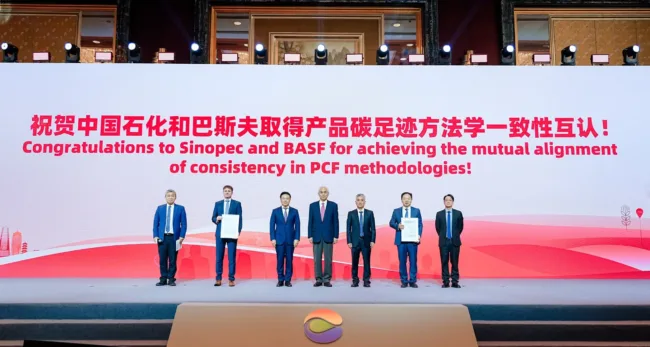
China Petroleum & Chemical Corporation (HKG: 0386), widely known as Sinopec, and German multinational BASF have jointly announced a significant milestone in the global carbon accounting landscape. At the 2025 China International Petroleum and Chemical Conference (CPCIC 2025) held in Ningbo between October 22 and 24, the two industrial giants confirmed mutual recognition of their product carbon footprint (PCF) methodologies. This alignment, independently verified for consistency by TÜV Rheinland, is being viewed as a benchmark-setting development that could fast-track international standardization of carbon footprint data within the global chemicals and petrochemical sectors.
The mutual recognition framework is rooted in both the international ISO14067:2018 protocol and China’s updated national carbon accounting standard, GB/T 24067–2024. Analysts say this dual compliance is a rare example of cross-border ESG interoperability between state-backed Chinese enterprises and multinational European firms, a development that could pave the way for wider harmonization of carbon data disclosures across global supply chains.

Why does this methodological alignment matter in the global context of carbon transparency and ESG reporting?
The collaboration between Sinopec and BASF comes at a critical moment for industries seeking greater transparency and consistency in ESG data, especially as governments and investors tighten disclosure norms. Historically, product-level carbon footprint data has suffered from inconsistencies across geographies due to varying definitions, boundary assumptions, and calculation methodologies. Without uniform metrics, institutions and regulators have struggled to verify emissions claims or compare products across markets.
By aligning their PCF accounting systems and subjecting them to independent verification from TÜV Rheinland, Sinopec and BASF are laying a foundational model for cross-border data trust. This is particularly important in the chemicals and petrochemicals sector, where global supply chains often span countries with different environmental regulations and carbon policies.
This initiative provides a framework for mutual recognition of carbon data, enabling buyers, regulators, and financiers to evaluate emissions footprints with greater accuracy and confidence. From a compliance perspective, the move could also facilitate easier adoption of upcoming regulatory requirements under frameworks such as the European Union’s Carbon Border Adjustment Mechanism (CBAM) or China’s anticipated national carbon footprint trading rules.
How were the carbon footprint methodologies validated and why is TÜV Rheinland’s role significant?
TÜV Rheinland, a globally recognized third-party certification and verification body, was appointed to conduct a detailed consistency review of the PCF methodologies used by Sinopec and BASF. The audit involved multiple rounds of cross-verification to ensure methodological coherence with both ISO14067:2018 and China’s GB/T 24067–2024.
This dual compliance is critical, not just because it meets global and domestic requirements, but also because it allows companies to operate across jurisdictions without recalibrating their data systems. According to TÜV Rheinland’s formal statement, both methodologies were found to be consistent in core elements such as life-cycle boundaries, emissions factors, data sourcing, allocation principles, and calculation frameworks.
Such validation from a neutral, internationally trusted auditor significantly strengthens the credibility of both companies’ emissions data and provides a replicable template for other multinational collaborations. Experts suggest that this may accelerate the creation of universally accepted PCF baselines in sectors where emissions data often vary wildly.
What is the historical background of Sinopec’s leadership in carbon footprint accounting within China?
Sinopec has played a pioneering role in establishing carbon accounting systems in China. The state-owned energy and chemicals major began studying product carbon footprints as early as 2015, well before it became a mainstream concern in Chinese industrial policy. At that time, Sinopec developed a first-of-its-kind methodological framework tailored for petrochemical products, positioning itself as a national leader in emissions quantification.
In 2023, Sinopec achieved a new milestone by introducing automated PCF accounting systems for its petroleum and chemical product lines. This innovation allowed for real-time tracking and reporting of embedded carbon emissions throughout its value chain, significantly enhancing internal monitoring and external disclosures.
In 2024, Sinopec co-launched the Carbon Footprint Alliance alongside industry heavyweights such as China National Petroleum Corporation (CNPC), China National Offshore Oil Corporation (CNOOC), and PipeChina. This alliance was established to jointly reduce emissions across the energy and chemical supply chain, pooling expertise and standardizing methodologies at a national scale.
These efforts align closely with China’s macro-level carbon roadmap, which aims to establish a comprehensive product carbon footprint management system by 2027. This includes not only methodological development but also nationwide adoption of lifecycle-based carbon assessment standards in line with international practices.
How does BASF benefit from this alignment and what does it signal for global value chains?
BASF has long maintained a proactive approach to ESG reporting and carbon accounting. With a net-zero target by 2050, the German multinational has invested heavily in life-cycle assessment tools and digital platforms to measure product-level emissions. The company’s initiatives align with broader European regulations, particularly the European Union’s CBAM and the Corporate Sustainability Reporting Directive (CSRD).
By aligning with Sinopec, BASF gains a trusted partner in the world’s largest chemicals market and strengthens its ability to assess emissions impacts throughout the upstream portion of its Asian supply chain. The mutual recognition agreement allows BASF to incorporate validated Chinese-sourced emissions data into its own product lifecycle assessments and carbon disclosures with higher confidence.
This is particularly important as European buyers and regulators increasingly require validated Scope 3 emissions data from suppliers. The credibility of such upstream data can directly influence eligibility for green finance, procurement contracts, and inclusion in ESG indices.
Analysts also note that BASF’s cooperation with Sinopec may encourage other European multinationals to pursue similar partnerships with Chinese state-owned enterprises, especially in high-emission sectors such as steel, cement, and heavy manufacturing.
How does this agreement align with China’s 2025–2027 carbon footprint policy goals?
China has outlined a phased strategy for building a national carbon footprint management system. Since 2021, the Chinese government has been formulating a product life-cycle carbon footprint system that emphasizes standardization, transparency, and sector-specific customization.
The goal is to establish a preliminary system by 2027, supported by a unified set of general standards for carbon accounting. These standards aim to be both internationally compatible and adaptable to China’s industrial realities.
Sinopec’s leadership, in collaboration with BASF and TÜV Rheinland, reinforces this national ambition. It demonstrates the feasibility of producing carbon footprint data that meets both global and local standards, while also making it easier for Chinese firms to participate in green trade and comply with future export regulations involving carbon content disclosures.
From a policymaker’s perspective, such corporate initiatives can serve as pilot models for national rollouts and may even inform future government-led regulatory designs.
How could the Sinopec–BASF carbon accounting alignment influence ESG investors and global capital flows?
For institutional investors and capital allocators, the development significantly improves the quality and comparability of emissions data within the chemicals industry. As sustainability-linked bonds (SLBs), green loans, and ESG ratings increasingly rely on verified Scope 3 data, the ability to trust upstream supplier disclosures is becoming a differentiator.
This alignment may also influence equity investor sentiment for listed entities such as Sinopec. With environmental performance playing a growing role in portfolio selection and index inclusion, credible emissions data could influence analyst ratings, institutional flows, and international investor access.
While Sinopec’s stock performance has historically mirrored broader trends in energy markets, its involvement in cutting-edge ESG initiatives may start to change the narrative. Investors are likely to track whether this move translates into improved ratings in ESG indices or attracts capital from climate-aligned funds.
For BASF, the partnership offers assurance to European regulators and clients that its Asian supply chain is producing emissions data on par with EU standards. This can reduce compliance risks and enhance investor confidence, particularly as the firm navigates net-zero transition challenges in both mature and emerging markets.
What are the next steps and challenges for carbon footprint data harmonization in global supply chains?
Despite the progress made, experts caution that the road to universal carbon footprint data harmonization remains steep. Methodological differences, data digitization gaps, and varying levels of verification capacity across countries pose major challenges.
However, partnerships like the Sinopec–BASF alignment are viewed as critical early steps in building an interoperable data ecosystem. By demonstrating how mutual recognition can work in practice, they help de-risk future attempts at global convergence in ESG data reporting.
The next phase may involve formalizing such frameworks through trade agreements, regional industry bodies, or international standardization efforts. Institutions such as the International Sustainability Standards Board (ISSB) or United Nations Framework Convention on Climate Change (UNFCCC) may play a role in scaling these efforts to other sectors and regions.
More companies are expected to follow suit, particularly as supply chain emissions transparency becomes a regulatory obligation rather than a voluntary differentiator.
Key takeaways from the Sinopec–BASF carbon footprint accounting alignment
- China Petroleum & Chemical Corporation (Sinopec) and BASF have formally aligned their product carbon footprint (PCF) methodologies, marking a first-of-its-kind mutual recognition between a Chinese state-owned chemical enterprise and a European multinational.
- The methodologies used by both parties were verified for consistency by TÜV Rheinland and were found to comply with both the international ISO14067:2018 standard and China’s GB/T 24067–2024 national carbon footprinting framework.
- This strategic alignment significantly boosts cross-border trust in emissions data, enabling better transparency for regulators, customers, and ESG-focused investors evaluating supply chain emissions.
- Sinopec has been a pioneer in carbon accounting in China, launching automated PCF systems in 2023 and co-founding the Carbon Footprint Alliance in 2024 to coordinate emissions reduction across the energy and chemical value chain.
- BASF benefits by strengthening upstream transparency in its Asia-Pacific supply chain, helping it meet rising European compliance expectations and climate disclosure mandates.
- Institutional investors and green finance stakeholders are likely to view this move as a positive signal, particularly for Sinopec’s ESG credibility and BASF’s global net-zero strategy integration.
- The alignment supports China’s goal to fully establish a national carbon footprint management system by 2027, with interoperability between domestic and global data standards now becoming a key priority for international trade readiness.
- Analysts expect this model of cross-border methodology alignment to be replicated across other heavy-emitting sectors such as steel, cement, and manufacturing, as sustainability-linked finance instruments demand more standardized, auditable emissions data.
Discover more from Business-News-Today.com
Subscribe to get the latest posts sent to your email.
