



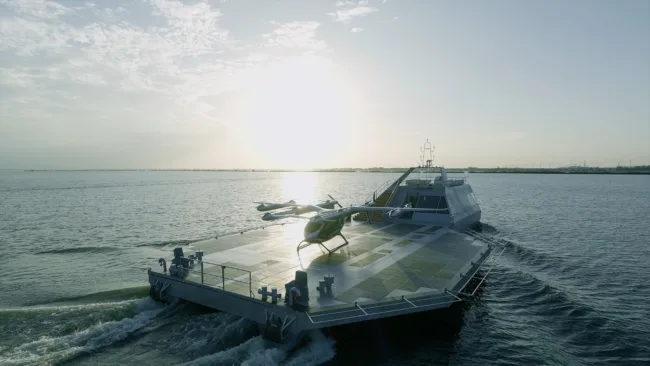
AutoFlight Aviation Technology has taken a major leap in the development of electric aviation infrastructure with the public unveiling of what it describes as the world’s first integrated water-based vertiport. Introduced at Dianshan Lake in Kunshan, China, the floating vertiport is designed for seamless electric vertical take-off and landing (eVTOL) operations across rivers, lakes, and coastal zones. This new platform, which does not require land-based construction, marks a shift in how electric air mobility infrastructure could be deployed in dense urban areas, offshore energy hubs, or tourism corridors.
The demonstration event included a live flight by AutoFlight’s two-ton-class eVTOL aircraft from the floating vertiport, followed by multi-aircraft formation flying and airdrop missions. With support from battery technology partner Contemporary Amperex Technology Co. Limited (CATL), the launch showcased a working ecosystem of aircraft, solar-powered infrastructure, and dispatch systems designed for scalable deployment in real-world conditions.
The Zero-Carbon eVTOL Water Vertiport brings together several of AutoFlight’s flagship technologies. It supports a modular landing platform, photovoltaic power generation, battery storage, intelligent dispatching, and real-time communications. It is fully compatible with AutoFlight’s key aircraft lines including the industrial-grade White Shark, the two-ton-class cargo eVTOL CarryAll, and the six-seat passenger eVTOL Prosperity. These models together form the backbone of the firm’s integrated sea–air mobility network.
What makes floating vertiports a breakthrough for regional electric aviation ecosystems?
As demand for zero-emission transport increases, city planners, energy firms, and aviation startups are under pressure to create viable infrastructure for eVTOL aircraft. However, land constraints in major cities have made the rollout of urban vertiports complicated, expensive, and politically sensitive. AutoFlight’s water-based approach circumvents these issues by repurposing existing waterways for eVTOL operations. This reduces both cost and regulatory friction, allowing cities or private operators to deploy aviation infrastructure without large-scale land development.
Floating vertiports also offer modularity and mobility. Unlike static terminals, they can be moved based on demand, environmental conditions, or mission-specific needs. For emerging economies and archipelagic regions, such as Southeast Asia or island nations in the Pacific, this flexibility could be a game-changer. By using water as a launchpad for aircraft rather than land, AutoFlight is opening a new deployment frontier for eVTOL systems.
The integration of solar panels and battery storage further supports the platform’s independence from terrestrial power grids. This makes it a viable option for emergency operations in areas affected by natural disasters or grid failures. It also enables deployment in off-grid zones such as energy platforms, isolated tourism zones, or research stations.
How does AutoFlight’s Sea–Air solution address five distinct market verticals?
AutoFlight has outlined five primary commercial and public sector use cases for its Sea–Air solution, each aligned with different geographic and sectoral needs. First, in offshore energy maintenance, the system enables rapid deployment of technicians and equipment to platforms, cutting dependence on fuel-based helicopters and boats. With the eVTOL’s lower operating costs and faster turnaround, operators can significantly reduce downtime and improve safety margins in adverse conditions.
Second, in emergency response, the vertiport allows for the combination of wide-area search with rapid aerial deployment of relief or rescue personnel. The company demonstrated live airdrop simulations during the Dianshan Lake event, highlighting the potential for time-critical missions in flooded zones or inaccessible terrains.
Third, the platform supports high-frequency commuting in urban and peri-urban areas. AutoFlight claims that its system can cut travel time from hours to minutes for regional commuters traveling across water bodies, islands, or congested metropolitan corridors. In cities like Hong Kong, Mumbai, or Istanbul, where road congestion and ferry dependence slow travel, such a system could provide meaningful relief.
Fourth, the platform serves the tourism sector by offering a premium “flight-plus” experience for high-end coastal and island destinations. With smooth boarding from floating docks, operators could create scenic air tours or point-to-point transfers to resorts, yachts, or event venues.
Fifth, the modular nature of the platform enables the formation of mobile vertiport fleets. This would allow governments or logistics providers to set up temporary aerial supply chains for large events, seasonal demand spikes, or disaster recovery operations. When integrated into a broader urban air mobility (UAM) ecosystem, such fleets could also serve as redundant nodes for mission continuity during outages or airspace restrictions.
Why is CATL’s partnership critical to AutoFlight’s energy and scalability roadmap?
AutoFlight’s decision to co-develop the vertiport with Contemporary Amperex Technology Co. Limited ensures that the platform is not just structurally modular but also energy efficient. CATL’s battery systems are known for high thermal stability, long cycle life, and support for fast charging. Embedding these into the vertiport’s solar-powered infrastructure means that aircraft turnaround times can be kept short without requiring grid-level upgrades or fuel-based backups.
The use of clean-energy battery tech aligns with policy priorities in China and across Southeast Asia, where national governments are promoting carbon neutrality in transport. The CATL battery integration also signals potential for bidirectional energy flows in the future. That could allow water-based vertiports to act as mobile battery storage units for smart cities or coastal microgrids during peak hours or emergency outages.
This partnership also addresses a significant hurdle in the eVTOL industry: energy redundancy and charging standardization. With CATL’s involvement, AutoFlight has greater flexibility in optimizing aircraft–platform interoperability, ensuring both reliability and performance even under high-throughput or emergency conditions.
What did the Dianshan Lake demonstration reveal about operational readiness and regulatory viability?
The public demonstration at Dianshan Lake was more than just a product showcase. It was a live validation of the Sea–Air ecosystem under coordinated mission parameters. The two-ton eVTOL performed vertical take-off from the floating vertiport, followed by a multi-aircraft formation flight and simulated airdrop missions. All functions were supported by the platform’s internal photovoltaic and dispatch systems, eliminating the need for external infrastructure.
This was a critical proof point not only for investors but also for regulators and public sector stakeholders. Demonstrating multi-aircraft coordination, autonomous dispatch, and emergency logistics simulations on water adds credibility to the concept’s commercial scalability. Aviation and maritime authorities evaluating next-generation transport platforms will likely use this event as a benchmark for operational testing and certification pathways.
Industry observers noted that the demonstration showcased integration across software, hardware, and energy systems in a real-world setting. This distinguishes AutoFlight from other eVTOL startups that remain at the prototype or land-bound phase of development. The ability to combine aircraft readiness with deployable infrastructure is emerging as a key differentiator in the race to scale advanced air mobility networks.
What should investors and cities expect next in AutoFlight’s global strategy?
Following the successful debut, AutoFlight is expected to target city governments, port authorities, and private infrastructure developers for pilot deployments. Coastal cities in China, the United Arab Emirates, and Southeast Asia are likely early adopters due to their regulatory agility, existing maritime logistics networks, and investment appetite for smart infrastructure.
AutoFlight may also attract interest from offshore oil and gas operators, especially those exploring carbon reduction goals and faster crew logistics. The Sea–Air system could offer a sustainable alternative to helicopter operations in the Gulf of Mexico, North Sea, or Asia-Pacific’s energy basins.
Investor sentiment around AutoFlight is likely to be influenced by future announcements regarding certifications, fleet orders, and cross-border mobility partnerships. Over the next 12 to 18 months, stakeholders will watch for signals of commercial traction, particularly in regions with significant maritime urban populations or growing eco-tourism sectors.
Analysts covering the electric aviation space have remarked that AutoFlight’s infrastructure-first strategy provides a clearer monetization path than pure aircraft manufacturing models. By owning both the airframe and the vertiport, AutoFlight can capture multiple revenue streams from hardware, operations, maintenance, and platform-as-a-service models.
The Sea–Air model also opens opportunities for broader smart city integration, including water transport digitization, data-driven dispatching, and potential links to electric ferries, drones, or even hydrogen-powered vessels. If adopted at scale, the concept could create a new category of low-altitude, low-emission maritime aviation hubs.
What are the key takeaways from AutoFlight’s zero-carbon floating eVTOL vertiport launch?
- AutoFlight Aviation Technology unveiled the world’s first floating, zero-carbon vertiport for eVTOL aircraft, powered by solar energy and battery storage.
- The launch event at Dianshan Lake featured live two-ton-class eVTOL takeoffs, formation flights, and airdrop missions, demonstrating operational readiness.
- The vertiport integrates photovoltaic charging, battery storage (via CATL), intelligent dispatch systems, and satellite communication—all deployable without land-based construction.
- AutoFlight’s Sea–Air solution targets five key sectors: offshore energy maintenance, emergency rescue, high-frequency commuter transport, sea-air tourism, and mobile vertiport networks.
- The platform is compatible with AutoFlight’s full eVTOL fleet, including the industrial-grade White Shark, cargo-focused CarryAll, and passenger-carrying Prosperity aircraft.
- By using existing waterways, cities can bypass real estate limitations and accelerate electric aviation deployment without the need for large-scale land development.
- CATL’s involvement enhances energy efficiency, fast-charging capabilities, and regulatory alignment with carbon-neutral policy goals.
- Modular design allows vertiports to be relocated or scaled on demand, supporting disaster relief, tourism, or seasonal logistics.
- Analysts believe this infrastructure-first model positions AutoFlight as a serious contender in Asia’s and the Middle East’s air mobility and smart infrastructure sectors.
- Investor focus will now shift to commercial pilots, fleet orders, certifications, and cross-border deployments over the next 12 to 18 months.
Discover more from Business-News-Today.com
Subscribe to get the latest posts sent to your email.