
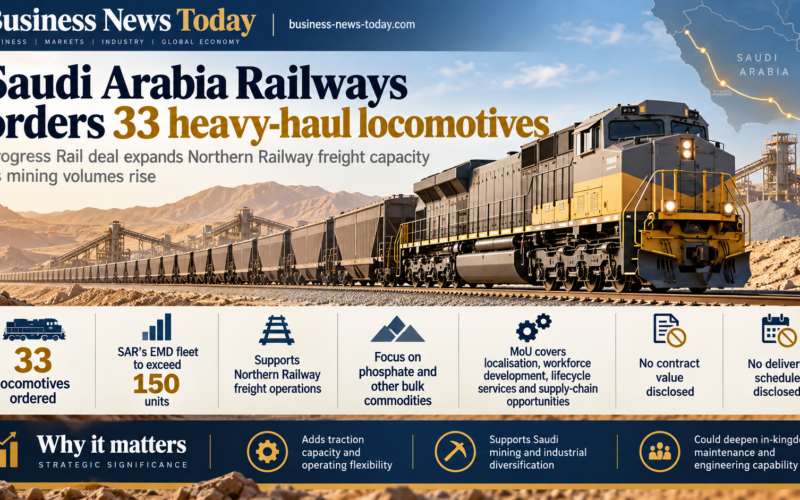
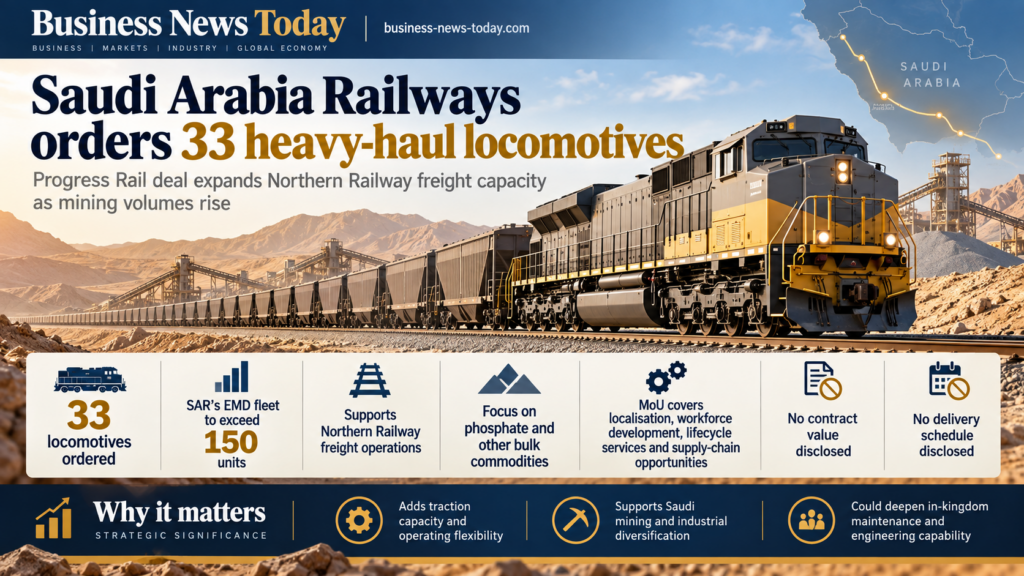
Progress Rail, a wholly owned subsidiary of Caterpillar Inc. (NYSE: CAT), has secured an order from Saudi Arabia Railways for 33 EMD SD70ACS heavy-haul locomotives, expanding one of the kingdom’s most important freight fleets as mining and industrial cargo volumes continue to grow.
The order will take Saudi Arabia Railways’ EMD locomotive fleet to more than 150 units and is specifically intended to support the Northern Railway, where freight operations include phosphate and other bulk commodities moving between mining regions and processing or export infrastructure.
Progress Rail and Saudi Arabia Railways also signed a memorandum of understanding covering localisation, workforce development, lifecycle services and supply-chain opportunities. That second agreement could prove strategically important because Saudi Arabia is increasingly seeking to capture more maintenance, engineering and industrial value inside the kingdom rather than relying entirely on imported rolling stock and overseas technical support.
No locomotive contract value or delivery schedule has been publicly disclosed. The most defensible interpretation is therefore that Saudi Arabia Railways has committed to a substantial fleet expansion while the precise revenue timing for Progress Rail and Caterpillar remains dependent on production and delivery milestones that have not yet been detailed.
Why does Saudi Arabia Railways need another 33 heavy-haul locomotives?
Saudi Arabia’s Northern Railway was developed partly to move large quantities of minerals over distances that would be expensive and inefficient to serve by road. Heavy-haul rail allows phosphate and other bulk commodities to move in long trains, reducing the number of trucks needed while providing more predictable transport capacity for mines and industrial customers.
SAR chief executive Bashar Al-Malik specifically linked the new order with expansion of phosphate transport. That matters because mining is becoming an increasingly important part of Saudi Arabia’s diversification strategy, with the government attempting to build processing and industrial activity around domestic mineral resources rather than relying overwhelmingly on hydrocarbons.
Additional locomotives give SAR more traction capacity and operating flexibility. A railway moving large bulk volumes needs spare locomotives for maintenance and disruption, so growth in fleet size can improve reliability as well as simply increase the number of trains running.
The 33-unit addition is material beside an installed EMD fleet that will exceed 150 locomotives afterward. On a simple fleet-count basis, the new order represents roughly one-fifth of the eventual EMD locomotive base, although individual locomotive utilisation and fleet composition will determine the true capacity increase.
What makes the EMD SD70ACS suitable for Saudi desert operations?
Heavy-haul locomotives operating in Saudi Arabia face extreme heat, airborne dust and sand alongside the mechanical demands created by long mineral trains. Those conditions place pressure on cooling systems, air filtration, electrical equipment and traction components.
The SD70ACS platform was designed for harsh desert environments rather than being a standard temperate-market locomotive moved into Saudi service without modification. That operating history matters because reliability losses on a heavy-haul railway can quickly affect mine logistics if one locomotive failure disrupts an entire train.
The economic case for specialised equipment becomes stronger as freight volumes grow. A locomotive with higher availability may cost more to acquire or maintain initially, but the expense can be justified if it reduces unscheduled downtime on a corridor serving high-volume industrial customers.
Saudi Arabia Railways already operates a sizeable EMD fleet, which also reduces training and maintenance complexity compared with introducing an entirely unfamiliar locomotive platform for the latest capacity expansion.
Why is the localisation memorandum potentially as important as the locomotive order?
Purchasing 33 locomotives creates immediate industrial demand, but lifecycle servicing can continue for decades after delivery. Locomotives require planned overhaul, component replacement, engine work, diagnostics and software support throughout their operating lives.
Progress Rail and SAR are exploring localisation of those capabilities inside Saudi Arabia. If implemented at scale, the arrangement could move more maintenance expenditure, spare-parts activity and technical employment into the domestic economy.
Local support can also improve fleet availability. Components and engineering expertise located closer to the railway may reduce turnaround times compared with sending major equipment overseas or waiting for international technical teams.
For Progress Rail, localisation does not necessarily reduce long-term economics. A supplier embedded inside the customer’s maintenance and technical ecosystem can generate recurring service and parts activity while strengthening its position when future fleet orders are awarded.
How does the order fit Saudi Arabia’s wider InnoTrans procurement push?
The Progress Rail agreement was only one part of a much larger procurement programme unveiled by Saudi Arabia Railways around InnoTrans 2026. SAR also signed arrangements covering 10 additional passenger trains and 782 freight wagons, while separate agreements addressed fleet maintenance, systems modernisation and technology transfer.
Those transactions indicate that the kingdom is scaling rail infrastructure across both passenger and freight businesses rather than making an isolated locomotive purchase. Additional wagons are particularly relevant to the 33-locomotive order because locomotives create limited freight capacity unless enough rolling stock is available to form larger or more frequent trains.
The procurement programme also illustrates the breadth of Saudi Arabia’s supplier strategy. SAR is working with European and US rolling-stock groups while simultaneously looking for opportunities to localise components and services.
That model allows the railway to acquire established global technology while gradually developing a deeper domestic railway industry around maintenance, manufacturing and technical capability.
Could Progress Rail gain more Saudi work beyond these 33 locomotives?
The memorandum explicitly refers to future fleet requirements and upcoming rail projects, leaving open the possibility of additional locomotive, service or component opportunities if Saudi freight demand continues expanding.
Progress Rail already has a substantial installed fleet advantage. More than 150 EMD locomotives create commonality around engines, parts, diagnostics and training, which can make switching suppliers more complicated for future heavy-haul additions.
Competition will nevertheless remain important because Saudi Arabia has shown a willingness to work with multiple international rail companies. Local-content requirements may also become more demanding as the kingdom seeks greater industrial participation from suppliers winning large infrastructure contracts.
The current order therefore gives Progress Rail both revenue and strategic positioning. The bigger opportunity will emerge if localisation develops into a permanent lifecycle-services platform and the Northern Railway continues requiring more traction as mining production and industrial freight grow.
Discover more from Business-News-Today.com
Subscribe to get the latest posts sent to your email.