



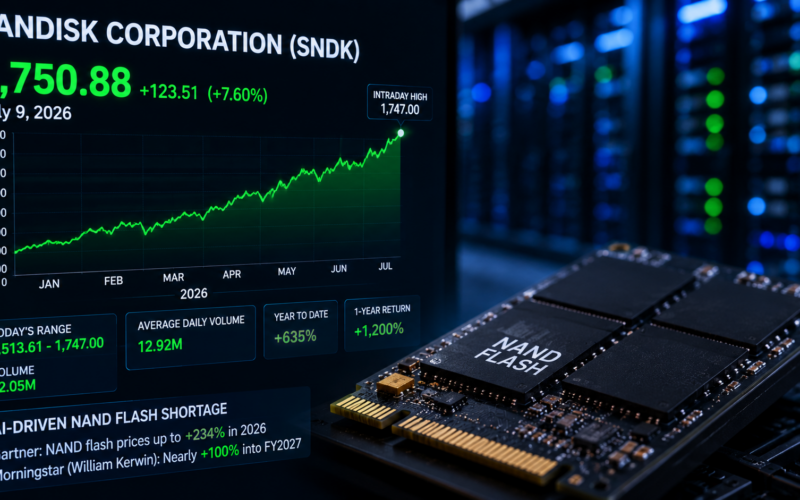
SanDisk Corporation (NASDAQ: SNDK) shares rallied approximately 7.6 percent on July 9, 2026, closing near 1,750.88 dollars after touching an intraday high of 1,747.00 dollars from a session low of 1,513.61 dollars on volume of 12.05 million shares, tracking closely with the average daily volume of 12.92 million shares. The move partly reversed a bruising week that had seen SanDisk Corporation shares tumble approximately 14 percent on July 2 amid broader semiconductor profit-taking, and it comes against the backdrop of a genuinely unprecedented year-to-date rally that has extended more than 635 percent since the start of 2026 and more than 1,200 percent over the trailing twelve months. The AI-driven NAND flash shortage has been the fundamental driver of the run, and market-consulting sources including Gartner estimate NAND flash prices could rise as much as 234 percent in 2026, with Morningstar analyst William Kerwin forecasting a further nearly 100 percent price increase into fiscal 2027, keeping SanDisk Corporation at the centre of the storage supercycle narrative.
The stock closed above the 1,700 dollar threshold for the fourth consecutive session, and the Milpitas, California-based NAND flash storage manufacturer now trades at approximately 23 to 28 times forward earnings against fiscal 2026 earnings per share growth of 551 percent, a valuation setup that has divided the sell-side sharply. The immediate market context is intensified by the scheduled July 10, 2026 Nasdaq listing of SK Hynix Inc. under the ticker SKHY through what is expected to be the largest foreign-company American Depositary Receipt offering in United States market history, raising approximately 28 to 29 billion dollars, and by SanDisk Corporation’s Q4 fiscal 2026 earnings release scheduled for August 13, 2026.
For a company that spun off from Western Digital Corporation in early 2025 at approximately 38.50 dollars per share, the current setup represents the pivotal transition from being the S&P 500’s best-performing stock of the first half of 2026 to a name that must now defend both its valuation and its scarcity premium against a genuinely new competitive dynamic.
What does SanDisk’s 7.6 percent rally actually signal about the AI NAND memory demand cycle
The Thursday rally is the market’s provisional answer to the fundamental question that had been driving intraday volatility across the memory complex through the previous fortnight, which is whether the AI NAND supercycle is materially different from prior memory cycles or whether the current price appreciation is at risk of a conventional cyclical unwinding. The rally combined a reset of profit-taking positions that had built through the previous week with fresh institutional buying by investors who see the underlying supply and demand dynamics as durable through at least 2028. Neither position is speculative, and the trading pattern of a substantial intraday recovery from the daily low of 1,513.61 dollars to a close above 1,750 dollars reflects genuine two-way institutional conviction rather than retail-driven momentum.
The composition of the AI NAND demand cycle is structurally different from any prior memory cycle in the post-2010 semiconductor era. Prior NAND flash demand was primarily driven by consumer smartphones, tablets, and consumer solid state drives, where per-unit storage requirements grew steadily but did not experience the step-change compression events that AI inference and training workloads have introduced. AI-driven enterprise storage demand requires an entirely different tier of NAND flash pricing, quality, and long-term supply commitment, and hyperscaler data centres and AI factory buildouts have been prepared to sign multi-year supply contracts at premium pricing to secure future NAND capacity. That structural demand shift is the foundation of the extended-duration pricing outlook.
The strategic implication for SanDisk Corporation is that the current commercial model is transitioning from spot pricing exposure to contracted revenue visibility across the balance of the decade. Long-term supply commitments allow SanDisk Corporation to lock in pricing at levels that support gross margins near 78.4 percent as reported in the most recent quarter, and they materially reduce the historical volatility of NAND memory earnings that had constrained sector valuation multiples in previous cycles. The 7.6 percent rally reflects both a technical reset and the fundamental market recognition that the transition from cyclical to contracted revenue is genuinely underway.

Why is the NAND flash pricing forecast of 100 percent more upside in fiscal 2027 the central thesis
The Morningstar William Kerwin forecast of nearly 100 percent additional NAND flash pricing increase in SanDisk Corporation’s fiscal 2027, following a more than 100 percent overall price increase in fiscal 2026, sits at the analytical centre of the SanDisk Corporation investment thesis. Two consecutive years of approximately doubling NAND flash prices is an extraordinary trajectory that reflects the specific supply and demand imbalance the AI-driven storage market is experiencing rather than a general memory cycle repeat. Supply capacity additions from Samsung Electronics Co., Ltd., SK Hynix Inc., Kioxia Holdings Corporation, and Micron Technology, Inc. take multiple years to bring online, and the current shortage is unlikely to ease meaningfully before 2028 when the announced capacity investments begin to deliver production.
The pricing dynamics that support this forecast have specific mechanistic drivers. AI inference workloads at hyperscale data centres require large volumes of enterprise-class NAND flash for both hot storage tiers close to compute and warm storage tiers that serve model checkpoints, embedding databases, and vector storage for retrieval-augmented generation applications. Each of these use cases carries different price and performance requirements, and the highest-value applications commanding the greatest per-terabyte revenue are precisely the applications where enterprise NAND flash is most tightly constrained. That pricing environment supports SanDisk Corporation’s ability to command premium pricing across its product portfolio.
The read-across for earnings expectations is substantial. SanDisk Corporation’s fiscal 2026 earnings per share growth of 551 percent reflects the initial pricing expansion phase, and the fiscal 2027 forecast implies a further material earnings acceleration if the pricing forecast materialises. The valuation debate on the equity is essentially a debate about how much of that fiscal 2027 earnings expansion is already priced into the current share price, and reasonable analysts differ substantially on the answer. The 20 covering analysts show a Moderate Buy consensus but with wide dispersion on price targets, and some sell-side voices have moved to Strong Sell arguing that the SK Hynix Inc. Nasdaq listing threatens the scarcity premium by approximately 70 percent from prior levels.
How does SanDisk’s $42 billion New Business Model contracted backlog reshape earnings visibility
SanDisk Corporation has publicly disclosed that its New Business Model contracted backlog now stands at approximately 42 billion dollars, comprising three long-term supply deals signed in the most recent quarter alone. That contracted backlog fundamentally reshapes the earnings visibility framework that the equity should be valued against, because it moves a substantial share of forward revenue from spot pricing exposure to contractually committed pricing under multi-year supply commitments with enterprise customers. The pricing terms embedded in the New Business Model contracts allow SanDisk Corporation to defend gross margin trajectory even against the eventual normalisation of NAND flash spot pricing that should follow the 2028 capacity additions.
The commercial architecture of the New Business Model contracts is analytically important. These arrangements are structured with hyperscale data centre operators, enterprise storage buyers, and specialty AI infrastructure customers who are committing to multi-year supply relationships in exchange for pricing predictability and supply security. The volume commitments allow SanDisk Corporation to plan manufacturing capacity, wafer allocation, and inventory management with substantially better visibility than the historic spot-market-anchored NAND flash business supported. That predictability is worth a materially higher valuation multiple than the historic sector average because it reduces the cyclical earnings volatility that has traditionally constrained memory manufacturer multiples.
The read-across for the broader memory manufacturer competitive landscape is that SanDisk Corporation is executing a strategy that Micron Technology, Inc., Samsung Electronics Co., Ltd., SK Hynix Inc., and Kioxia Holdings Corporation are all attempting to replicate but at different stages of execution. The company that establishes the largest and longest-duration contracted backlog will capture the greatest portion of the AI NAND supercycle earnings while reducing exposure to the eventual cyclical normalisation. SanDisk Corporation’s 42 billion dollar backlog is a substantial lead in that race, and management commentary at the upcoming August 13, 2026 earnings release will be critical for validating that the contracted revenue trajectory is on the trajectory that the current equity valuation implies.
Why does the SK Hynix Nasdaq listing on July 10 threaten SanDisk’s scarcity premium
SK Hynix Inc. is scheduled to begin trading on Nasdaq under the ticker SKHY on July 10, 2026 through what is expected to become the largest foreign-company American Depositary Receipt offering in United States market history, raising approximately 28 to 29 billion dollars with bookbuilding having commenced on July 6. The listing changes the structural composition of United States institutional investor exposure to AI memory in a specific and material way. Prior to July 10, United States investors seeking pure-play AI memory exposure had essentially two options at meaningful scale in Micron Technology, Inc. for DRAM and High Bandwidth Memory, and SanDisk Corporation for NAND flash. Once SKHY trades, institutional investors will have a third option that offers both HBM leadership and NAND capacity at a materially lower price-to-earnings multiple than SanDisk Corporation.
The specific threat to SanDisk Corporation’s scarcity premium is that a portion of the institutional capital that has been rotating into SNDK as the preferred NAND flash pure-play may reallocate to SKHY once the ADR listing provides equivalent liquidity and lower valuation. The Seeking Alpha analyst who published a Strong Sell on SanDisk Corporation specifically citing this dynamic estimated a probability-weighted fair value implying approximately 70 percent downside from prior levels, and the argument is analytically defensible even if the specific percentage estimate is debatable. Multiple pure-play options within a single sector typically compress the individual multiples of each option through a process of relative valuation arbitrage across the newly expanded peer set.
The commercial fundamentals do not change, however, and SanDisk Corporation retains distinct competitive advantages that SK Hynix Inc. does not directly replicate. SanDisk Corporation’s BiCS8 QLC technology roadmap, its established relationships with enterprise data centre and hyperscale customers, and the 42 billion dollar contracted backlog represent structural competitive assets that a new United States-listed peer cannot match immediately regardless of listing liquidity. The scarcity premium debate is therefore not a binary outcome but a valuation reset that could either compress the SanDisk Corporation multiple somewhat while preserving substantial value or trigger a more substantial rerating if the market perceives SKHY as a more attractive risk-adjusted memory exposure.
How does the BiCS8 technology roadmap position SanDisk within the AI memory hierarchy
The BiCS8 technology is SanDisk Corporation’s next-generation NAND flash architecture that delivers higher storage density, improved power efficiency, and enhanced performance characteristics that align specifically with AI data centre workload requirements. BiCS8 contributed approximately 15 percent of SanDisk Corporation’s bits shipped in Q1 fiscal 2026 and is expected to become the predominant production technology by the end of fiscal 2026. That technology transition is analytically important because it moves SanDisk Corporation up the value chain from commoditised NAND flash for consumer applications into higher-margin enterprise NAND flash products with sustained pricing power.
The strategic implication of the BiCS8 ramp is that SanDisk Corporation’s gross margin trajectory should be supported through the transition even as older NAND generations face potential pricing normalisation. Higher-density QLC and TLC products with BiCS8 architecture command premium pricing per gigabyte because they deliver the specific storage performance characteristics that AI inference and training workloads require, and the customer base for these products is concentrated among enterprise buyers who value long-term supply relationships and are willing to sign New Business Model contracts to secure them. That combination of premium technology, premium customer base, and contracted revenue architecture supports the equity story better than the general NAND flash pricing narrative alone.
The competitive dynamic against Samsung Electronics Co., Ltd., SK Hynix Inc., Micron Technology, Inc., and Kioxia Holdings Corporation on the technology roadmap is nuanced. Each of these peers is advancing similar next-generation NAND flash architectures with corresponding density and performance improvements, and the specific technology leadership at any given moment matters less than the aggregate pace of industry technology advancement. What differentiates SanDisk Corporation is the combination of the technology roadmap execution with the commercial infrastructure that has secured the 42 billion dollar backlog, and it is that combination rather than the technology alone that supports the current valuation trajectory.
What role do QLC and TLC innovations play in SanDisk’s move beyond traditional cold storage
The Quad Level Cell and Triple Level Cell technology roadmap represents SanDisk Corporation’s strategic pivot from being positioned primarily as a cold storage provider for enterprise archival applications toward being positioned as a higher-value provider across the full AI memory hierarchy. Cold storage applications, while a substantial market historically, deliver lower per-terabyte revenue than warm and hot storage tiers that sit closer to compute infrastructure. QLC and TLC technology enables higher-density flash products that can serve the warm storage tier requirements of AI inference workloads, model checkpoint storage, and vector database applications with pricing and margin characteristics that are substantially superior to traditional cold storage economics.
The high-bandwidth flash roadmap that SanDisk Corporation has been developing further extends the company’s positioning into applications closer to the compute layer. High-bandwidth flash products serve as tier zero storage between DRAM and traditional SSD storage, and they address the specific AI inference requirement of low-latency, high-throughput access to model weights and inference intermediate representations. This tier of the AI memory hierarchy has previously been dominated by DRAM and specialty memory products, and moving into it represents a substantial addressable market expansion for SanDisk Corporation.
The commercial implication of the QLC, TLC, and future high-bandwidth flash roadmap is that SanDisk Corporation is progressively moving its product portfolio away from commoditised NAND flash and toward specialty enterprise flash products that command premium pricing, longer contract terms, and stickier customer relationships. That evolution supports the case for extended earnings visibility beyond the current NAND supercycle and reduces the risk that the equity is valued purely on the current NAND flash pricing environment. The distinct competitive advantage that this positioning creates is difficult for SK Hynix Inc. to replicate quickly regardless of the ADR listing effect, and it is one of the structural reasons the SanDisk Corporation scarcity premium may prove more durable than the immediate SKHY listing pressure suggests.
Why is the August 13 Q4 fiscal 2026 earnings release the next binary catalyst for SNDK
The Q4 fiscal 2026 earnings release scheduled for August 13, 2026 is the single most important upcoming catalyst on the SanDisk Corporation calendar. Consensus expects strong headline numbers given the pricing environment through the quarter, but the operative variables are not the headline revenue or earnings figures themselves. They are the forward guidance for fiscal 2027, the update on the QLC BiCS8 technology transition, the status of additional New Business Model contract negotiations, and any management commentary on NAND flash average selling prices heading into the second half of calendar 2026. Each of these variables carries substantially more analytical weight than the headline earnings performance for the just-ended quarter.
The specific forward guidance detail investors will focus on includes the expected pace of BiCS8 becoming the predominant production technology, the specific contract terms and duration profile of any New Business Model additions to the backlog, the pricing trajectory embedded in guidance ranges for fiscal 2027, and the balance sheet management approach for the 1.4 billion dollar cash position and zero long-term debt profile. Any softening in the tone of forward guidance or any commentary suggesting that NAND flash average selling prices may be nearing a peak would trigger substantial share price pressure regardless of the headline results.
The competing risk is that a strong forward guidance signal validates the current valuation and supports another leg of share price appreciation. The wide dispersion in current analyst positioning, with some voices arguing for approximately 70 percent downside based on the SK Hynix Inc. listing pressure and others targeting share prices near 4,000 dollars based on the earnings trajectory, will begin to compress in the days following the August 13 release as the specific guidance detail confirms one narrative or another. The Q4 fiscal 2026 earnings release is therefore the next specific point at which the market’s divided view on SanDisk Corporation will be forced toward a more converged position.
Key takeaways on what the SanDisk story signals for NAND memory investors and AI supercycle exposure
- SanDisk Corporation shares rallied approximately 7.6 percent on July 9, 2026 to close near 1,750.88 dollars, partly reversing the previous week’s 14 percent single-day sell-off on July 2 and confirming institutional conviction in the AI NAND supercycle thesis despite recent volatility.
- SanDisk Corporation has appreciated more than 635 percent year to date in 2026 and more than 1,200 percent over the trailing twelve months, making it the best-performing S&P 500 constituent of the first half of 2026 by a margin of nearly 500 percentage points against second-place Micron Technology, Inc.
- Gartner estimates NAND flash prices could rise 234 percent in 2026, and Morningstar analyst William Kerwin forecasts a further nearly 100 percent price increase into fiscal 2027, reflecting the specific supply and demand dynamics of the AI-driven storage supercycle.
- SanDisk Corporation’s approximately 42 billion dollar New Business Model contracted backlog, comprising three long-term supply deals signed in the most recent quarter alone, materially reshapes earnings visibility by transitioning revenue from spot pricing exposure to contracted revenue with hyperscale data centre and enterprise customers.
- The SK Hynix Inc. Nasdaq listing under ticker SKHY on July 10, 2026, expected to be the largest foreign-company ADR offering in United States market history at approximately 28 to 29 billion dollars, tests the SanDisk Corporation scarcity premium by adding a third pure-play AI memory option for United States institutional investors.
- The BiCS8 QLC technology contributed approximately 15 percent of bits shipped in Q1 fiscal 2026 and is expected to become the predominant production technology by end of fiscal 2026, supporting the transition from commoditised NAND flash toward higher-margin enterprise storage products.
- SanDisk Corporation reports fiscal 2026 Q3 revenue of approximately 5.95 to 6.0 billion dollars up 251 percent year over year, gross margins of 78.4 percent, adjusted free cash flow of 448 million dollars, and a 1.4 billion dollar cash buffer with zero long-term debt.
- The 20 analysts covering SanDisk Corporation carry a Moderate Buy consensus with wide dispersion, ranging from Strong Sell ratings implying approximately 70 percent downside based on the SK Hynix Inc. listing effect to price targets near 4,000 dollars based on the earnings trajectory.
- The Q4 fiscal 2026 earnings release scheduled for August 13, 2026 will be the next binary catalyst, with investor focus on fiscal 2027 revenue guidance, BiCS8 technology transition timing, additional New Business Model contract updates, and commentary on NAND flash average selling price trajectory into the second half of calendar 2026.
- The AI NAND supercycle is unlikely to ease before 2028 as announced capacity additions from Samsung Electronics Co., Ltd., SK Hynix Inc., Kioxia Holdings Corporation, and Micron Technology, Inc. take multiple years to deliver production, supporting the extended-duration pricing outlook that underpins the SanDisk Corporation investment thesis.
Discover more from Business-News-Today.com
Subscribe to get the latest posts sent to your email.



