
Saab AB (STO: SAAB B) has received two high-value orders from Airbus Defence and Space to supply its advanced Arexis electronic warfare sensor suite for integration into the German Air Force’s Eurofighter EK fleet. The total contract value stands at approximately EUR 549 million, with deliveries scheduled between 2025 and 2028. The deal not only underscores Saab AB’s strategic role in European defence modernization but also deepens its collaboration with both Airbus and the German military establishment. As Europe strengthens its military readiness amid a volatile security landscape, the incorporation of next-generation electronic warfare systems is becoming a cornerstone of fighter jet capability upgrades.
The first order, valued at EUR 291 million, follows a previously announced agreement from March 2024 between Saab AB and Airbus Defence and Space. It formalizes the next phase of Eurofighter EK integration, focused on embedding Arexis’ suite across the electronic attack variant of the Eurofighter Typhoon. A second order, worth EUR 258 million, is currently subject to regulatory approval and introduces artificial intelligence functionality developed in partnership with Helsing GmbH, a German defence AI company. Together, these contracts reflect an intensified push toward autonomous threat detection, networked battlefield awareness, and pre-emptive signal disruption in contested electromagnetic environments.
According to Saab AB’s President and Chief Executive Officer Micael Johansson, the orders reaffirm the company’s position as a key supplier to both national and NATO-aligned fighter modernization efforts. He indicated that the Arexis suite would significantly enhance survivability and mission success for the German Eurofighter platform by providing real-time signal intelligence, jamming capabilities, and sensor fusion across a range of combat scenarios.

How will Arexis redefine Germany’s electronic attack capability on the Eurofighter platform?
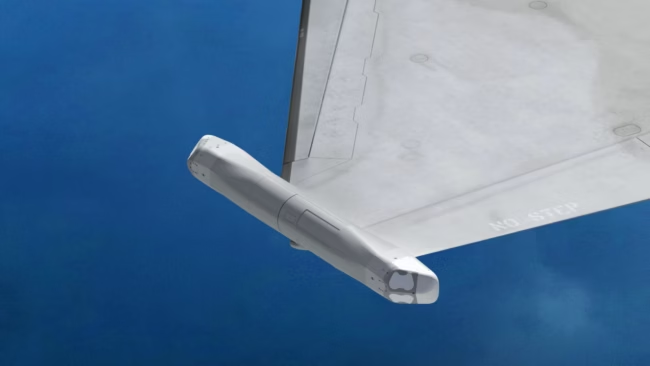
The Arexis suite is designed to serve as both a defensive shield and an offensive weapon in the electromagnetic spectrum. Its modular configuration allows for rapid integration in various forms, whether installed directly onto the aircraft, deployed via mission pods, or used in unmanned aerial vehicles. For the German Eurofighter EK, Arexis will function as the central electronic warfare system, capable of detecting, identifying, and neutralizing hostile radars and sensors through a combination of gallium nitride-based AESAs (active electronically scanned arrays), ultra-wideband digital receivers, and digital radio frequency memories.
This upgrade is expected to shift the operational role of the Eurofighter EK variant from a conventional air superiority platform to a multi-role asset capable of executing support and escort jamming missions. In dense signal environments where adversaries rely on layered anti-access and area-denial strategies, Arexis can jam and deceive advanced air defence radars, enabling allied aircraft to operate deeper into contested airspace. The system’s AI-enabled components will also help automate threat recognition, prioritize emitter threats, and adapt jamming waveforms in real time based on the electronic battlefield’s shifting dynamics.
What is the role of AI in Saab AB and Helsing GmbH’s Arexis expansion?
The second contract announced by Saab AB introduces artificial intelligence-driven enhancements to the Arexis system. Developed in conjunction with Helsing GmbH, a Berlin-based defence technology firm specializing in real-time battlefield AI, the upgrade will enable the system to autonomously interpret signals, distinguish between friend and foe emitters, and rapidly assess emerging threats. This collaboration represents a new frontier in European electronic warfare capability, where machine learning is embedded directly within mission-critical systems to reduce operator burden and speed up decision-making cycles.
Unlike traditional reactive systems that respond only after threat detection, the AI-enabled Arexis suite is designed to anticipate electronic threats based on behavior patterns and historical data. The addition of predictive signal processing improves the Eurofighter EK’s ability to suppress threats before they compromise mission parameters. Experts in the European defence sector note that such pre-emptive electronic attack capability, backed by real-time data fusion and onboard autonomy, is rapidly becoming essential in scenarios involving swarm drones, radar-guided interceptors, and multi-spectrum surveillance assets.
By linking the Arexis system with broader ISR (intelligence, surveillance, and reconnaissance) networks, the AI components also enable distributed situational awareness. Data collected by the aircraft and other nodes in the battlespace can be analyzed and shared across allied assets, expanding the system’s tactical utility far beyond the immediate platform.
Why does this deal matter for European defence alignment and industrial strategy?
This dual-order agreement strengthens Swedish-German defence ties at a critical moment in European military realignment. Sweden’s formal entry into the North Atlantic Treaty Organization in 2024 and Germany’s renewed commitment to NATO force readiness have both prompted a surge in cross-border defence programs. Saab AB’s ability to deliver advanced systems like Arexis in collaboration with Airbus Defence and Space supports Europe’s ambition to build sovereign defence technology capabilities and reduce reliance on non-European suppliers for critical battlefield systems.
Analysts believe this agreement may also serve as a template for future joint defence procurements, particularly as Germany and Sweden participate in the development of next-generation air combat systems such as the Future Combat Air System (FCAS). In that context, Saab AB’s expertise in modular, scalable electronic warfare solutions could play a foundational role in shaping how European air forces approach spectrum dominance in future conflicts.
Moreover, the contract helps Airbus Defence and Space fortify its Eurofighter offering in export markets, positioning the Arexis-equipped EK variant as a platform with increased survivability and deep strike support potential. As global demand for electronic warfare capabilities continues to grow, especially in Asia and the Middle East, the success of Arexis in Germany could catalyze further adoption among Eurofighter partner nations including Spain and Italy.
How does Arexis compare to U.S. and allied peer systems?
The Arexis suite enters a competitive landscape alongside offerings from global defence majors such as Lockheed Martin Corporation, Northrop Grumman Corporation, and Raytheon Technologies Corporation. Saab AB positions Arexis as a lightweight, modular, and scalable alternative to tightly integrated U.S. systems like the AN/ASQ-239 suite on the F-35 Lightning II. Unlike those systems, which are tailored to specific platforms, Arexis is designed with platform agnosticism in mind and can be adapted across multiple fighter types, drones, or ground-based platforms with minimal integration burden.
The inclusion of gallium nitride AESAs gives Arexis an edge in terms of high-output jamming efficiency, while its real-time signal processing engine competes with more expensive systems typically offered in U.S. export markets. The system’s modularity reduces maintenance complexity and provides operators with greater flexibility for future software upgrades, minimizing lifecycle costs. Saab AB has also emphasized that Arexis is in serial production, fully financed, and operationally validated, most notably through its deployment on the Gripen E/F fighter platform.
Defence analysts following Saab AB suggest that the Arexis program could serve as a key export differentiator for the company, especially as nations modernize legacy fighter fleets and seek cost-effective ways to integrate advanced electronic warfare functionality.
What is the institutional sentiment around Saab AB and future defence orders?
Saab AB’s shares have gained approximately 22 percent over the past twelve months, supported by a robust order book in defence aviation, naval systems, and now electronic warfare. Investor interest in the company has been rising steadily as European countries recalibrate their defence spending in response to heightened geopolitical risk and increased NATO readiness initiatives.
Institutional flows into Saab AB have picked up, particularly from Scandinavian and German defence-focused funds. Analysts expect further contract announcements in the coming quarters, particularly related to the Gripen export program, radar systems, and unmanned platform integration. The company’s emphasis on scalable, future-proof technology and its growing presence in AI-enhanced combat systems are viewed as competitive advantages in an increasingly automated defence environment.
Looking ahead, Saab AB is expected to expand the Arexis offering into additional platforms beyond the Eurofighter and Gripen ecosystems. Discussions are underway with potential partners across Asia-Pacific and the Middle East, regions where fighter modernization is accelerating but where full fifth-generation fighter procurement remains cost-prohibitive. The ability to retrofit fourth-generation platforms with next-generation EW tools could prove commercially decisive.
Key takeaways from Saab’s €549 million Arexis electronic warfare contract
- Saab AB has received two orders from Airbus Defence and Space worth a combined EUR 549 million to supply its Arexis electronic warfare suite for Germany’s Eurofighter EK fleet, with deliveries planned from 2025 to 2028.
- The first order, valued at EUR 291 million, follows a prior 2024 agreement and initiates formal integration of Arexis onto the Eurofighter platform. The second order, worth EUR 258 million, incorporates artificial intelligence enhancements co-developed with Helsing GmbH and is pending regulatory approval.
- Arexis will enable both defensive and offensive electronic warfare capabilities, offering real-time threat detection, jamming, and signal disruption using gallium nitride AESAs, digital receivers, and advanced signal processing.
- The AI-powered components will allow autonomous threat classification and proactive jamming, marking a shift from reactive to anticipatory mission execution in contested electromagnetic environments.
- The contract represents deepened Swedish-German defence cooperation and aligns with broader European efforts to enhance sovereign EW capabilities across NATO air forces.
- Arexis has already been selected for the Gripen E/F program and is in serial production, allowing for low integration complexity, faster deployment, and reduced lifecycle costs.
- Saab AB’s competitive advantage lies in Arexis’ modularity and cross-platform compatibility, which make it a viable alternative to more expensive, platform-locked U.S. EW systems.
- The deal is expected to boost Saab AB’s order book and investor sentiment, with analysts anticipating future export opportunities in Asia, the Middle East, and other NATO partner nations.
- Institutional flows into Saab AB have remained strong, with defence-focused funds increasing exposure in anticipation of additional contracts and AI-led defence innovations.
- Future roadmap indicators include further platform integration, enhanced ISR data fusion, and broader NATO deployment of Arexis-based EW capabilities beyond the Eurofighter EK.
Discover more from Business-News-Today.com
Subscribe to get the latest posts sent to your email.