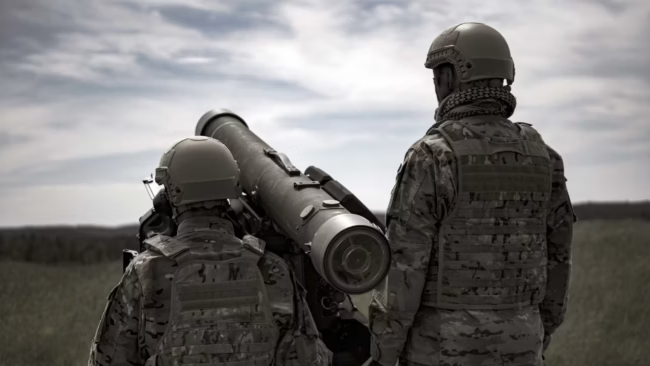
Saab AB (STO: SAAB B) has secured a SEK 3 billion order from the Lithuanian Ministry of National Defence for its RBS 70 Bolide missiles, further solidifying the Swedish defense company’s role in Europe’s front-line air defense posture. Announced December 31, 2025, the deal extends through 2032 and falls under an existing framework agreement between Saab, the Swedish Defence Materiel Administration, and Lithuania, covering Saab’s RBS 70 NG short-range air defense system.
The new order highlights both continuity and escalation. Lithuania has operated Saab’s short-range systems since 2004, but this contract represents a longer-term, volume-anchored deepening of that commitment. It also signals an alignment of NATO member procurement with a layered defense strategy where distributed, mobile, and easily integrated platforms like RBS 70 NG play a decisive role in countering low-flying threats—including cruise missiles, drones, and close air support assets.

Why Lithuania’s renewed investment in Saab’s RBS 70 missiles matters in 2026 defense planning
This order is not merely a refresh of existing inventory. The delivery timeline from 2028 through 2032 gives Lithuania a window to scale the capability in tandem with expected deployments of NATO’s broader Integrated Air and Missile Defense (IAMD) architecture across the Baltics. Given rising regional security concerns, especially following continued military exercises and infrastructure upgrades by Russia near Kaliningrad and Belarus, Lithuania is acting preemptively to ensure operational depth across its ground-based air defense grid.
The Bolide variant of the RBS 70 missile introduces significant enhancements in intercept speed and multi-target tracking, making it more effective against emerging low-observable aerial threats. Combined with Saab’s MSHORAD vehicle-based mobile solution—which Lithuania also procured in recent years—the country is building redundancy and mobility into its forward-positioned forces. This mobility is a critical differentiator in the evolving landscape of air defense, where static systems risk saturation or preemptive targeting.
Lithuania’s decision is also notable for its financial scale. A SEK 3 billion (~USD 290 million) allocation for a single category of short-range missiles indicates a substantial reweighting of procurement priorities, away from legacy systems and toward highly survivable, modular platforms. This marks a shift in how smaller NATO countries are distributing finite defense budgets: prioritizing systems that integrate into alliance-wide command-and-control networks while also offering autonomous national resilience.
How does Saab’s RBS 70 order from Lithuania reflect broader European missile defense shifts?
At a continental level, the Saab–Lithuania agreement must be seen within the broader trend of decentralized missile defense investment across NATO. Germany’s European Sky Shield Initiative (ESSI), Norway’s ramp-up of NASAMS production, and Poland’s recent deal with MBDA on CAMM-ER systems all signal a move toward distributed yet interoperable short- and medium-range systems.
In this matrix, Saab’s RBS 70 NG occupies a specific niche. Unlike radar-dependent or electronically guided solutions, it is laser-guided, unjammable, and operator-controlled—making it a critical fallback asset in environments where electronic warfare or cyber disruption is likely. That feature has gained newfound appreciation among NATO planners following Ukrainian battlefield observations, where Russia has frequently attempted to jam or spoof Western-guided systems.
Moreover, the open framework under which Lithuania placed this order—via a trilateral agreement with Sweden’s FMV—allows for future pooling, scaling, or regional joint maintenance models. This is increasingly favored by mid-sized NATO countries seeking cost-effective support ecosystems without creating logistical silos. Saab’s ability to insert into such frameworks may explain its growing presence in NATO-aligned procurement cycles despite competing with larger U.S. and Franco-Italian players.
What are the competitive implications for Saab’s defense business from this Lithuanian order?
From a business perspective, this contract gives Saab extended forward revenue visibility in its Dynamics division, which houses the RBS 70 family. With deliveries running through 2032, the deal will likely support workforce stabilization, local subcontracting, and potentially even regional co-manufacturing initiatives if pressure mounts for defense-industrial reshoring within the EU.
Importantly, the Lithuanian order creates halo effects. Saab now has fresh proof points for its short-range system’s scalability, logistical simplicity, and combat relevance. This could enhance its positioning in upcoming competitions across Eastern Europe, particularly in Romania, Bulgaria, and Slovakia, where modular air defense packages are being evaluated as part of NATO standardization and modernization efforts.
It also bolsters Saab’s arguments for RBS 70 NG’s integration into larger NATO IAMD architectures, which are increasingly emphasizing cross-domain kill chains that connect ground-based sensors and shooters to airborne early warning systems, space-based surveillance, and manned fighter platforms. A combat-proven, jamming-resistant point-defense system with plug-and-play mobility becomes an attractive node in this architecture.
Could this deepen Sweden’s defense role in the Baltic even before full NATO integration is complete?
While Sweden’s formal accession to NATO has been politically delayed, its defense-industrial integration with the alliance is accelerating. This order allows Sweden—through Saab—to play a de facto operational role in NATO deterrence via its Baltic neighbors.
The RBS 70 NG’s tactical footprint offers Sweden a platform to indirectly support Baltic defense without permanent troop stationing or base arrangements. It also lays groundwork for future joint exercises, command integration, and technology interchange. From Stockholm’s vantage point, the export is more than a commercial win—it is a strategic handshake.
This arrangement may become a prototype for Sweden’s post-accession defense diplomacy: enabling allies with interoperable tools while retaining national technological sovereignty and economic upside. If NATO’s Baltic strategy evolves toward more agile, networked, and nationally anchored layers, Saab’s RBS 70 could become the go-to short-range system across multiple member states.
What to watch next: Will Baltic states move toward pooled missile defense stockpiles?
One of the silent shifts underway in NATO’s eastern flank is the idea of pooled or rotational missile defense stockpiles. Given the small size of individual Baltic states, and their overlapping threat profiles, joint procurement, maintenance, and even training regimes are being explored. Lithuania’s expanded RBS 70 inventory may become a testbed for this model, particularly if Latvia or Estonia follow suit with similar Saab procurements under the same trilateral framework.
This would mirror developments in ammunition stockpile pooling and drone surveillance operations, where NATO has experimented with regional resource sharing to reduce per-unit costs and increase coverage density.
If successful, this procurement could push defense integration among Baltic states beyond declarations and toward shared infrastructure—quietly reinforcing NATO’s eastern deterrent without waiting for political consensus on larger defense frameworks.
What Saab’s RBS 70 missile order from Lithuania means for NATO defense posture and European missile system competition
- Saab AB has secured a SEK 3 billion order for RBS 70 Bolide missiles from Lithuania, with deliveries scheduled from 2028 through 2032.
- The contract reinforces Lithuania’s shift toward mobile, distributed air defense capabilities aligned with NATO’s evolving doctrine.
- Saab’s laser-guided, jamming-resistant system is increasingly seen as a complementary node in multi-layered air defense grids.
- The deal strengthens Saab’s visibility in upcoming short-range missile competitions in Eastern Europe.
- It reflects Sweden’s growing defense-industrial integration with NATO even as political accession remains in process.
- Lithuania’s long-term delivery horizon suggests future interoperability planning with other Baltic states may be underway.
- The contract supports Saab’s Dynamics division with forward revenue and potential EU industrial policy advantages.
- Saab’s RBS 70 NG is now positioned as both a strategic export and a geopolitical enabler in the European security architecture.
Discover more from Business-News-Today.com
Subscribe to get the latest posts sent to your email.