


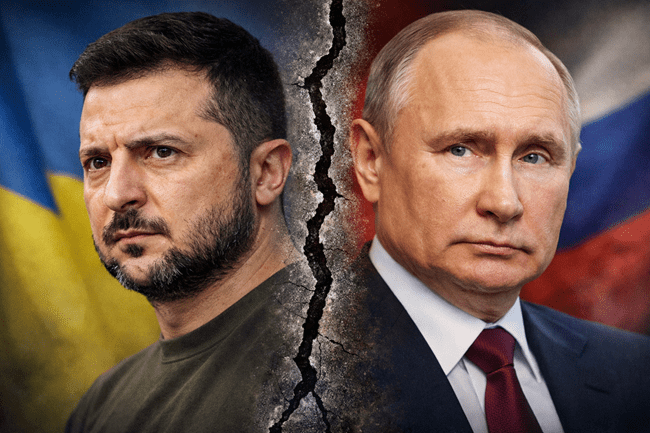
Russian President Vladimir Putin has said there is a realistic chance of reaching an agreement to end the war in Ukraine, while Ukrainian Foreign Minister Andrii Sybiha has separately described a new phase of political and diplomatic engagement, producing one of the rare occasions in recent months when both governments have simultaneously used comparatively positive language about peace prospects.
Putin told the Eastern Economic Forum in Vladivostok that the United States, China and other countries were prepared to support a settlement, although he stressed that Russia and Ukraine would ultimately have to resolve the conflict themselves. Sybiha told reporters in Kyiv that he expected a new dynamic in peace efforts as diplomatic engagement resumed across multiple capitals. Neither side identified a specific concession or negotiating breakthrough that would explain the sudden improvement in tone.
The comments come after months in which diplomacy largely stalled while Russia and Ukraine intensified long-range drone and missile attacks deep inside one another’s territory. Fighting at sea has also expanded, with attacks on ports and commercial shipping contributing to higher grain-market volatility. Chicago wheat futures dropped by more than 2% following Putin’s remarks, showing how even tentative peace signals can immediately influence commodity markets.
Why are Putin and Kyiv suddenly sounding more optimistic about peace talks?
The immediate explanation appears to be a renewed round of international diplomacy rather than evidence of an agreed negotiating framework. Putin said several countries are actively interested in helping achieve a settlement, while Sybiha pointed to a broader return of political engagement across world capitals.
The United States remains central despite being heavily occupied with the Iran conflict. Russia and Ukraine last participated in U.S.-mediated negotiations in February, after which meaningful formal talks slowed.
India is also becoming more visible diplomatically. Indian External Affairs Minister S. Jaishankar appeared alongside Sybiha in Kyiv and said New Delhi was prepared to help in any way it could, while Prime Minister Narendra Modi told Putin earlier in the week that the war needed to end and that India would support efforts toward peace.
China similarly retains influence because of its close economic relationship with Moscow and its repeated calls for negotiations.
The convergence of several diplomatic channels may therefore explain the change in language even though no one has announced a new formal peace process.
What did Putin reveal about continuing contacts between Russia and Ukraine?
Putin confirmed that contacts have continued on an ongoing basis, primarily through intelligence channels.
That admission matters because public diplomacy often creates the impression that the two governments are completely disconnected when formal talks collapse. In reality, wartime adversaries frequently maintain indirect or intelligence-level communication to handle prisoner exchanges, humanitarian issues, military deconfliction and exploratory political messages.
Such channels can become particularly valuable when leaders do not want to be seen publicly negotiating before sufficient groundwork exists.
They also allow both sides to test proposals without immediately committing political capital. A suggestion can be transmitted, rejected or modified without producing the public consequences associated with a summit or formal negotiation.
The existence of contacts therefore improves the possibility of diplomacy, but it does not prove those conversations are focused on a comprehensive peace agreement.
Why does Russia say Ukraine’s latest drone and aviation strategy makes talks harder?
Putin simultaneously tempered his positive language by accusing Ukraine of targeting civilian merchant shipping and creating threats for civilian aviation. He described those actions as state terrorism and said they complicated prospects for direct peace negotiations.
Ukraine rejects the claim that it intends to attack civilian aircraft. President Volodymyr Zelenskyy has warned airlines and insurers that Russian airspace is increasingly unsafe because Ukrainian drones are operating deep inside Russia, while insisting that Ukraine targets military facilities rather than civilian aviation.
Kyiv has also asked international aviation authorities to reconsider the safety of Russian airspace. Ukraine itself has effectively been removed from normal international civil aviation since Russia’s full-scale invasion made its skies unsafe.
The dispute is important because attacks deep inside Russia have become one of Ukraine’s main methods for imposing costs far behind the front line.
Any peace framework involving restrictions on long-range strikes would therefore require reciprocal guarantees rather than a unilateral Ukrainian pause.
Why have Ukrainian long-range drone operations become part of diplomatic bargaining?
Ukraine has dramatically expanded its ability to hit targets hundreds or even thousands of kilometres inside Russia using domestically produced unmanned aircraft.
Those operations target military airfields, fuel infrastructure, defence factories and logistics networks, creating strategic pressure on Moscow while partially compensating for Russia’s much larger conventional missile arsenal.
Zelenskyy has also revealed that Ukraine has temporarily suspended certain long-range attacks when international partners asked it to create space for diplomacy. In an earlier address, he said Kyiv paused strikes toward Moscow and St. Petersburg on August 25-27 at Washington’s request and separately honoured another request concerning the Vladivostok direction.
That detail shows that drone operations are no longer only battlefield tools. They have become bargaining assets that can be paused temporarily to support diplomatic meetings.
The problem is reciprocity. Ukraine argues that Russian attacks continued during some of those pauses, reinforcing Kyiv’s reluctance to accept unilateral limits without enforceable guarantees.
Why did wheat prices fall after Putin’s comments about a possible peace agreement?
The Russia-Ukraine war remains one of the largest geopolitical risks affecting global grain supply. Both countries are major agricultural exporters, and fighting around Black Sea ports can increase freight, insurance and shipping uncertainty.
Reuters reported that Chicago wheat futures fell more than 2% after Putin said an agreement remained possible.
The market reaction does not indicate traders believe peace is imminent. Commodity prices often respond to changes in perceived probability, meaning even a small reduction in the risk of further port disruption can move futures prices.
Recent attacks on commercial shipping have made that sensitivity particularly strong. Maritime escalation threatens not only Ukrainian exports but potentially wider Black Sea logistics.
A credible ceasefire could reduce insurance costs and improve shipping predictability. Conversely, renewed attacks would quickly restore the geopolitical premium.
What are the biggest unresolved issues still blocking a Russia–Ukraine agreement?
Territory remains the central obstacle. Russia controls substantial areas of internationally recognised Ukrainian territory and has formally claimed several occupied regions as part of the Russian Federation, while Ukraine insists its sovereignty and territorial integrity must be protected.
Security guarantees are another fundamental dispute. Kyiv wants arrangements strong enough to prevent Russia from using a ceasefire to rebuild forces and attack again, while Moscow opposes many forms of deeper Ukrainian military integration with Western states.
Sanctions and economic restrictions would also need to be addressed. Russia would seek significant relief, while Ukraine and its allies would want sanctions linked to compliance with any agreement.
Questions involving prisoners, displaced civilians, reconstruction, accountability and the status of strategic infrastructure would create additional layers of negotiation.
None of those issues has publicly moved far enough to justify describing a settlement as close.
What role could India, China and the United States play in a renewed peace process?
The three countries have different relationships with the belligerents, which may make their involvement complementary.
The United States remains Ukraine’s most influential external security partner and has the greatest ability to shape Western military assistance and sanctions.
China is Russia’s largest major economic partner and therefore has leverage in Moscow that many Western governments lack.
India maintains working relations with both Russia and Ukraine and has resisted aligning fully with either side, allowing New Delhi to present itself as a potential facilitator rather than a direct participant in the conflict.
Jaishankar’s statement in Kyiv that India is prepared to help reinforces that positioning.
The challenge is turning diplomatic access into an agreement acceptable to both sides. Mediation is useful only if Russia and Ukraine are willing to compromise on underlying issues.
What are the key takeaways from the latest Russia–Ukraine peace signals?
- Vladimir Putin said publicly on September 3 that he believes there is a chance of reaching an agreement to end the war.
- Ukrainian Foreign Minister Andrii Sybiha separately said he expects a new dynamic in peace efforts and renewed diplomatic engagement.
- Neither Moscow nor Kyiv identified a specific breakthrough explaining the more optimistic language.
- Putin confirmed that contacts between Russia and Ukraine continue, primarily through intelligence channels.
- The United States, China and India are among the countries seeking to support diplomatic efforts.
- India’s External Affairs Minister S. Jaishankar said New Delhi was prepared to help if useful.
- Putin also accused Ukraine’s maritime and long-range drone strategy of complicating negotiations.
- Chicago wheat futures fell more than 2% after the peace comments, reflecting reduced short-term concern over Black Sea disruption.
Is this the beginning of a real Ukraine peace process or another temporary diplomatic opening?
The answer remains unknowable because tone has changed faster than substance. Both governments have reasons to appear open to peace even while continuing military operations, particularly when international partners are pressing for renewed diplomacy.
What makes the September 3 comments noteworthy is the symmetry. It is unusual for Putin and senior Ukrainian officials to sound cautiously optimistic at roughly the same moment after months dominated by escalation.
The existence of ongoing intelligence-channel contacts adds credibility to the possibility that private discussions are more active than public statements reveal.
Still, no ceasefire, territorial framework or security-guarantee package has emerged. Until one of those elements changes, the war remains fundamentally where it was before the latest remarks.
This is therefore best understood as a reopening of diplomatic space rather than evidence that peace is near. The next important signal will not be another encouraging speech, but whether Russia and Ukraine agree to a formal meeting, reciprocal strike limits or another concrete measure that requires both sides to change behaviour.
Discover more from Business-News-Today.com
Subscribe to get the latest posts sent to your email.

