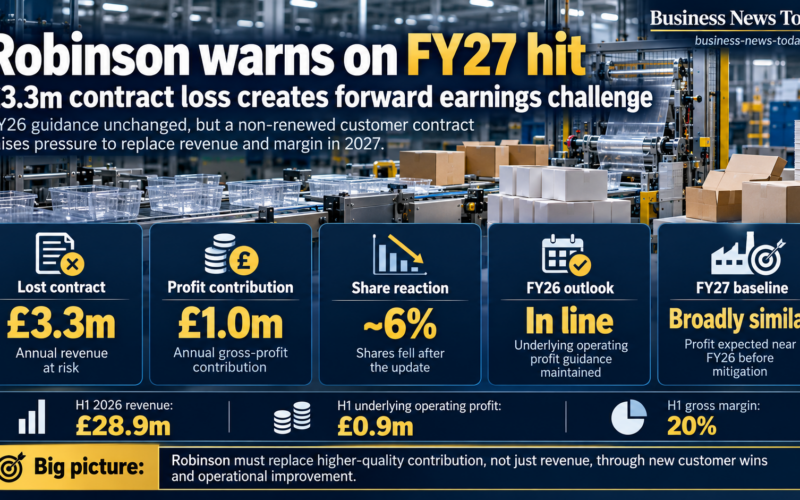
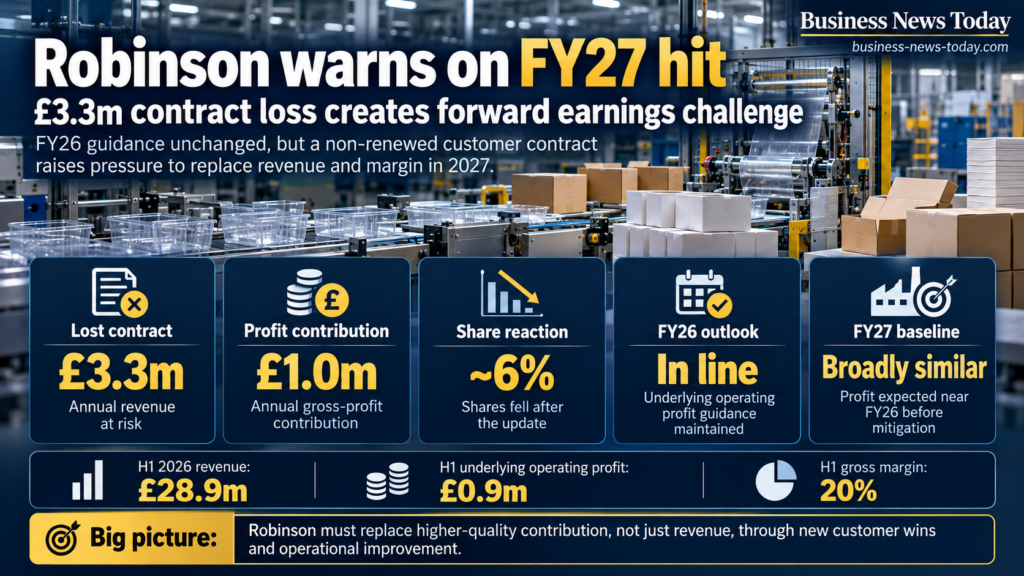
Robinson plc (AIM: RBN), a Chesterfield-based manufacturer of custom plastic and rigid paperboard packaging for food, homecare, personal-care and luxury-gift customers, has warned that a significant contract expiring at the end of December will not be renewed. The contract generates approximately £3.3 million of annual revenue and £1.0 million of annual gross-profit contribution, creating a direct FY27 earnings challenge unless Robinson replaces the business through new customer wins or operational initiatives. The company nevertheless maintained its expectation that FY26 underlying operating profit will be in line with current market expectations.
Robinson shares fell around 6% following the announcement, reflecting the fact that the contract loss affects the forward earnings base rather than the year about to end. That timing distinction is important because FY26 guidance remains intact, while FY27 profitability is now expected to be broadly similar to FY26 even before any potential mitigation from new business.
How large is the lost contract relative to Robinson’s current business?
Robinson generated £28.9 million of revenue during the first half of 2026, up 5% year on year, meaning an annual £3.3 million customer contract is economically meaningful without dominating the entire group. If first-half sales were simply annualised as a rough reference, the contract would represent around 6% of revenue. That makes the loss large enough to affect earnings forecasts while remaining potentially replaceable through a combination of new accounts and increased business with existing customers.
The £1.0 million gross-profit contribution deserves even more attention. Robinson reported first-half underlying operating profit of just £0.9 million, down from £2.0 million a year earlier as gross margin fell to 20% from 22%. A £1 million annual earnings contribution is therefore material to the current profitability base even though the revenue percentage looks manageable.
Management said Robinson will continue supplying other products to the same customer, which means the commercial relationship has not disappeared entirely. That reduces the strategic damage compared with losing the customer completely and may create future opportunities to regain work, but investors should value only the business still contracted rather than assuming lost volumes automatically return.
Why was Robinson already under margin pressure before the contract loss?
First-half revenue increased by 5% and sales volumes rose 3%, yet underlying operating profit more than halved to £0.9 million. The problem was gross margin, which declined from 22% to 20% as the company dealt with product mix, operational inefficiencies and the need to reshape its commercial and operating structures. Net debt also increased to £6.4 million from £5.4 million at the end of 2025.
That backdrop makes replacing the lost contract more difficult because management needs to restore margin quality at the same time as filling the revenue gap. Winning £3.3 million of lower-margin business would replace the sales number without necessarily replacing the £1 million contribution the company is losing.
Robinson has created new Head of Commercial and Head of Operations roles as part of its refreshed strategy, signalling that management was already trying to improve sales discipline and factory performance before the customer decision became public. The FY27 outcome will therefore provide an early test of whether those organisational changes can produce tangible new-business wins.
Why is FY27 profit expected to remain broadly flat rather than fall £1 million?
Robinson said that, excluding the benefits of mitigation actions, FY27 profitability is now expected to be broadly in line with FY26 even though the lost contract would otherwise remove approximately £1 million of underlying operating profit. That implies other factors in the existing plan are already expected to offset a meaningful portion of the contract loss, although the September statement did not quantify each component separately.
The company is pursuing operational initiatives and new business development to improve on that baseline. Investors should therefore view broadly flat profitability as the new starting point rather than management’s ultimate objective.
The strongest outcome would be replacing the contract with higher-quality work that raises utilisation without damaging margins. Robinson’s manufacturing network carries fixed costs, so incremental production can produce attractive operating leverage when new volumes fit existing equipment and capacity.
Does the share-price fall look proportionate to the contract loss?
The immediate decline of about 5.9% suggests investors applied a meaningful but not catastrophic penalty. That appears rational given FY26 guidance remains unchanged and the lost business does not begin affecting reported revenue until 2027.
The bigger issue is the quality of the FY27 earnings base. Robinson’s first-half results had already shown that revenue growth alone was not enough to produce stronger profit, so investors are likely to demand evidence of both replacement sales and margin recovery before reversing the September discount.
The stock had been trading around the high-120p to low-130p area before the update, meaning the market had not been assigning an especially aggressive growth valuation to the company. That limits the scale of expectation being removed, but it also means management needs to demonstrate that the current profitability weakness is temporary if Robinson is to achieve a substantial rerating.
What should Robinson investors watch over the next six months?
New contract wins are the clearest catalyst. Investors should compare not only their headline revenue values but also the end markets, expected margins, duration and extent to which they utilise existing factory capacity. A £1 million gross-profit gap can be repaired in several ways, but replacing it with low-return revenue would not strengthen the business.
Gross margin is equally important. The first-half decline to 20% means even modest operational improvement could make a meaningful difference to profit if volumes remain stable. Net debt also deserves attention because a weaker earnings base would make leverage less comfortable even if absolute borrowings remain modest.
The September 25 warning is therefore not primarily about FY26. Robinson has effectively given investors three months of notice that the starting line for FY27 will be weaker because a significant customer has chosen not to renew one contract. Management now has time to respond, and the share-price recovery will depend on whether it uses that time to replace contribution rather than merely revenue.
Discover more from Business-News-Today.com
Subscribe to get the latest posts sent to your email.