



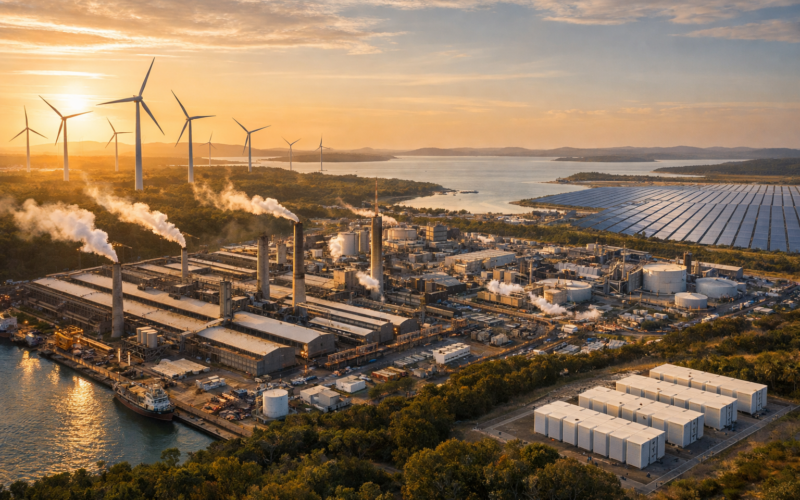
Rio Tinto (ASX/LSE/NYSE: RIO), the global diversified miner, has finalised a tripartite agreement with the Queensland Government and the Australian Commonwealth Government to secure the long-term operational future of Boyne Smelters Limited, Australia’s second-largest aluminium smelter located at Boyne Island near Gladstone in central Queensland. Under the deal, the two governments will collectively invest A$2 billion over ten years to 2040, while Rio Tinto underwrites A$7.5 billion in new Queensland renewable energy and storage infrastructure through a series of power purchase agreements, bringing the total combined investment to roughly A$9.5 billion. The arrangement, which formalises a previously signalled state-federal partnership and sits within the Commonwealth’s Future Made in Australia initiative, extends Boyne’s production mandate well beyond the expiry of its current power contract in 2029. For Rio Tinto, the deal secures one of the world’s few remaining fully integrated aluminium value chains, running from bauxite mining at Weipa through alumina refining at Gladstone to final metal production, at a moment when demand for low-carbon aluminium is accelerating with the global energy transition.
Why did the Australian government commit A$2 billion to keep Boyne Smelters operating through 2040?
The financial logic for government intervention is straightforward even if it is not entirely comfortable. Aluminium smelting is among the most electricity-intensive industrial processes in existence, consuming roughly 13 to 15 megawatt-hours per tonne of finished metal through the Hall-Heroult electrolytic process. At that scale of power dependency, the cost and terms of energy supply effectively determine whether a smelter is globally competitive or structurally unviable. Boyne Smelters Limited’s current power arrangements, built around legacy fossil fuel contracts, expire in 2029, and without a credible pathway to cost-competitive renewable power thereafter, the facility would face closure. That prospect carries a direct employment cost of approximately 3,000 jobs in the Gladstone region alone, including 1,000 at the smelter itself and another 2,000 in connected roles, alongside the broader economic activity anchored by Rio Tinto’s Weipa and Gladstone operations, which support more than 4,500 direct employees statewide.
Federal Industry Minister Tim Ayres framed the rationale in terms of leverage: for every dollar of public investment, the deal is designed to catalyse roughly four dollars of private capital in Queensland’s renewable energy grid. That 4:1 ratio, if achieved, would make the A$2 billion government outlay one of the more productive examples of industrial policy in recent Australian memory. Whether that multiplier holds in practice depends on the execution of five major renewable energy projects that Rio Tinto has contracted across Queensland since January 2024, collectively representing more than 2.8 gigawatts of generation capacity and over 600 megawatts of storage.
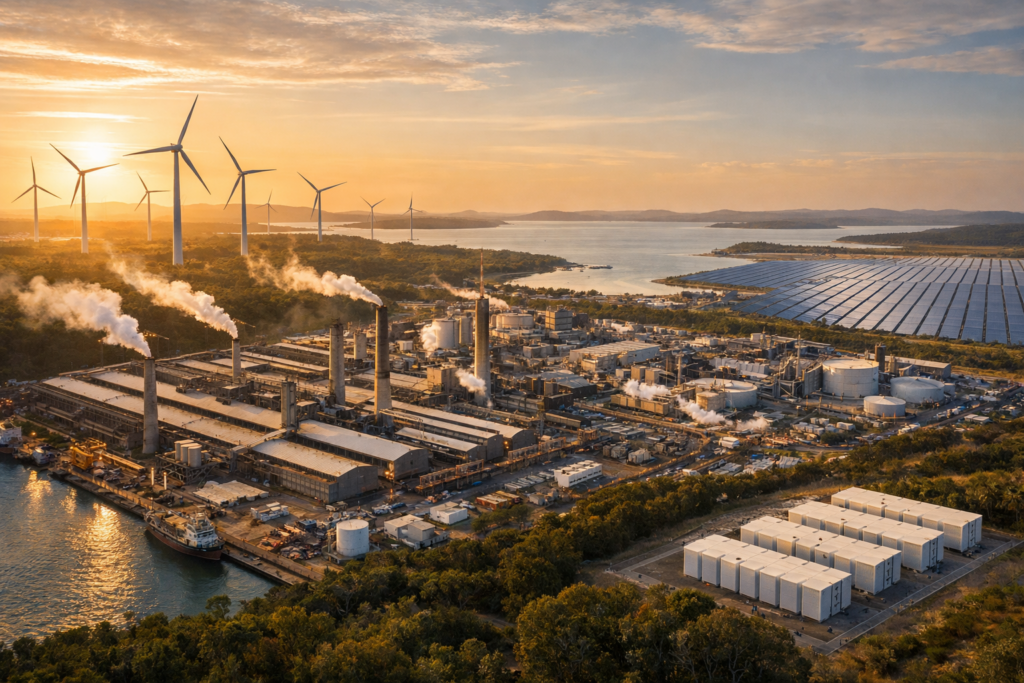
How does Rio Tinto’s 2.8GW Queensland renewables portfolio address the smelter’s baseload power challenge?
The technical challenge at the heart of this deal is not generating renewable energy. It is generating renewable energy that behaves like baseload. Aluminium smelters cannot tolerate power interruptions: the electrolytic pots that reduce alumina to aluminium metal operate continuously at temperatures exceeding 950 degrees Celsius, and any significant power disruption risks solidifying the molten bath, causing severe physical damage that can take months and hundreds of millions of dollars to repair. This constraint has historically made solar and wind power unsuitable for direct smelter supply without substantial firming capacity.
Rio Tinto’s response to this constraint is a deliberately diversified portfolio. The five contracted projects combine intermittent generation at scale with significant battery storage and geographic spread to smooth variability. The portfolio spans the 1.1 gigawatt European Energy Upper Calliope solar project, the 1.1 gigawatt Bungaban wind project, the 540 megawatt Smoky Creek and Guthrie’s Gap solar and battery facility providing 2,160 megawatt-hours of storage, and, announced alongside today’s deal, a 40% offtake of Lightsource bp’s Lower Wonga solar and battery hybrid project near Gympie delivering 112 megawatts of solar capacity and approximately three hours of associated battery storage. The combination of wind, solar, and storage across multiple Queensland sites is designed to create a portfolio effect that reduces the aggregate risk of intermittency to a level compatible with smelter-grade reliability requirements.
Whether this portfolio is genuinely sufficient to backstop continuous smelter operations remains the central execution risk in the agreement. Three hours of battery duration at the Lower Wonga facility, for instance, addresses short-cycle gaps rather than extended calm or overcast weather events. The broader portfolio includes substantial storage at Smoky Creek, but the industry benchmark for aluminium-grade power security typically requires extended firming capacity or a grid interconnection guarantee as a fallback. Rio Tinto and the Queensland Government have not yet publicly detailed the grid management protocols that will govern the transition from fossil-backed supply to the renewable portfolio between now and 2029.
What does the Boyne Smelter agreement signal about the competitive position of Australian aluminium on global markets?
The global aluminium industry is undergoing a structural reconfiguration driven by two converging forces: rising fossil fuel power costs that are eroding the competitive position of coal-backed smelters, and growing buyer demand for low-carbon aluminium from manufacturers operating in carbon-priced or carbon-regulated markets. The European Union’s Carbon Border Adjustment Mechanism is creating concrete price signals that reward low-emissions aluminium production, and automotive and aerospace supply chains are increasingly requiring carbon provenance data from their metal suppliers. Rio Tinto’s existing fleet of hydro-powered smelters in Quebec and Iceland already positions the company among the lowest-carbon primary aluminium producers globally. The Boyne deal extends that positioning to the Queensland operation, which has historically carried a heavier carbon footprint given its reliance on Queensland’s coal-dominated grid.
Commercially, the transition to solar and wind-backed power at Boyne could unlock a green premium for metal produced at the facility, particularly for customers in regulated European and North American markets. The market for low-carbon aluminium has been expanding at a compound annual growth rate of nearly 6%, and producers that can credibly demonstrate renewable provenance are increasingly able to price above commodity benchmarks. If Rio Tinto can position Boyne as a certified low-carbon facility by the time the renewable portfolio is fully operational, the commercial upside extends well beyond the cost savings on power itself.
Competitors are watching. Norwegian producer Hydro has operated hydro-powered smelters for decades and already commands a meaningful green premium. Emirates Global Aluminium is pursuing a US$4 billion greenfield smelter in Oklahoma with a renewable energy structure. In the Asia-Pacific region, the benchmark is currently defined by coal-fired Chinese production, which supplies the majority of global aluminium but faces growing carbon tariff exposure. An Australian smelter with credible renewable credentials occupies a differentiated position relative to Chinese supply for premium buyers, and that positioning could become more commercially significant as CBAM-style mechanisms proliferate globally.
What are the integration risks for Rio Tinto in transitioning Boyne Smelters to renewable energy before the 2029 power contract deadline?
The 2029 deadline is not generous. Rio Tinto’s renewable portfolio is still largely under development, with several projects yet to reach financial close or commence construction. The European Energy Upper Calliope solar project and the Bungaban wind project together represent 2.2 gigawatts, and while both have been contracted, the construction and commissioning timelines required to have them operational and grid-integrated before 2029 leave limited margin for delays. Construction delays in Queensland’s renewable sector, which has experienced supply chain pressures and grid connection bottlenecks in recent years, represent a real operational risk rather than a theoretical one.
The smelter itself also requires investment to adapt its operations to the different power quality characteristics of renewable supply. Managing voltage and frequency stability when drawing from a renewable portfolio rather than a dedicated fossil fuel plant requires grid-side and smelter-side infrastructure upgrades that are not trivial. The A$2 billion in government funding is described as supporting infrastructure upgrades and efficiency improvements alongside energy transition costs, suggesting some portion of public capital is earmarked for these technical adaptations. However, Rio Tinto has not published a detailed capital expenditure breakdown for the Boyne transition, and the extent of smelter-side modification costs remains unclear from current public disclosures.
How does the Future Made in Australia initiative frame the strategic and political calculus behind the Boyne Smelter deal?
The Future Made in Australia initiative reflects a broader policy shift in Canberra toward active industrial strategy, particularly for sectors deemed strategically significant to the energy transition. Aluminium sits at the intersection of several policy priorities: it is a critical material for electric vehicles, solar panels, grid infrastructure, and defence applications, and Australia’s integrated value chain from bauxite to metal represents a relatively rare asset in a global aluminium industry increasingly dominated by Chinese production capacity. Preserving that chain is both an economic and a strategic decision.
For the federal government, the Boyne commitment also provides a visible demonstration that industrial decarbonisation does not require the sacrifice of manufacturing employment, a politically important framing as Australia navigates the economic disruption of its energy transition. The deal gives the government a concrete example of public capital catalysing private renewable investment at scale, which supports its broader narrative around the Future Made in Australia framework. Whether this model is replicable for other energy-intensive industries, including steel, cement, and chemicals, will be closely watched by those sectors as they assess their own transition timelines and public funding prospects.
How has Rio Tinto stock performed recently and does the Boyne deal shift the investment thesis for RIO shareholders?
Rio Tinto shares on the NYSE closed at approximately US$85.84 as of 23 March 2026, pulling back from an all-time closing high of US$98.04 reached on 25 February 2026, and trading within a 52-week range of US$51.67 to US$101.53. The stock has delivered roughly 39% over the past year according to available market data, materially outperforming the broader Basic Materials sector. The one-month performance has been softer, with the stock down approximately 14% from its February peak, reflecting broader macro headwinds including concerns around tariff exposure, Middle East supply chain disruption, and Australian interest rate movements.
The Boyne deal is unlikely to move the near-term earnings needle significantly for Rio Tinto given the scale of the company’s overall operations and the long timeframe over which the A$9.5 billion in total investment is deployed. The more relevant question for institutional investors is whether the deal reduces long-term stranded asset risk in Rio Tinto’s aluminium segment and strengthens the quality of the earnings stream from that division. An aluminium smelter with a credible renewable energy structure and government-backed cost support through 2040 carries meaningfully less closure risk than one exposed to volatile fossil fuel power markets post-2029. For investors applying ESG screens or carbon risk weighting to portfolio positions, the deal is directionally positive. Argus Research maintained a Buy rating with a raised price target as recently as December 2025, and consensus positioning has been broadly constructive given Rio Tinto’s cash generation capacity and dividend yield.
What happens to the Queensland aluminium industry if the Boyne Smelter renewable transition does not proceed as planned?
The downside scenario is worth examining precisely because the deal has been structured to avoid it. If Rio Tinto’s renewable portfolio encounters significant construction delays, grid connection failures, or storage capacity shortfalls that prevent a reliable power supply for the smelter by 2029, Boyne Smelters Limited would face the choice of either reverting to market-priced fossil fuel power, accepting prolonged curtailment, or ceasing operations. Smelter closures are notoriously difficult to reverse: once a potline is shut down and the electrolytic cells are allowed to cool, restoring operations requires extensive rebuilding and can cost hundreds of millions of dollars, assuming the physical infrastructure has not degraded beyond economic repair.
The Queensland Government’s financial commitment can be read partly as a risk-sharing mechanism designed to keep Rio Tinto engaged through the transition rather than opting for an economically rational exit as fossil fuel costs escalate. Without that public backstop, a rational capital allocator might reasonably conclude that a Queensland smelter facing rising coal-backed power costs and a constrained renewable transition window represents suboptimal capital deployment relative to alternatives in hydropower-rich jurisdictions such as Quebec or Iceland. The government’s A$1 billion stake changes that calculus by reducing Rio Tinto’s net transition cost and providing a financial incentive to see the renewable programme through to completion.
Key takeaways: What Rio Tinto’s Boyne Smelter deal means for the company, its competitors, and the Australian aluminium industry
- Rio Tinto has secured Boyne Smelters Limited’s operations through at least 2040 via a A$9.5 billion combined investment involving A$2 billion in government co-funding and A$7.5 billion in Rio Tinto-underwritten renewables, eliminating the near-term closure risk that loomed beyond 2029.
- The deal preserves one of the world’s few fully integrated aluminium value chains, running from Rio Tinto’s Weipa bauxite operations through Gladstone’s Queensland Alumina Limited refinery to final metal production at Boyne Island, a supply chain structure that is operationally difficult and capital-expensive to replicate.
- With over 2.8 gigawatts of contracted Queensland renewable energy and more than 600 megawatts of storage across five projects, Rio Tinto is positioning Boyne as a candidate for low-carbon aluminium certification, which carries commercial premium potential as EU carbon border adjustment and buyer ESG requirements tighten.
- The central execution risk is timeline: multiple large-scale renewable projects must be constructed, grid-integrated, and operationally proven before Boyne’s existing power contract expires in 2029, leaving limited room for the delays that have characterised Queensland’s renewable build-out in recent years.
- The 4:1 leverage ratio cited by the federal government, A$1 of public investment per A$4 of private capital, will be the key performance metric for the Future Made in Australia initiative and could influence whether similar industrial co-investment structures are extended to steel, cement, or chemicals.
- Global competitors including Hydro, Emirates Global Aluminium, and China’s state-backed smelters are all pursuing their own energy transition strategies; Rio Tinto’s Queensland move is a defensive play to preserve existing capacity rather than a greenfield bet, which limits its upside but reduces execution risk relative to new-build alternatives.
- For RIO shareholders, the deal reduces long-term stranded asset risk in the aluminium segment and improves the quality of earnings from that division without requiring significant near-term capital outlay beyond the renewable PPA commitments already on Rio Tinto’s books.
- The political dimension is material: the Commonwealth’s backing under Future Made in Australia signals that energy-intensive manufacturing will receive active government support during the transition, which has read-across implications for other industrial sectors assessing their own decarbonisation timelines.
- Aluminium demand is structurally supported by the energy transition itself, through its use in EVs, grid infrastructure, and solar frames, meaning Boyne’s long-term market access is arguably stronger today than at any point in the smelter’s operational history since 1982.
- RIO traded near US$85.84 as of 23 March 2026, approximately 15% below its February 2026 all-time high of US$98.04, within a 52-week range of US$51.67 to US$101.53; the Boyne deal is a long-duration positive for the aluminium segment rather than a near-term catalyst, but it removes a credible downside risk from the valuation.
Discover more from Business-News-Today.com
Subscribe to get the latest posts sent to your email.


