Rheinmetall AG (XETRA: RHM) has secured a fresh order from the Bundeswehr to supply more than 2,000 military transport vehicles worth 1.015 billion euros gross, deepening its position as the logistical backbone of Germany’s armed forces. The order covers unprotected logistic vehicles in 4×4, 6×6 and 8×8 variants and forms part of a framework contract concluded in 2024 for up to 6,500 vehicles. Rheinmetall will book the award in the second quarter of 2026 through its joint venture Rheinmetall MAN Military Vehicles GmbH, with the vast majority of deliveries scheduled before the end of the year. The contract lands at an awkward moment for the stock, which is changing hands near 1,287 euros, close to its 52-week low and well below last year’s peak. For the company that became the defining trade of Europe’s rearmament cycle, the gap between a swelling order book and a deflating share price is now the central question for investors.
What does the €1.015 billion UTF order signal about Bundeswehr logistics spending in 2026?
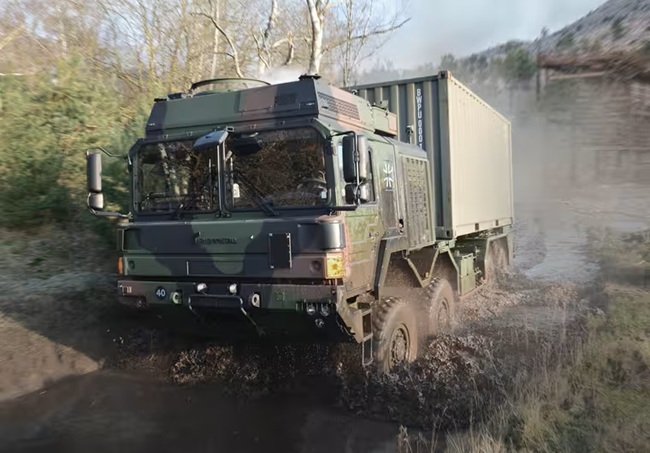
The order comprises roughly 1,000 of the heavy 8×8 vehicles and about 1,000 of the lighter 4×4 and 6×6 variants, spanning payload classes from 3.5 tonnes to 15 tonnes. This is not a glamorous category. Unprotected logistic vehicles, known in German shorthand as UTF, move fuel, ammunition, spares and supplies rather than firepower, and they rarely generate headlines the way main battle tanks or air defence systems do. That is precisely why the order matters. Sustained logistics procurement signals that Germany is funding the unglamorous backbone of force readiness, not just the marquee platforms that dominate political announcements.
The strategic reading is that Berlin is moving past the symbolic phase of rearmament and into the harder work of making its forces deployable at scale. An army that cannot move and resupply at speed is an army that exists mainly on paper, and the Bundeswehr’s logistics fleet has long been a recognised weak point. Funding 2,000 vehicles in a single tranche, with delivery compressed into a matter of months, suggests procurement urgency that goes beyond routine fleet renewal. For Rheinmetall, it also confirms that defence budgets are flowing into recurring, high-volume hardware rather than one-off prestige buys, which is the more durable revenue base.
How does the 2024 framework contract for up to 6,500 vehicles shape Rheinmetall’s backlog visibility?
The most important detail sits in the structure rather than the headline number. This 1.015 billion euro award is a call-off against a framework signed in 2024 that authorises up to 6,500 vehicles in total. That framework converts what would otherwise be episodic tendering into a pipeline Rheinmetall can plan production around, and it gives the company a multi-year claim on Bundeswehr logistics demand without needing to re-win each batch in open competition.
For an investor trying to value Rheinmetall, framework contracts are worth more than their face value because they compress procurement risk and lengthen revenue visibility. Each call-off de-risks the next. With roughly 2,000 vehicles now committed against a 6,500 ceiling, a substantial volume remains available for future tranches, which supports the argument that order intake in the vehicle systems division has further to run. The flip side is that framework ceilings are not guarantees. Future call-offs depend on continued budget appropriation, and a political shift in German fiscal priorities could leave a portion of that headroom unused. The contract reduces uncertainty rather than eliminating it.
Why is Rheinmetall MAN Military Vehicles central to the HX family standardisation strategy?
The vehicles are built on the HX family developed by Rheinmetall MAN Military Vehicles GmbH, the joint venture between Rheinmetall and MAN. Christoph Müller, chief executive officer and chairman of the board of Rheinmetall MAN Military Vehicles, framed the value proposition around standardisation, arguing that a common vehicle family delivers synergies in training, operation and maintenance across the fleet. That argument carries real commercial weight. The HX range is positioned as a military off-the-shelf platform that pairs mass-production truck technology with military-specific modifications, which lowers unit cost and shortens delivery timelines compared with bespoke military designs.
The strategic logic is lock-in. Once an armed force standardises on a single vehicle family for both protected and unprotected roles, the switching cost of moving to a rival platform becomes prohibitive, because it would fragment spare parts, retraining and maintenance ecosystems. The HX fleet is already in service across multiple militaries, and every incremental order thickens that installed base. For Rheinmetall, the logistics truck business is therefore less a commodity contract and more an annuity, with the initial platform sale opening a long tail of sustainment, spares and follow-on revenue.
What does the Bundeswehr truck order mean for Rheinmetall’s competitors in European military logistics?
The award reinforces a competitive reality that European peers are still adjusting to. Rheinmetall has spent the rearmament cycle converting Germany’s home market into a near-captive demand base, and a framework contract of this size makes it structurally harder for rivals to contest domestic logistics procurement. Competitors in the broader European defence vehicle market, including the wheeled and tactical specialists that might otherwise chase Bundeswehr volume, are effectively shut out of this tranche by the framework structure and the standardisation argument behind it.
The second-order implication reaches the wider defence sector. Peers such as Saab, Leonardo, Hensoldt, RENK and Thales operate in adjacent niches, but the logistics backbone segment is where Rheinmetall’s scale and integration with MAN’s truck manufacturing give it a moat that is difficult to replicate. Rivals seeking comparable recurring revenue will likely concentrate on segments where Rheinmetall is less entrenched, such as munitions, sensors or naval systems, rather than confronting it head on in wheeled logistics. The order is a reminder that in defence, incumbency in the unglamorous categories can be more valuable than dominance in the headline ones.
Why is Rheinmetall stock trading near its 52-week low despite a record order pipeline?
This is the contradiction that defines the current Rheinmetall story. The share has fallen roughly 32 percent over the trailing twelve months and is trading in the lower part of its 52-week range, with a 52-week span running from about 1,099 euros to 2,008 euros. The 52-week low was set in mid-May 2026, meaning the stock is near its weakest level in a year even as order intake remains robust. A billion-euro contract that would have sent the shares sharply higher in 2024 now barely registers against the broader de-rating.
The market is pricing a change in narrative rather than a change in fundamentals. The defence rally that lifted Rheinmetall to its 2,008 euro peak was built on escalation expectations, and the easing of those expectations has compressed the multiple. Reporting through 2026 has linked European defence share weakness to the path of Iran-related peace talks, with the sector sliding when de-escalation looks more likely. Rheinmetall’s last reported quarter also missed on both earnings and revenue, which dented the perfect-growth story that justified the premium. The order book and the share price are now telling different stories, and the gap reflects a market that has stopped paying peak prices for peak geopolitics.
Valuation context complicates the bear case. The average 12-month analyst price target sits near 1,889 euros, with a consensus rating skewed heavily toward buy, which implies meaningful upside if order momentum translates into delivered revenue. The risk for bulls is that the stock had priced years of growth in advance, so even strong contract news struggles to move a multiple that remains elevated on traditional measures. The investment debate is no longer whether Rheinmetall wins orders. It is whether the valuation already assumed it would.
What execution and timing risks surround delivering 2,000 vehicles before the end of 2026?
The delivery schedule is aggressive. Rheinmetall MAN Military Vehicles is set to begin handovers in the first half of 2026 with the bulk of more than 2,000 vehicles due before year-end, which compresses a large industrial program into a narrow window. Meeting that timeline depends on supply chain stability, component availability and production throughput at a moment when defence manufacturers across Europe are competing for the same inputs and skilled labour. Any slippage would push revenue recognition into later periods and could blunt the near-term earnings contribution investors expect from the Q2 booking.
The reliance on military off-the-shelf production cuts both ways as a risk factor. It lowers cost and accelerates delivery in normal conditions, but it ties military output to the same industrial base serving commercial truck demand, which can create bottlenecks if either side surges. Execution, not order intake, is the variable most likely to determine whether this contract supports or disappoints the 2026 numbers. For a stock already under pressure, a visible delivery miss would land harder than a smooth one would help.
Key takeaways on what the Bundeswehr UTF order means for Rheinmetall, its competitors, and the defence sector
- The 1.015 billion euro award is a call-off against a 2024 framework for up to 6,500 vehicles, so its real value lies in multi-year backlog visibility rather than the headline figure alone.
- Logistics vehicle procurement signals that Germany is funding deployability and readiness, not just marquee platforms, which points to a more durable revenue base for Rheinmetall.
- Framework structure de-risks future tranches but does not guarantee them, leaving roughly 4,500 vehicles of headroom dependent on continued budget appropriation.
- The HX family standardisation strategy creates customer lock-in through shared training, spares and maintenance, turning truck sales into a long-tail sustainment annuity.
- Rheinmetall’s integration with MAN gives it a logistics moat that European peers including Saab, Leonardo and Thales will struggle to contest directly.
- The stock trades near its 52-week low and down about 32 percent over twelve months, a striking divergence from order momentum.
- The de-rating reflects fading escalation premium tied to Iran peace talks and a recent earnings and revenue miss, not collapsing fundamentals.
- Analyst consensus still points to material upside, with an average target near 1,889 euros against a price around 1,287 euros.
- The compressed delivery schedule into year-end 2026 makes execution the key swing factor for near-term earnings.
- The core investor debate has shifted from whether Rheinmetall wins orders to whether the valuation already assumed it would.
Discover more from Business-News-Today.com
Subscribe to get the latest posts sent to your email.