




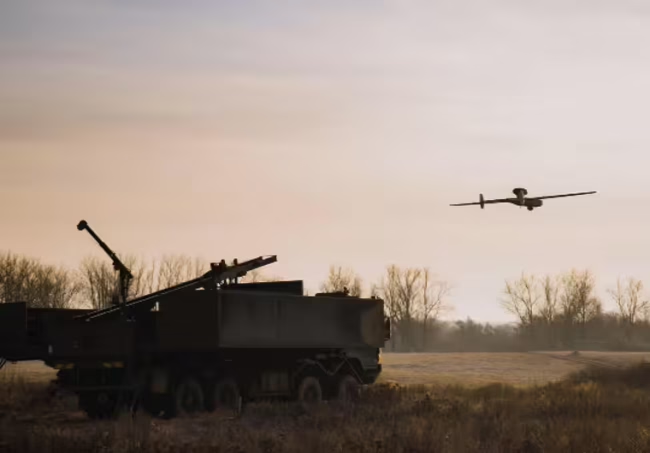
Rheinmetall AG (ETR: RHM) has successfully demonstrated its LUNA NG unmanned aerial system in a Bundeswehr-led exercise testing Germany’s next-generation reconnaissance and operational drone networks. The campaign marked a significant advancement in integrating high-altitude, long-endurance drones with loitering munitions and command-and-control systems for swarm-based combat scenarios. Strategically, the test positions Rheinmetall at the center of NATO-aligned digital battlefield transformation efforts.
How does Rheinmetall’s LUNA NG integrate into Germany’s evolving drone warfare and battlefield digitalization strategy?
The LUNA NG, a long-endurance unmanned aerial vehicle developed by Rheinmetall, was put through a rigorous test by the German Army at the Combat Training Centre in Saxony-Anhalt. Unlike traditional UAV field exercises, the Bundeswehr’s latest campaign exclusively relied on unmanned systems—both for reconnaissance and combat. The test was not only about showcasing individual system performance but also about assessing how various unmanned platforms—drones, loitering munitions, and command software—operate as a swarm.
Within the Bundeswehr, LUNA NG is designated as part of the HUSAR initiative (Highly Efficient Unmanned System for Medium-Range Reconnaissance). Its standout capabilities include a maximum flight duration exceeding 12 hours and an operational ceiling of 5,000 meters. These traits make it suitable for persistent surveillance and silent operation in high-altitude threat zones, especially where low radar signatures and real-time data relay are mission-critical.

Crucially, LUNA NG’s integration with the Bundeswehr’s Command & Control Unmanned Management System (C2-UMS Bw) enables it to operate in mesh-like networks with other autonomous or semi-autonomous systems. This interoperability is a core enabler of what the German Armed Forces call a “fully digitalized operational picture.” That means each drone or munition not only executes tasks but shares sensor data, positional awareness, and status updates across the combat system in near real-time.
During the test, Rheinmetall’s UAV demonstrated rapid adaptation to dynamic tasks, particularly in detecting, marking, and enabling coordinated counter-attacks on targets—faster than manned alternatives or earlier-generation systems. The LUNA NG also helped reduce latency between detection and engagement through live relay of sensor feeds to ground forces, confirming the viability of unmanned reconnaissance as a decisive enabler of networked firepower.
What makes this test relevant now amid NATO modernization and evolving peer threat dynamics?
The successful swarm operation of LUNA NG lands at a time when NATO forces are rapidly reconfiguring battlefield doctrine around unmanned autonomy and joint sensor–shooter loops. The Russia–Ukraine conflict has served as a catalyst for European militaries to reevaluate force posture, with drone swarms, real-time ISR (intelligence, surveillance, reconnaissance), and digital targeting now shaping procurement strategies.
Germany, in particular, is under pressure to modernize its force projection systems, both under its €100 billion military upgrade plan and in response to growing expectations from NATO to contribute scalable and interoperable combat platforms. By proving that swarm-compatible drones can detect and initiate engagement actions faster and with lower human risk, the Bundeswehr is laying the groundwork for broader unmanned systems adoption across air, land, and sea domains.
The LUNA NG test also signals Germany’s intent to reduce dependency on U.S.-supplied unmanned assets for mid-range ISR operations. Rheinmetall’s positioning in this transformation reflects a broader push by German defense contractors to secure larger domestic and EU-funded orders by aligning product capabilities with sovereignty, interoperability, and digital-first doctrines.
Could Rheinmetall’s LUNA NG become a flagship UAV export in Europe’s defense realignment?
While the LUNA NG system is currently focused on Bundeswehr integration, its performance could shape demand elsewhere—especially among NATO members seeking swarm-ready, sovereign UAV solutions. Many European militaries are actively seeking alternatives to Israeli, Turkish, or American systems, often citing constraints around political dependencies, data sharing limitations, or platform customization.
Rheinmetall’s advantage lies in its embeddedness within Germany’s defense-industrial base and its ability to comply with EU and NATO procurement standards. The firm is already engaged in multiple pan-European initiatives, and its growing suite of unmanned and digital battlefield offerings—including loitering munitions and C2 software—could give it an edge in joint tenders or bilateral supply contracts.
However, export success will hinge on demonstrating not just flight performance, but seamless plug-and-play interoperability with varied NATO and allied command frameworks. If Rheinmetall can show that LUNA NG and its C2 integrations work across defense clouds and combat networks outside Germany, it may capture demand from smaller NATO states or EU border nations seeking scalable ISR solutions under tighter budgets.
What challenges remain in scaling swarm-based unmanned systems for operational use?
While the test validated the LUNA NG’s functional capabilities, transitioning such swarm-based platforms from controlled demonstrations to operational deployments involves multiple friction points. First is the need for hardened communication and cybersecurity protocols to prevent jamming, spoofing, or command injection in live-theater operations. Second is legal and doctrinal clarity—NATO members must agree on autonomous engagement thresholds and ethical use parameters, especially for AI-assisted countermeasures.
Moreover, scaling swarm operations requires resilient digital infrastructure, real-time satellite or tactical link bandwidth, and harmonization of command standards. These are non-trivial challenges, particularly in contested or degraded communications environments.
Another open question is whether Rheinmetall can industrially scale production of LUNA NG systems and supporting hardware fast enough to meet urgent military timelines. Current geopolitical conditions are accelerating drone procurement cycles across Europe, and suppliers that cannot ramp quickly may lose market share to agile rivals from Turkey, Israel, or the United States.
Key takeaways on what this development means for Rheinmetall, its competitors, and Europe’s defense industry
- Rheinmetall AG demonstrated its LUNA NG drone in a Bundeswehr test focused on unmanned swarm reconnaissance and strike capability.
- The test validated LUNA NG’s ability to operate within the Bundeswehr’s digital C2-UMS network and interact with loitering munitions in real time.
- LUNA NG’s 12+ hour flight time and 5,000-meter altitude capacity make it well-suited for persistent, high-altitude ISR missions in NATO theaters.
- Integration with reconnaissance and operational networks cut down time-to-target cycles and showed potential for unmanned sensor–shooter loops.
- This aligns with broader NATO moves toward autonomous, mesh-networked battlefield platforms in response to lessons from the Ukraine conflict.
- Rheinmetall’s performance in the trial enhances its positioning for Bundeswehr modernization contracts under Germany’s €100 billion rearmament plan.
- The company could also benefit from European demand for sovereign, interoperable mid-range UAVs amid concerns over third-party data security and lock-in.
- Challenges include production scalability, command standard harmonization across NATO, and cybersecurity resilience in contested environments.
- Competitors like Baykar, Elbit Systems, and General Atomics will watch closely as European tenders begin to prioritize swarm-compatible systems.
- This test strengthens Rheinmetall’s visibility as a digital battlefield enabler, complementing its other roles in munitions, armored systems, and logistics.
Discover more from Business-News-Today.com
Subscribe to get the latest posts sent to your email.



