



Resolution Minerals (ASX: RML, OTCQB: RLMLF) has transformed from a multi-commodity exploration hopeful into one of the most strategically positioned critical minerals developers on the ASX, sitting on a 15,000-acre antimony, tungsten and gold project in Idaho that shares a fence line with Perpetua Resources’ A$2 billion Stibnite mine. Trading at around A$0.048 at the time of writing, the stock has surged more than 550% over the past twelve months, driven by a series of catalysts that have compounded into a genuine thesis: a new gold discovery at the Golden Gate fault zone, the acquisition of a processing mill that brings production into view, an unsolicited A$225 million takeover offer that management rejected, and a planned dual listing on NASDAQ to access US institutional capital. The next major catalyst is a Phase 2 diamond drilling program at Golden Gate set to begin in early May 2026, with a maiden JORC-compliant Mineral Resource Estimate targeted for Q1 2027.
Why the Horse Heaven project in Idaho is not just another junior antimony play chasing headlines
Most retail investors who come across RML do so through the antimony narrative, and it is a legitimate one. But the Horse Heaven project in Valley County, Idaho, is more than a single-commodity story. The project covers more than 5,644 hectares and hosts three concurrent mineral systems: antimony, tungsten and a growing gold system along the three-kilometre Golden Gate trend that the company only began drilling in 2025. The project sits directly adjacent to Perpetua Resources’ Stibnite gold mine, one of the most advanced antimony projects in the Western world, which means the same geological system that hosts a multi-billion-dollar deposit extends into ground Resolution controls 100%. That adjacency is not marketing. It is the reason Snow Lake Resources made an unsolicited A$225 million offer for the project in August 2025, which management declined on the basis that it undervalued what was in the ground.
The company’s managing director Ari Zaetz and CEO of US Operations Craig Lindsay have been explicit about the differentiation. Horse Heaven has demonstrated three commercially relevant commodities in the same footprint, which is unusual for a project at this stage. Antimony grades at Antimony Ridge, where historic wartime trenches are located, have returned average grades of 40% antimony, which is exceptional. The Golden Gate gold-tungsten system has now returned wide near-surface intercepts including 189.2 metres at 1.30 grams per tonne gold. The project is not a speculative anomaly. It is a drill-confirmed, multi-commodity system in the most strategically relevant mining jurisdiction in the United States right now.
What the Johnson Creek mill acquisition means for the path from explorer to producer
The acquisition of the Johnson Creek Tungsten and Antimony Mill, completed in March 2026, is the most operationally significant step Resolution has taken since securing Horse Heaven itself. The mill sits on approximately 25 acres of private land directly adjoining the project. It includes water rights, electrical infrastructure, workshop and accommodation facilities, and two historic tungsten ore stockpiles from the former Golden Gate Mine containing an estimated 2,000 tonnes of tungsten ore. The consideration was modest: US$1.25 million in cash plus 70 million shares and 35 million attaching options to Remington Capital Corporation, the Canadian entity that held the option over the site.
The strategic value of the acquisition exceeds the headline price by a significant margin. Private land in that region of Idaho is scarce. Having a permitted, already-infrastructured processing site adjacent to an active exploration project removes one of the highest-friction elements of moving from exploration to production in the United States. It also strengthens Resolution’s position in discussions with the US Department of Defense and potential offtake partners, both of which are actively seeking US-domiciled antimony and tungsten supply. Craig Lindsay has publicly stated that Resolution can have the United States producing antimony within twelve months, a claim that rests on the combination of high-grade historic production at Antimony Ridge and the now-secured processing capability at Johnson Creek.
How China’s export controls on antimony and tungsten have made Horse Heaven a geopolitical asset
The macro backdrop for RML is as favourable as it has been for any ASX-listed critical minerals company since the lithium boom. China announced export restrictions on antimony in August 2024 and progressively tightened them through late 2024, culminating in a December 2024 ban on antimony exports to US military users or for military purposes. The result was a collapse in Chinese antimony shipments to the United States of approximately 97% between August and December 2024, and a price surge that took antimony to an all-time high of around USD 59,750 per tonne in July 2025. As of early April 2026, the antimony price has moderated to around USD 49,100 per kilogram, still up more than 150% since the start of 2024 and structurally elevated because the supply disruption is not cyclical. It is geopolitical and potentially permanent.
China then extended export controls to tungsten in February 2025, with Resolution’s own documentation noting that tungsten prices have surged approximately fivefold over the past year to around USD 1,775 per tonne. The Centre for Strategic and International Studies has noted that the US uses antimony in more than 200 types of ammunition and that the country has no meaningful domestic production to fall back on. Washington has already committed USD 24.8 million through the Defense Production Act to help advance Perpetua’s Stibnite project, which sits on Resolution’s boundary. The logical inference for investors is that Resolution’s Horse Heaven sits in the same strategic frame. The company’s team has already been in Washington, DC, presenting the Horse Heaven project to government officials, and the NASDAQ listing is explicitly designed to accelerate access to US government funding and offtake discussions.
What does the Phase 2 drilling program at Golden Gate mean for investors watching the MRE timeline?
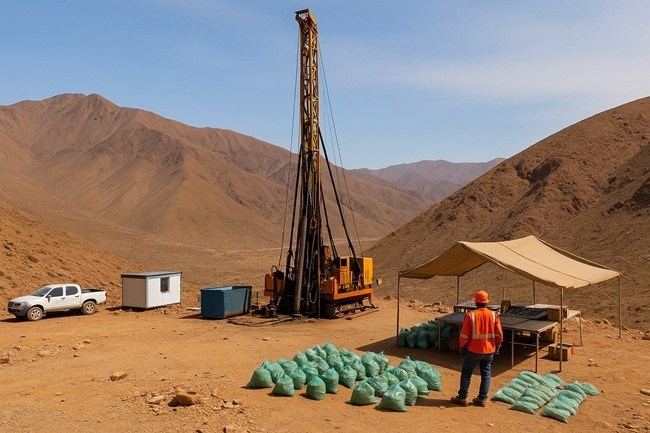
The Phase 2 drilling program is the most important near-term event for RML shareholders. It is scheduled to begin in early May 2026 and run through to mid-August 2026. The program will deploy two MP1500 diamond drill rigs across up to 45 holes for 13,700 metres, targeting both Golden Gate North and Golden Gate South, with approximately 60% of the meterage allocated to the southern area where a new discovery was announced in February 2026. The aim is to define the strike and depth extensions of the mineralised system, test whether the North and South zones are connected or offset along the Golden Gate fault zone, and advance the project toward a maiden JORC-compliant Mineral Resource Estimate targeted for Q1 2027.
The significance of this program is amplified by Phase 1 outcomes. Every one of the 14 holes drilled in 2025, totalling 3,780 metres, intersected gold mineralisation from surface and remained open at depth. That kind of continuity in a first-pass program is not common and is precisely why the company is stepping up to a near-quadruple increase in meterage for Phase 2. The company is funded for this work with approximately A$15 million in cash on hand. Investors watching the MRE timeline should understand that results from Phase 2 drilling will be released progressively through May, June, July and August, meaning there are multiple newsflow windows before the resource estimate itself lands. Each set of assay results is a potential catalyst. The question is not whether there is gold at Golden Gate. Phase 1 confirmed that. The question now is how large the system is.
How the planned NASDAQ dual listing could change the investor base and valuation framework for RML
Resolution has confidentially submitted a Form F-20 registration statement with the US Securities and Exchange Commission and has appointed ROTH Capital Partners, a US investment bank focused on growth companies, to assist with the NASDAQ listing. The company presented at the 38th Annual Roth Conference in Dana Point, California, in March 2026, which is an invitation-only event that brings together US institutional investors and growth-stage companies. The timing is deliberate. Critical minerals names with US exposure and a credible near-term production story are attracting significant institutional attention in the United States, where access to non-Chinese supply chains has become a policy and investment priority under the current administration.
The NASDAQ listing matters to existing ASX shareholders for several reasons. US institutional investors operate with larger position sizes and are more familiar with Idaho-based mining projects than Australian retail or institutional money. A dual listing creates an ADR facility that US funds can access without dealing with ASX settlement mechanics. It also brings the company into direct comparison with Perpetua Resources, which trades on NASDAQ at a market capitalisation of approximately A$2 billion. Resolution’s current market capitalisation of around A$100 million represents a fraction of that, despite sitting on the same geological system. That comparison will be front of mind for any US fund manager who reads the Horse Heaven pitch deck, and it is already being used in investor presentations. The valuation gap does not automatically close, but it becomes harder to ignore once Resolution has a NASDAQ ticker and US sell-side coverage.
What does the retail investor community make of RML and where is the conversation happening?
RML has developed a dedicated retail following on HotCopper, InvestorHub, and Twitter/X under the cashtag $RML, with significant traffic also on the OTCQB community in the United States where the stock trades as RLMLF. The conversation centres on three things: the gold discovery at Golden Gate and whether it has the scale to compete with regional peers, the antimony play and whether Washington will formalise support before Perpetua’s Stibnite mine starts producing in 2028, and the NASDAQ listing as a re-rating catalyst. The A$225 million unsolicited offer from Snow Lake Resources, which was disclosed in August 2025 and declined by the board, has become a reference point in retail discussions. At the current market capitalisation of roughly A$100 million, the stock is trading at less than half the value an external party was willing to pay months ago, before the Johnson Creek mill was acquired and before the Golden Gate South discovery was announced. That observation drives a significant portion of the bullish community sentiment.
Forum participants have also been tracking the drilling calendar closely, with interest spiking around each new permit or operational update. The company’s communication cadence has been active, with regular video updates from Craig Lindsay, presentations in Washington DC, and investor conference appearances providing a higher level of engagement than is typical for an explorer of this size. The retail thesis is not complicated: a multi-commodity critical minerals project in Idaho, adjacent to a proven deposit, with its own processing mill, funded for a major drill program, and pursuing a NASDAQ listing into a market that is actively seeking exactly this kind of asset.
What are the execution risks that investors in RML need to price into their thinking?
The risks are real and worth examining honestly. The first and most significant is the gap between current operations and actual production. Despite the positive framing around the Johnson Creek mill acquisition, the facility requires refurbishment before it can process anything. The metallurgical test work on the 2,000-tonne tungsten stockpile is still in progress. The timeline from drill results to maiden resource to permitting to production involves multiple stages where timelines can extend significantly, particularly in a US federal permitting environment that has historically moved slowly for mining projects in sensitive ecosystems. The Idaho wilderness context, while less constrained than some comparable US locations, still requires careful environmental management.
The second risk is commodity price normalisation. Antimony has pulled back from its 2025 highs, and while the structural argument for elevated prices remains intact as long as Chinese export controls hold, any relaxation of those controls, or any meaningful new supply entering from Southeast Asia, could reduce the price urgency around Western antimony development. Fastmarkets and other market analysts have flagged that the gap between Chinese domestic and international antimony prices is narrowing, which reflects some easing of the supply disruption. At A$49,100 per kilogram, the antimony price is still historically high. But the direction of travel in early 2026 is downward rather than upward.
The third risk is dilution. Resolution has been actively raising capital through placements to fund its exploration and acquisition activity, and the 70 million shares issued as part of the Johnson Creek mill deal add to a share count that has expanded significantly over the past two years. Further capital raises are likely as the company advances toward production and potentially funds a NASDAQ listing process. Shareholders should expect ongoing dilution and factor that into return calculations. The fourth risk is NASDAQ listing timing and execution. A confidential F-20 submission is not an approved listing, and US regulatory review of foreign private issuers can be protracted. If market conditions for critical minerals names deteriorate before the listing completes, the anticipated re-rating may not materialise in the expected timeframe.
Key takeaways for retail investors researching ASX:RML
- Resolution Minerals controls 100% of the Horse Heaven gold-antimony-tungsten-silver project in Idaho, directly adjacent to Perpetua Resources’ Stibnite mine, the most advanced antimony project in the Western world, with Phase 2 diamond drilling scheduled to begin in May 2026 targeting a maiden JORC resource in Q1 2027.
- The acquisition of the Johnson Creek Tungsten and Antimony Mill for approximately US$1.25 million in cash plus scrip gives the company on-site processing capability and materially strengthens its position in US government funding discussions, a genuine differentiator among ASX-listed antimony explorers.
- China’s export controls on antimony, which cut US-bound shipments by approximately 97% between August and December 2024, have made Horse Heaven a geopolitical asset and created a policy environment where Washington is actively seeking to fund and support US-domiciled antimony projects.
- An unsolicited A$225 million acquisition offer from Snow Lake Resources, received in August 2025 and declined by the board, provides a reference valuation that sits more than double the company’s current market capitalisation of around A$100 million, even after the Johnson Creek acquisition and the Golden Gate South discovery have materially upgraded the asset.
- The planned NASDAQ dual listing, with Form F-20 confidentially submitted to the SEC and ROTH Capital Partners appointed as advisers, is designed to open US institutional capital to the company and bring it into the same valuation conversation as Perpetua Resources.
- Key risks include the extended timeline from exploration to production, potential normalisation of antimony prices if Chinese export controls ease, ongoing share capital dilution, and execution risk around the NASDAQ listing process itself.
- Retail investors should monitor Phase 2 assay results released progressively from May through August 2026 as the primary near-term catalyst series, with the maiden resource estimate and any NASDAQ listing confirmation as the larger milestone events.
Discover more from Business-News-Today.com
Subscribe to get the latest posts sent to your email.