


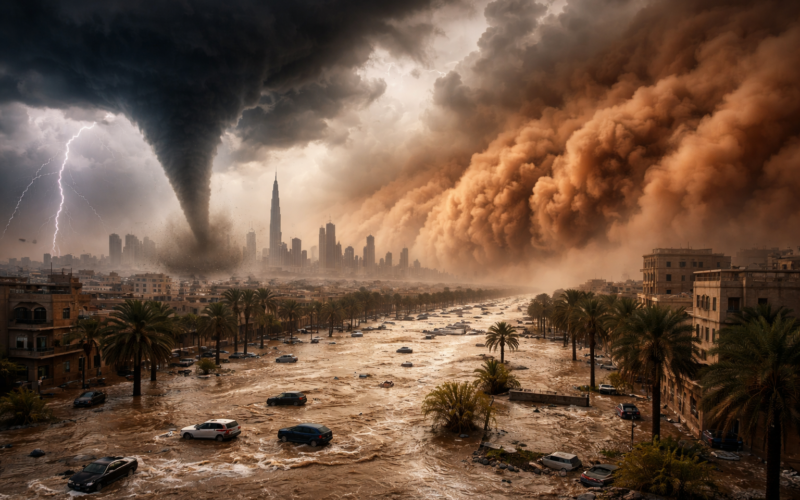
A significant and anomalous storm system is forecast to move through the Middle East during the week of 25 March 2026, bringing a multi-hazard severe weather event to a region already experiencing widespread armed conflict involving Israel, the United States, Iran, Hezbollah, and multiple Gulf states. Meteorological forecasters have projected that the storm will generate severe thunderstorms, flash flooding, haboobs or large desert dust storms, damaging winds exceeding 96 kilometres per hour, destructive hail, and the possibility of brief tornadoes across the Arabian Peninsula and Persian Gulf. The combination of hazards is characterised by forecasters as resembling a Tornado Alley-style convective setup, a configuration described as virtually unprecedented for the region.
Rain and thunderstorms are forecast to enter Israel and Lebanon on Wednesday 25 March 2026, where they are expected to remain relatively scattered. By Thursday 26 March 2026, the storm is projected to organise and intensify as it tracks southward and eastward across the region. Peak impacts are expected across Syria and further south into the Arabian Peninsula on Thursday, extending into Friday 27 March 2026. Countries within the projected impact corridor include Saudi Arabia, Qatar, Kuwait, the United Arab Emirates, Bahrain, and Iran, all of which are simultaneously subject to active missile and drone exchanges stemming from the broader regional military conflict that began on 28 February 2026.
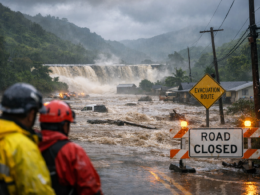
Forecasters have identified the threat of widespread flooding rainfall across desert areas that are largely unequipped to manage rapid runoff. Some locations could receive rainfall totals of three to six inches over three days, an amount approaching or exceeding annual averages for several Gulf cities. Dubai, which typically receives approximately 79 millimetres or 3.12 inches of rainfall per year according to the World Meteorological Organization, could receive between three and six inches by the end of the week. A comparable rainfall event in April 2024 deposited approximately 163.8 millimetres at Dubai International Airport in a single event, forcing the cancellation of more than 1,200 flights and leaving airport runways submerged. Forecasters assessing the current system have characterised the atmospheric profile as more organised and energetically intense than that 2024 event.
Why is a Tornado Alley-style storm system so unusual for the Middle East and Arabian Peninsula?
Severe convective weather events of the kind forecast for 26 March 2026 are exceptionally rare across the Middle East and Arabian Peninsula. The atmospheric ingredients required for tornado and supercell thunderstorm formation, including high convective available potential energy, strong directional wind shear, and sufficient low-level moisture, rarely align simultaneously across the Arabian Gulf. The region sits within a subtropical high-pressure belt for much of the year, suppressing organised storm development. While March is among the more meteorologically active months in the Levant, parts of Iraq, and northern Iran, where Mediterranean weather systems occasionally intrude, organised severe weather outbreaks involving tornado risk in the central and southern Arabian Peninsula have no strong historical precedent.
The atmospheric setup responsible for the exceptional severity of the 26 March 2026 storm involves the simultaneous presence of several factors that are individually uncommon in the region and collectively rare. Anomalously warm and moist air advected northward from the Arabian Sea has built high convective available potential energy across the Arabian Peninsula. Strong directional and speed shear in the mid and upper levels of the atmosphere, driven by a deep upper-level trough originating over the Mediterranean, provides the rotational forcing necessary to organise convection into severe thunderstorm cells capable of producing damaging winds, large hail, and tornado circulations.
The greatest tornado risk is concentrated along southwestern Saudi Arabia near the Red Sea, where enhanced low-level moisture from the Red Sea and Gulf of Aden increases both atmospheric instability and the potential for discrete supercell development. Provinces including Makkah, Al-Baha, Aseer, and Jazan in Saudi Arabia fall within this elevated risk zone, along with northwestern portions of Yemen’s Tamah and Azal governorates. Across the broader Arabian Peninsula and Persian Gulf, including Dubai in the United Arab Emirates, northern Oman, Qatar, Bahrain, and Kuwait, the primary hazards are severe thunderstorm winds, destructive hail, and flash flooding, though brief rotation cannot be excluded. Haboobs driven by outflow boundaries from severe thunderstorm clusters crossing desert terrain add a distinct visibility and air quality hazard throughout Thursday and into Friday.
How does active armed conflict across the Middle East in March 2026 complicate the civilian impact of a severe weather emergency?
The arrival of the storm coincides with a major multi-front armed conflict that has inflicted direct damage on civilian infrastructure, aviation networks, and energy facilities across virtually every country in the storm’s projected path. The joint United States and Israeli military campaign against Iran, which commenced on 28 February 2026 with the death of Iranian Supreme Leader Ali Khamenei, triggered Iranian retaliatory strikes across all six Gulf Cooperation Council countries. As of early March 2026, Iran had launched more than 2,000 missiles and drones at United States military installations and national infrastructure across Bahrain, Kuwait, Oman, Qatar, Saudi Arabia, and the United Arab Emirates, damaging energy facilities, civilian airports, seaports, and residential districts.
Dubai International Airport has been operating at reduced capacity following an earlier drone strike that caused temporary flight suspension, emergency evacuation, and minor structural damage. Qatar’s Ras Laffan industrial complex, the primary global source of Qatari liquefied natural gas and the backbone of approximately 12 to 14 percent of European liquefied natural gas supply, has sustained significant damage. QatarEnergy declared force majeure on gas contracts on 4 March 2026. Kuwait’s Mina al-Ahmadi refinery has been struck multiple times. Road and drainage infrastructure across the Gulf has not been reinforced or maintained under the wartime operational environment now prevailing across the region. The approaching storm’s flash flooding, sustained winds, hail, and haboobs will impose additional stress on infrastructure that is already impaired by military damage.
In Lebanon, where Israel has conducted more than 250 airstrikes since Hezbollah entered the conflict on 2 March 2026, the humanitarian situation is particularly severe. At least 1,001 people have been killed in Lebanon, including at least 118 children, according to Lebanon’s Ministry of Public Health. Approximately one million people have been displaced, representing 20 percent of the Lebanese population. Syrian refugees in Lebanon totalled approximately 1.4 million people as of March 2026, many living in informal settlements with minimal protection from either military activity or severe weather. Thunderstorms and flash flooding are forecast to move through Lebanon on 25 and 26 March 2026, imposing immediate physical risk on displaced and refugee populations concentrated in areas that have already sustained extensive infrastructure damage from Israeli airstrikes targeting Hezbollah facilities in southern Lebanon and the Beirut suburbs.
What is the strategic and economic significance of the Gulf states now simultaneously facing military strikes and catastrophic flooding risk?
The Gulf Cooperation Council states constitute some of the most economically significant transit and energy-producing territories in the global economy. The Strait of Hormuz, passing between Iranian and Omani territorial waters, handles approximately 20 million barrels of oil per day under normal conditions, representing roughly 20 percent of global seaborne oil trade. As of March 2026, the Strait of Hormuz remains effectively closed to most commercial shipping following Iranian threats and a suspension of Gulf shipping insurance. Brent crude oil was trading above 112 dollars per barrel as a direct consequence of the closure and infrastructure disruptions. The compound disruption of military conflict and severe weather arriving simultaneously across this geography represents a scenario with few historical analogues in terms of energy market exposure.
Dubai functions as a global financial, aviation, and logistics hub of singular importance, handling approximately 15 percent of the world’s gold trade and processing remittances for migrant worker populations across South Asia, Southeast Asia, and sub-Saharan Africa. Total commercial bank deposits across the Gulf Cooperation Council reached approximately 2.3 trillion dollars in recent years, with significant nonresident holdings concentrated in Qatar and the United Arab Emirates. The United Arab Emirates Ministry of Foreign Affairs characterised Iranian strikes on the country’s territory as terrorist attacks. Sultan Al Jaber, the chief executive of the Abu Dhabi National Oil Company, described the targeting of energy infrastructure across the region as global economic warfare. The arrival of a severe weather system with the potential to cause widespread urban flooding, close Dubai International Airport, and disrupt road networks across an already militarily stressed Gulf economy compounds the humanitarian and economic risks substantially.
How have international institutions and governments responded to the converging emergencies of conflict and severe weather affecting the Middle East in March 2026?
The United States State Department has issued a Depart Now advisory covering 16 countries across the Middle East, including Bahrain, Egypt, Iran, Iraq, Israel, the occupied West Bank and Gaza, Jordan, Kuwait, Lebanon, Oman, Qatar, Saudi Arabia, Syria, the United Arab Emirates, and Yemen. Iraq has been classified at Level 4, the highest United States State Department risk designation. The State Department has ordered the departure of non-emergency personnel and family members from Kuwait, Bahrain, Iraq, Qatar, Jordan, and the United Arab Emirates. The United States Embassy in Beirut remains operational under heightened security conditions with emergency consular services maintained on a constrained basis. Consular services at the United States Embassy in Riyadh and consulates across Saudi Arabia were suspended as of 23 March 2026.
The United Nations Human Rights Council convened an urgent meeting to address the civilian impact of Iranian strikes on Gulf states, reflecting the scale of the humanitarian emergency already underway before the weather system’s arrival. The United States announced a five-day pause on strikes against Iranian power plants and energy infrastructure, citing productive negotiations, but Iran’s Foreign Ministry denied that any direct talks were underway, characterising the announcement as an effort to reduce energy prices. Israel confirmed that its own operations against Iran and Lebanon would continue independently of any United States pause. The United Kingdom, France, and Germany issued a joint statement condemning Iranian counter-strikes and calling for a resumption of diplomacy, with the United Kingdom government indicating it was not participating militarily in the strikes on Iran.
Bahrain has circulated a draft United Nations Security Council resolution seeking to authorise all necessary means to restore freedom of navigation in and around the Strait of Hormuz. Qatar, despite having sustained Iranian missile strikes on its territory, remains a key diplomatic intermediary. Qatar’s Emir Sheikh Tamim bin Hamad Al Thani had lobbied Washington extensively not to use Gulf bases for operations against Iran prior to the conflict’s commencement. Qatar and Oman’s status as diplomatic mediators between Tehran and Washington has not insulated either country from Iranian strikes. The compound exposure of these diplomatically active neutral states to both military and meteorological hazard in the same week reflects the degree to which the current crisis has overrun the normal boundaries of Gulf regional management.
Iran’s head of the Iranian Red Crescent Society has stated that more than 18,000 civilians have been injured in Iran and tens of thousands of civilian structures damaged since United States and Israeli airstrikes began. The United Nations has estimated the civilian death toll in Iran alone at 550 since fighting began, while Lebanon’s Ministry of Public Health reports more than 1,001 killed in Lebanon. Against this backdrop of active and escalating military casualties, the approaching storm system introduces an additional and compounding layer of civilian risk across a region whose emergency management capacity has been severely degraded by weeks of sustained conflict. Meteorological agencies and civil emergency authorities in the Gulf states have advised residents to monitor official weather briefings, secure outdoor objects and vulnerable structures, prepare emergency supplies, and maintain access to elevated areas in flood-prone zones.
Key takeaways on what this development means for the countries, institutions, and global context involved
- A rare Tornado Alley-style storm system is forecast to strike the Arabian Peninsula and Persian Gulf on 26 March 2026, bringing severe thunderstorms, flash flooding of three to six inches, haboobs, destructive hail, damaging winds exceeding 96 kilometres per hour, and isolated tornado risk across Saudi Arabia, Qatar, Kuwait, the United Arab Emirates, Bahrain, and Iran — countries simultaneously engaged in or directly affected by active armed conflict.
- The storm arrives as Dubai International Airport operates at reduced capacity following earlier drone damage, Qatar’s Ras Laffan liquefied natural gas complex has been struck and declared force majeure, and the Strait of Hormuz remains effectively closed to most commercial shipping, compounding the economic and logistical disruption across the Gulf at a moment of peak regional instability.
- In Lebanon, where more than one million people are displaced by Israeli military operations and approximately 1.4 million Syrian refugees are present, the storm’s arrival on 25 to 26 March 2026 imposes immediate flash flooding and wind risk on civilian and displaced populations already living in conflict-damaged environments with severely degraded infrastructure.
- The United States State Department’s Depart Now advisory covers 16 Middle Eastern countries spanning the storm’s entire projected path; embassy and consular operations across Beirut, Riyadh, Manama, and Doha are operating under heightened security or suspended routine services, reducing the formal support available to civilian populations during the compound emergency.
- The convergence of a historically anomalous severe weather event with an active regional war affecting all six Gulf Cooperation Council states, Lebanon, Iran, and Israel simultaneously has no strong modern historical precedent and represents a multi-hazard scenario with significant implications for global energy supply, aviation connectivity, humanitarian access, and emergency response capacity across the region.
Discover more from Business-News-Today.com
Subscribe to get the latest posts sent to your email.