



Why did Stellantis decide to stop development of the all-electric Ram 1500 pickup in 2025?
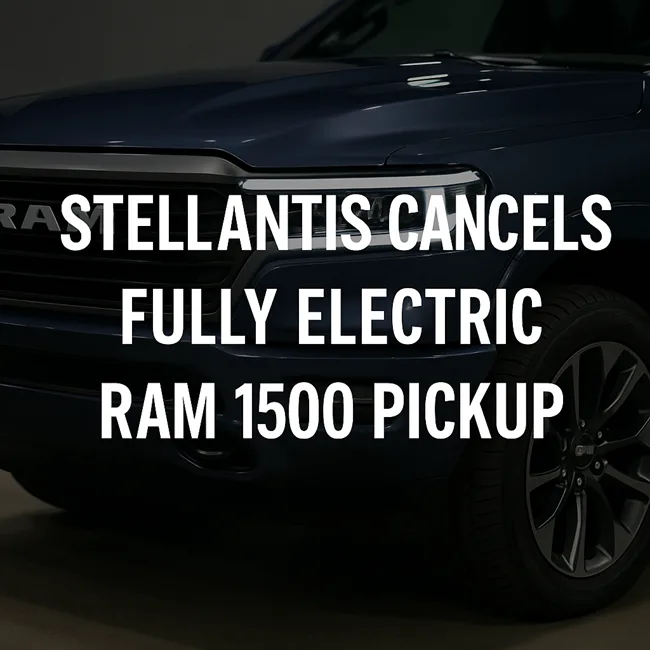
Stellantis has confirmed that it is ending development of its fully electric Ram 1500 pickup, marking one of the clearest signs yet that the mass-market push for battery-powered trucks has lost steam. The decision, announced on September 12, 2025, represents a major pivot in strategy for the automaker’s Ram brand, which had previously marketed the Ram 1500 REV as a cornerstone of its U.S. electrification roadmap. Company executives acknowledged that the full battery version was no longer commercially viable in the face of softer demand and rising customer skepticism about long-range performance under heavy duty cycles.
The announcement effectively halts the rollout of the Ram 1500 BEV, which had been in development since Stellantis unveiled early prototypes in 2023. While the company had promised to deliver a competitive electric truck with up to 500 miles of range, changing market dynamics have led Stellantis to retreat from a segment once thought to be a battleground for U.S. automakers. Instead, the company is shifting its focus toward hybrid and extended-range variants that it believes will better align with buyer expectations in North America.
What challenges did Stellantis face with the electric Ram 1500 compared to rivals like Ford and Tesla?
The electric pickup market was never an easy arena, even for established players. Ford’s F-150 Lightning and Tesla’s Cybertruck both generated early excitement but have since faced slower-than-expected adoption. Rivian’s R1T also appealed to early adopters but struggled to scale production profitably. Stellantis found itself entering this competitive landscape late, without the same first-mover advantage or loyal EV community. Consumer hesitation around towing capacity, charging times, and the real-world reliability of heavy electric pickups created headwinds that no amount of advertising could easily overcome.
Beyond consumer hesitation, Stellantis also encountered the economics of EV truck production. Large battery packs pushed vehicle costs well above gasoline or hybrid versions, and the company struggled to make a compelling business case for a model that risked pricing out its traditional Ram buyer base. With U.S. EV tax credits phasing out for higher-income buyers and charging infrastructure gaps still evident across rural markets, the calculus turned against a full battery Ram. Unlike compact crossovers, which can be sold in larger volumes with smaller batteries, a truck of this size required immense investment with uncertain returns.
How is Stellantis repurposing the Ram 1500 REV brand after shelving the BEV model?
Rather than abandoning the EV push entirely, Stellantis is redirecting its resources toward a range-extended electric pickup previously branded as the Ramcharger. The company has now reassigned the Ram 1500 REV nameplate to this hybridized model, which combines an electric drivetrain with an onboard gasoline engine that acts as a generator. This approach offers electric-only range for daily use while providing long-distance flexibility when towing or traveling away from charging infrastructure.
The rebranded Ram 1500 REV will therefore not be a pure BEV, but Stellantis hopes it will strike a balance between emissions reduction and utility. For customers who still want to experiment with electric driving but fear running out of power in demanding conditions, the range-extended option could prove attractive. Analysts view this as a more pragmatic compromise that mirrors consumer adoption trends, where plug-in hybrids continue to outsell full battery vehicles in many segments.
What does this reveal about the broader slowdown in U.S. electric pickup adoption?
The Stellantis move highlights a broader reality in the U.S. auto market: full-size electric pickups remain a niche rather than a mainstream choice. While Tesla and Ford both pushed hard to prove that the segment could transform, sales figures have lagged far behind projections. The International Energy Agency has observed that while global EV sales overall continue to grow, the North American pickup segment remains an outlier due to higher energy requirements, heavier usage demands, and less dense charging networks in suburban and rural areas.
Infrastructure remains a particularly stubborn barrier. Pickup owners, unlike sedan drivers, are more likely to haul equipment, tow trailers, or drive long distances away from urban charging hubs. Until fast-charging networks capable of supporting high-capacity batteries are built at scale, adoption of BEV trucks is likely to remain limited. Stellantis’ decision therefore aligns with consumer patterns rather than trying to force a transition that is not yet supported by infrastructure.
How are investors and analysts reacting to Stellantis’ cancellation of the BEV Ram 1500?
Investor sentiment is mixed but leaning toward cautious approval. Stellantis (STLAM) shares have not shown dramatic volatility since the announcement, suggesting that markets may have already priced in a more conservative EV rollout from the company. Some analysts argue that abandoning a capital-intensive project could free resources for more profitable initiatives, particularly as Stellantis works to maintain dividends and reduce debt. Others caution that the move risks positioning Stellantis as a laggard in electrification compared to General Motors and Ford, who continue to at least maintain their BEV truck strategies despite slower sales.
For institutional investors, the key question is whether Stellantis can generate sufficient margins on its extended-range and hybrid models. If the renamed Ram 1500 REV can achieve strong sales while reducing R&D overhead, the shift could be framed as disciplined strategy rather than retreat. However, should consumer adoption of BEV trucks accelerate again — for instance, if battery breakthroughs dramatically lower costs or if new U.S. charging infrastructure investments prove transformative — Stellantis may find itself scrambling to reenter a space it just abandoned.
What does this pivot mean for the long-term electrification roadmap of Stellantis?
Stellantis has repeatedly stressed its commitment to electrification as part of its Dare Forward 2030 strategy, which calls for 100 percent of passenger car sales in Europe and 50 percent of sales in the United States to be electric by the end of the decade. The discontinuation of the Ram 1500 BEV does not undo this ambition but does highlight a willingness to adapt to consumer realities. By focusing on plug-in hybrids and range-extended designs, Stellantis is buying time while waiting for battery density improvements and cost reductions.
Industry experts believe this is a pragmatic step, though it risks sending a confusing message. On one hand, Stellantis continues to release electric crossovers and compact SUVs under brands like Jeep, Fiat, and Peugeot. On the other, its hesitation in the truck market could raise doubts about how aggressively it intends to compete with Ford, GM, and Tesla in high-profile U.S. categories. Trucks are not just vehicles; they are cultural symbols and profit centers in the American market, and retreating here could dent Stellantis’ perception as a serious EV player.
Did Stellantis make the right call by cancelling the electric Ram 1500?
Industry observers argue that Stellantis’ decision reflects pragmatic realism rather than strategic weakness. Electrifying full-size trucks is among the most difficult challenges in the automotive transition, given the physics of towing, payload, and battery weight. Delivering an affordable, high-performing battery-only pickup has so far proven elusive across the industry. By shelving the fully electric Ram 1500, Stellantis is protecting margins and aligning more closely with what many pickup buyers currently demand: flexibility and reliability. The rebranded Ram 1500 REV, with its range-extending engine, is positioned to capture sales in a way that a costly BEV may not have achieved at scale.
That said, the longer Stellantis avoids the BEV truck space, the greater the risk it cedes first-mover advantage permanently. If Tesla, Ford, or even new entrants succeed in cracking the code of affordable, long-range BEV trucks, Stellantis could be left playing catch-up. For now, the company is signaling to both investors and customers that it prioritizes pragmatism over idealism. The coming years will show whether that is enough to maintain competitiveness as the EV market evolves.
Discover more from Business-News-Today.com
Subscribe to get the latest posts sent to your email.