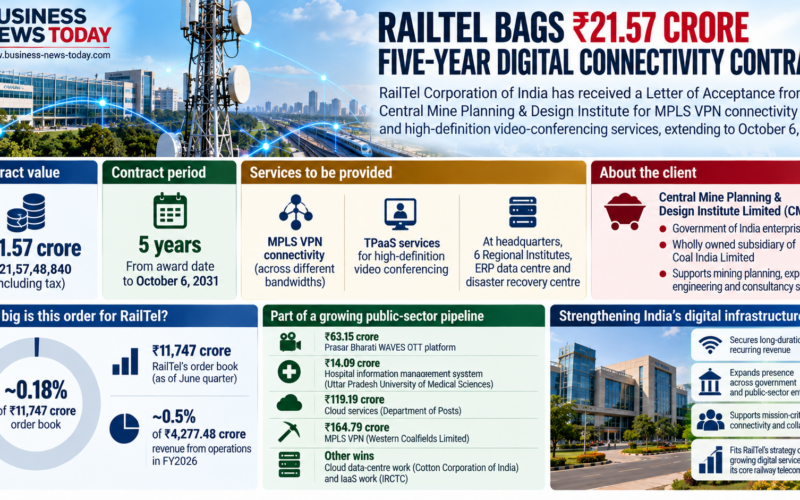
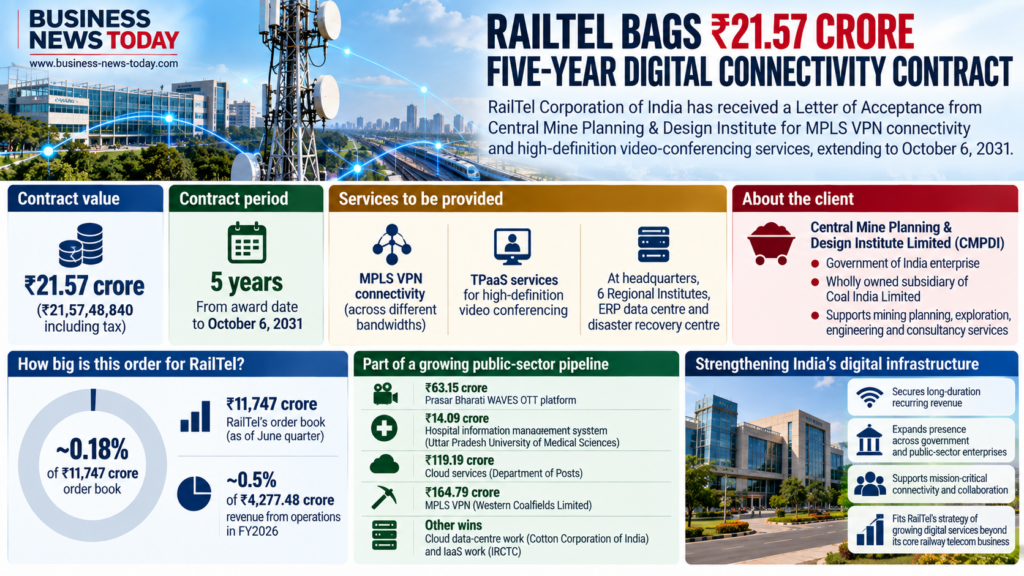
RailTel Corporation of India Limited (NSE: RAILTEL), the Navratna public sector telecom and information technology infrastructure company under the Ministry of Railways, has received a Letter of Acceptance worth approximately ₹21.57 crore from Central Mine Planning & Design Institute Limited for a five-year digital connectivity project. The contract covers MPLS VPN connectivity across different bandwidths and TPaaS services for high-definition video conferencing at the customer’s headquarters, six Regional Institutes, ERP data centre and disaster recovery centre, with execution extending to October 6, 2031. Central Mine Planning & Design Institute Limited is a Government of India enterprise and wholly owned subsidiary of Coal India Limited, giving RailTel another multi-year mandate within India’s public-sector digital infrastructure ecosystem. The individual contract is modest relative to RailTel Corporation of India Limited’s ₹11,747 crore order book, but its recurring five-year structure and customer profile fit an increasingly visible strategy of building long-duration digital service relationships across government departments and public-sector enterprises.
The estimated contract value is ₹21,57,48,840 including tax. RailTel Corporation of India Limited said it received the Letter of Acceptance on September 25 at 7:05 p.m., after the Indian equity market had closed for the week, meaning the September 28 session will provide the first opportunity for NSE investors to trade after the disclosure. The company said the transaction is domestic, carries no promoter or promoter-group interest in the awarding entity and does not constitute a related-party transaction.
What exactly will RailTel provide under the ₹21.57 crore CMPDI digital connectivity contract?
The Central Mine Planning & Design Institute Limited mandate combines managed network connectivity with high-definition video collaboration infrastructure rather than representing a simple one-time equipment supply. RailTel Corporation of India Limited will provide MPLS VPN connectivity of different bandwidths together with TPaaS services across Central Mine Planning & Design Institute Limited’s headquarters, six Regional Institutes, ERP data centre and disaster recovery centre. The contractual period extends for five years, with the disclosed completion date set for October 6, 2031.
MPLS VPN infrastructure allows an organisation with geographically distributed offices to connect locations across a managed private network while controlling traffic, service quality and security more effectively than through basic public internet connections. For an organisation such as Central Mine Planning & Design Institute Limited, which supports mining planning, exploration, engineering, environmental monitoring and consultancy activities across different Indian regions, dependable connectivity between technical offices and central systems has an operational role beyond conventional office communications.
The high-definition video-conferencing component adds another recurring service layer. RailTel Corporation of India Limited already operates telecom infrastructure, data centres, cloud services, security operations, network operations and enterprise information and communication technology platforms, so the contract sits within an existing service portfolio rather than requiring the company to create an entirely new capability. That should make execution more comparable with RailTel’s existing enterprise and government contracts, although actual project profitability will depend on service costs and the final operating mix over the five-year period.
How meaningful is the ₹21.57 crore CMPDI order compared with RailTel’s ₹11,747 crore order book?
The new Central Mine Planning & Design Institute Limited contract represents only around 0.18% of RailTel Corporation of India Limited’s ₹11,747 crore order book reported around the end of the June quarter. It is also equivalent to roughly 0.5% of the ₹4,277.48 crore revenue from operations that RailTel recorded in fiscal 2026. On size alone, therefore, the contract is unlikely to materially change near-term earnings expectations.
Its significance becomes more visible when viewed as part of RailTel Corporation of India Limited’s continuing accumulation of public-sector digital projects. Recent disclosed wins have included a ₹63.15 crore mandate connected with Prasar Bharati’s WAVES OTT platform, a ₹14.09 crore five-year hospital information management system assignment from Uttar Pradesh University of Medical Sciences, a cloud-services order of approximately ₹119.19 crore from the Department of Posts and a ₹164.79 crore MPLS VPN contract from Western Coalfields Limited.
RailTel Corporation of India Limited has also secured cloud data-centre work from Cotton Corporation of India Limited and infrastructure-as-a-service work from Indian Railway Catering and Tourism Corporation Limited. Those awards span healthcare, postal services, broadcasting, mining, agriculture and railway-linked enterprises, illustrating that the company’s project business is increasingly exposed to digital spending outside its original railway telecom role.
This diversification matters more than any single small contract because government information technology expenditure often arrives through numerous individual procurement exercises rather than a handful of exceptionally large awards. A sustained stream of ₹10 crore, ₹20 crore, ₹50 crore and ₹100 crore projects can become material collectively when execution is disciplined and customer relationships lead to renewals, extensions or adjacent assignments.
Why is RailTel increasingly winning digital projects outside its traditional railway network business?
RailTel Corporation of India Limited was established to modernise telecommunications used by Indian Railways while developing a nationwide broadband and multimedia network alongside the railway network. That infrastructure foundation has since been expanded into enterprise connectivity, data-centre services, cloud infrastructure, managed information technology, cybersecurity, hospital management systems, digital education, signalling projects and other government technology assignments.
The company now operates a nationwide optical-fibre network spanning more than 63,000 route kilometres, supported by more than 21,000 kilometres of city access network. That physical footprint gives RailTel Corporation of India Limited an established connectivity backbone that can be used to compete for enterprise and government digitalisation contracts without relying exclusively on railway-related work.
The Central Mine Planning & Design Institute Limited project fits that transition particularly well because it combines communications infrastructure and managed digital services. Central Mine Planning & Design Institute Limited operates from its headquarters in Ranchi and through Regional Institutes serving different coal-producing regions, creating a geographically dispersed network requirement that closely matches RailTel Corporation of India Limited’s connectivity capabilities.
The strategic opportunity is to convert that infrastructure reach into higher-value recurring digital services. Plain network bandwidth can become increasingly commoditised, whereas managed cloud, cyber-security, data-centre, application and platform services can deepen customer relationships and expand revenue generated from the same underlying infrastructure. RailTel Corporation of India Limited’s recent contract flow indicates that management is pursuing precisely that broader mix.
What do RailTel’s latest financial results say about revenue growth and project execution?
RailTel Corporation of India Limited entered fiscal 2027 with substantial operating momentum after posting its highest annual revenue from operations in fiscal 2026. Revenue from operations increased about 23% to ₹4,277.48 crore from ₹3,477.50 crore in the previous financial year, while profit after tax increased to approximately ₹346.32 crore from ₹299.81 crore. Fiscal 2026 EBITDA reached roughly ₹658 crore, demonstrating that the expanding project portfolio was contributing meaningful scale to the business.
The first quarter of fiscal 2027 continued the revenue growth trend but also demonstrated why project mix remains important. Revenue from operations rose approximately 20.1% year on year to ₹893.27 crore from ₹743.81 crore, while total income reached ₹909.60 crore. Profit after tax, however, was almost unchanged at ₹65.78 crore compared with ₹66.10 crore in the corresponding quarter of the previous year.
Project Work Services generated ₹532.46 crore of first-quarter revenue, rising about 30% year on year and accounting for close to 60% of revenue from operations. Telecom Services generated approximately ₹360.81 crore, up around 7.8% from the comparable quarter. The faster expansion of project work has accelerated the top line, but project expenditure also increased sharply, limiting the translation of the higher revenue into comparable profit growth.
That creates an important analytical distinction for RailTel Corporation of India Limited. A larger order book improves revenue visibility, but order-book growth is not automatically equivalent to profit growth because different projects carry different execution costs and margins. Investors therefore need to examine the quality and profitability of order conversion alongside the headline size of new awards.
Can RailTel convert its ₹11,747 crore order book into faster earnings growth during fiscal 2027?
Management entered fiscal 2027 with an order book of approximately ₹11,747 crore, equivalent to roughly 2.7 times fiscal 2026 revenue from operations. That provides considerable medium-term execution visibility, particularly because several major projects extend over multiple years rather than requiring completion within a single financial period.
Management has indicated an ambition to maintain revenue growth of around 25% during fiscal 2027 and has previously discussed recognising approximately ₹3,500 crore of project income during the year. If achieved, that would reinforce Project Work Services as the largest engine of incremental growth while telecom operations provide the more recurring connectivity base.
The margin question remains central because Q1 demonstrated that rapid project revenue growth does not necessarily produce proportional growth in profit after tax. Project work tends to include third-party equipment, implementation expenditure and other pass-through costs, while the economics of telecom services can benefit more directly from utilisation of RailTel Corporation of India Limited’s existing network infrastructure.
The most attractive trajectory would therefore combine strong project execution with expansion of recurring managed services, cloud, data-centre and network revenue. The five-year Central Mine Planning & Design Institute Limited contract is relatively small, but its multi-year managed-service characteristics fit that direction better than a short-duration hardware supply order.
How is RailTel’s share price positioned before trading resumes after the CMPDI contract announcement?
RailTel Corporation of India Limited shares closed at ₹260.15 on the National Stock Exchange of India on September 25, down 0.54% for the session. The stock traded between ₹257.20 and ₹261.40 during the day, with approximately 392,954 shares changing hands. Because the Central Mine Planning & Design Institute Limited Letter of Acceptance was received after the market close, that price does not reflect a trading response to the new contract disclosure.
The broader share-price trend has remained weaker despite regular order announcements. RailTel Corporation of India Limited traded at ₹277.90 on September 1, meaning the September 25 close was about 6.4% lower than the beginning of the month. The stock was also around 35% below its 52-week high near ₹400.80 while remaining only about 6% above its 52-week low around ₹245.
RailTel Corporation of India Limited’s market capitalisation at the September 25 NSE close was approximately ₹8,350 crore. That places the ₹21.57 crore Central Mine Planning & Design Institute Limited contract at only about 0.26% of the company’s current equity-market value, reinforcing why the investment relevance lies more in cumulative order momentum and execution than in the value of this contract by itself.
The stock’s position close to the lower end of its 52-week range also means individual contract announcements are being assessed against broader questions around valuation, profit conversion and future earnings growth. RailTel Corporation of India Limited has continued to win work, but sustained share-price improvement would require evidence that the expanding project pipeline is translating into stronger earnings and cash generation rather than merely higher reported revenue.
What should investors watch as RailTel executes the CMPDI contract through October 2031?
The Central Mine Planning & Design Institute Limited contract adds another five-year revenue opportunity to RailTel Corporation of India Limited’s project portfolio, but the next quarterly financial statements will provide more useful evidence than the individual award value. Project revenue growth, segment profitability, receivables, operating cash flow and the pace of order-book conversion will show whether the company is extracting adequate economic returns from its expanding portfolio.
New order inflows also remain important because RailTel Corporation of India Limited needs to replenish the backlog as existing projects convert into revenue. The company has demonstrated an ability to win contracts from railway entities, ministries, public-sector companies, universities and other government-linked customers, reducing dependence on a single procurement channel even though public-sector spending remains central to the business model.
The data-centre and cloud businesses could become increasingly important to this transition. Management has been expanding digital infrastructure alongside its telecom network, while its range of recent assignments indicates that government customers increasingly require combinations of connectivity, hosting, cloud, cybersecurity and application-management services rather than standalone bandwidth.
The ₹21.57 crore Central Mine Planning & Design Institute Limited award is therefore not large enough to transform RailTel Corporation of India Limited’s financial outlook independently. Its greater value lies in reinforcing a pattern: RailTel is using the national network originally built around the railway system to compete for a wider share of India’s public-sector digital infrastructure spending. The next measurable proof point will be whether the ₹11,747 crore order book converts into the stronger profit growth that did not fully emerge despite the 20% revenue expansion recorded in the June quarter.
Key takeaways from RailTel’s ₹21.57 crore Central Mine Planning & Design Institute order
- RailTel Corporation of India Limited has received a Letter of Acceptance worth approximately ₹21.57 crore including tax from Central Mine Planning & Design Institute Limited.
- The five-year contract covers MPLS VPN connectivity and TPaaS services for high-definition video conferencing.
- Services will extend across Central Mine Planning & Design Institute Limited’s headquarters, six Regional Institutes, ERP data centre and disaster recovery centre.
- The disclosed execution period runs through October 6, 2031.
- The contract represents roughly 0.18% of RailTel Corporation of India Limited’s approximately ₹11,747 crore order book.
- RailTel recorded fiscal 2026 revenue from operations of ₹4,277.48 crore and profit after tax of ₹346.32 crore.
- Q1 fiscal 2027 revenue increased about 20% year on year to ₹893.27 crore, while profit after tax remained broadly flat at ₹65.78 crore.
- Project Work Services contributed ₹532.46 crore of first-quarter revenue, making project execution an increasingly important driver of group performance.
- RailTel shares closed at ₹260.15 on September 25, around 35% below their 52-week high and near the lower end of the annual trading range.
- Order-book conversion, project margins, recurring digital-service revenue and cash generation will provide stronger evidence of value creation than individual contract wins alone.
Discover more from Business-News-Today.com
Subscribe to get the latest posts sent to your email.