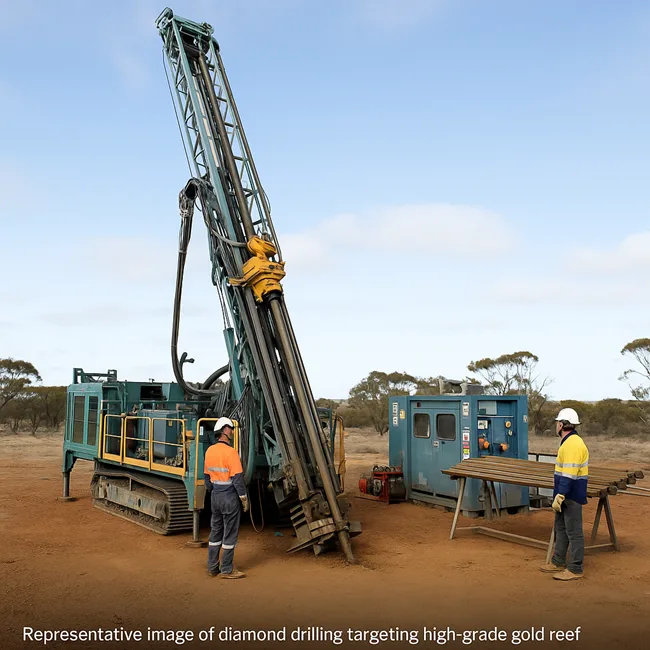
QMines Limited (ASX: QML), the Australian copper and gold exploration and development company, has reported visually identified copper sulphide mineralisation approximately 180 metres north-northeast of the existing Mt Chalmers Mineral Resource boundary near Rockhampton in Queensland. The 12 October 2026 announcement follows diamond drilling in a relatively untested area between the established Mt Chalmers deposit and prospective targets toward Botos, with drillhole 26MCDD052 intersecting approximately 11 metres of chalcopyrite and pyrite mineralisation. The result provides a new geological target outside the existing resource and the open-pit design used in the project’s 2024 prefeasibility study. However, laboratory assays remain outstanding, and neither the copper grade nor the continuity, true width or economic significance of the mineralisation has been established.
What has QMines discovered 180 metres beyond the existing Mt Chalmers copper-gold resource?
The latest result comes from diamond drillhole 26MCDD052, which intersected visibly identified sulphide mineralisation between approximately 192 and 203 metres downhole. The interval contains chalcopyrite and pyrite occurring in stringer veins, together with localised patches of more concentrated sulphide mineralisation. Chalcopyrite is a common copper-bearing mineral, but its visual presence does not establish the recoverable copper grade of an interval. Laboratory analysis will be needed to determine the concentrations of copper and associated metals.
The intersection lies approximately 180 metres north-northeast of the current Mt Chalmers resource boundary and outside the open-pit envelope used in the earlier prefeasibility assessment. The location is significant because relatively little drilling has tested the area beyond the northern end of the known deposit. QMines described the discovery hole as only the second hole to test this particular area north of the main pit. The limited historical drilling means the current geological model has substantial gaps that additional exploration could help resolve.
QMines has reported that the interval occurs approximately 167 metres below surface, at a depth broadly comparable with the northern edge of the existing resource. The mineralised zone includes irregular sulphide-bearing veins and locally semi-massive sections, with the company recording visual sulphide estimates of up to 25% to 35% in selected portions. Those percentages describe visually estimated sulphide mineral abundance, not the grade of copper or another payable metal. They should not be used to calculate contained metal or project value.
The 11-metre figure is a downhole length rather than a confirmed true geological width. The orientation of the drilled hole relative to the mineralised structure affects how the intersection should be interpreted, particularly because the hole was drilled approximately parallel to an interpreted geological trend. Additional drilling from different positions will be needed to determine the actual geometry of the zone. The forthcoming assays will provide the first quantitative test of whether the visible mineralisation represents grades that justify continued delineation.
Could the new copper sulphide intersection connect Mt Chalmers with the Botos mineralised system?
QMines is investigating whether the new intersection forms part of a larger mineralised system extending beyond the existing Mt Chalmers deposit. The company’s geological interpretation identifies an approximately four-kilometre corridor encompassing Woods Shaft, Mt Chalmers and Botos. This corridor contains geological structures and historical mineralisation that support additional exploration. However, the presence of targets along the same interpreted trend does not establish continuous mineralisation between them.
The company is considering several explanations for the new drillhole result. One possibility is that it represents an extension of the existing Mt Chalmers main lode toward the north. Another is that it belongs to a separate north-northeast-trending mineralised zone, potentially representing an additional structure east of the established main lode. A third interpretation is that the mineralisation may be related to the Botos system further along the corridor.
Each interpretation has different implications for subsequent exploration. An extension of the existing deposit could potentially support resource growth if continuity and economically relevant grades are confirmed. A separate zone might require a distinct geological model and additional drilling before its dimensions can be estimated. A connection with Botos could suggest a broader mineralised corridor, but demonstrating that relationship would require considerably more geological evidence.
The observed mineralisation resembles stringer-style sulphides associated with the Mt Chalmers volcanic-hosted massive sulphide system. Such deposits can contain concentrations of copper, zinc, gold, silver and other metals formed through ancient hydrothermal processes. Stringer mineralisation may occur in association with more concentrated massive sulphide bodies, making the surrounding geological environment prospective. However, the presence of stringer veins does not prove that another massive sulphide lens exists nearby.
QMines has initiated follow-up drilling to investigate the orientation and extent of the newly identified zone. The work will help determine whether the intersection can be correlated with known mineralisation to the south or targets closer to Botos. The results could refine the geological model even if they do not establish a continuous deposit. The distinction between a promising geological interpretation and an economically mineable resource will remain important throughout the exploration programme.
Why is the Mt Chalmers discovery important while QMines advances its definitive feasibility study?
Mt Chalmers is the company’s principal copper and gold development project in Central Queensland. The project has an existing Mineral Resource of approximately 11.3 million tonnes and was the subject of a prefeasibility study completed in 2024. QMines has since continued drilling, technical investigations and project development work as it progresses toward a definitive feasibility assessment. The latest exploration result offers potential to expand the geological opportunity beyond the boundaries used in earlier technical modelling.
A definitive feasibility study requires more detailed information on mining, processing, infrastructure, environmental requirements and project economics. New mineralisation identified outside the existing model is not automatically incorporated into those estimates. Before additional material can influence a mine plan, QMines must establish its grade, geometry, continuity and relationship to potential mining infrastructure. The newly reported interval has not been included in the existing Ore Reserve or the definitive feasibility work currently underway.
The location of new mineralisation can be as important as its grade when evaluating possible project expansion. Material close to an existing planned pit or infrastructure corridor may have different development implications from a separate deposit requiring new access roads, excavation or processing arrangements. However, depth, rock conditions and mining geometry can still make nearby mineralisation expensive to extract. The northern intersection will require engineering assessment if future drilling demonstrates a potentially economic deposit.
QMines also needs to balance exploration expenditure against the capital required to advance the existing Mt Chalmers development. Additional drilling may improve the resource base, but it consumes capital and technical resources before generating operating revenue. The company has appointed specialist financial adviser BurnVoir Corporate Finance to assist with funding strategies for the project. That appointment reflects preparation for future project financing rather than confirmation that construction funding has already been secured.
The exploration result may become strategically valuable if it supports additional mine life, higher production or a more flexible development plan. Yet none of those outcomes can be calculated from the visual discovery alone. The existing resource and feasibility work remain the foundation of the development assessment. The new drilling provides a potential opportunity to strengthen that foundation once assays and subsequent geological studies are available.
How do QMines’ recent high-grade pontoon drilling results compare with the unassayed northern intersection?
The October discovery follows encouraging drilling results reported on 7 October from beneath the flooded Mt Chalmers historical open pit. QMines used a pontoon-mounted diamond drilling rig to obtain modern geological information from an area that had previously been difficult to test. The first two reported holes returned copper-gold mineralisation immediately beneath the pit floor, including intervals with meaningful concentrations of associated metals. Those laboratory-confirmed results provide a separate source of evidence about the project’s mineralisation.
Drillhole 26MCDD025 returned 6.7 metres grading 2.07% copper, 2.37 grams per tonne gold and 60 grams per tonne silver from approximately 23.3 metres downhole. Within the interval, QMines also identified a 2.7-metre polymetallic section grading 1.29% copper, 4.44 grams per tonne gold, 109 grams per tonne silver, 5.25% zinc and 3.04% lead. These are laboratory assay results from the previously reported pontoon drilling programme. They should not be confused with the visually identified mineralisation in the newly announced northern hole.
Another pontoon hole, 26MCDD027, intersected 11.3 metres grading 1.32% copper and 0.43 grams per tonne gold, including a higher-grade section of 3.3 metres grading 2.70% copper. The results provide information about mineralisation beneath the pit floor and the possible distribution of higher-grade material within the existing deposit. QMines has reported that the two pontoon holes delivered local copper-equivalent grades approximately 20% above the corresponding resource block model estimates. That comparison applies to the specific tested intervals rather than demonstrating a deposit-wide grade increase.
The pontoon results are relevant because they provide modern assays against which earlier resource estimates can be evaluated. Historical deposits often contain areas where drilling density, sampling methods or geological interpretations require updating before final mine design. Modern drilling may identify variations in grade or mineralisation geometry that affect planning. However, two encouraging holes cannot establish that the entire deposit is underrepresented in the existing model.
Together, the pontoon results and the northern exploration intersection demonstrate that QMines is investigating both the established resource and its surrounding geological potential. One programme provides laboratory-confirmed information from beneath the historic open pit, while the other seeks to identify mineralisation outside the known resource boundary. Their development implications are different, and each requires separate assessment. A future resource update will need to integrate verified information from the relevant drilling programmes without treating visual observations as assayed metal grades.
What does QMines’ expanded 20,000-metre drilling programme mean for Mt Chalmers resource growth?
QMines announced on 29 September that it would expand its planned drilling programme from 10,000 metres to 20,000 metres. The increase reflects management’s decision to allocate additional exploration effort to the Mt Chalmers project and surrounding targets following recent drilling results. A larger programme can provide more information about geological continuity, grade distribution and areas currently constrained by limited data. It does not guarantee a larger Mineral Resource because the final outcome depends on the material intersected and the quality of the supporting evidence.
The programme covers different objectives, including drilling within the existing deposit, testing potential extensions and investigating targets that may support future exploration growth. Infill drilling can improve confidence in the location and grade of known mineralisation, potentially supporting more reliable resource classification. Step-out drilling, by contrast, tests whether mineralisation extends beyond previously established boundaries. The northern hole is an example of the latter approach, with follow-up work now intended to determine its significance.
The company has also identified a substantial pipeline of pending assay results. As of the 7 October pontoon drilling announcement, approximately 37 holes totalling 2,985 metres were awaiting laboratory results. Those pending assays create near-term opportunities to update the geological interpretation using quantitative data. Nevertheless, not every hole will necessarily return economic grades, and results need to be evaluated collectively rather than selected according to the strongest intersections.
Expanded drilling also has cost implications. Additional metres require drilling contractors, geological supervision, sampling, laboratory analysis and subsequent resource modelling. The company will need to determine how much information is necessary to support the definitive feasibility study and how much additional exploration should be undertaken independently of the initial development plan. That allocation decision becomes increasingly important as a project progresses from exploration toward potential financing and construction.
How do QMines’ recent land acquisitions improve access to the Botos copper-gold exploration targets?
In September 2026, QMines announced agreements to acquire two rural properties covering the Botos exploration area for combined consideration of approximately A$2.388 million. The properties provide access to ground associated with the prospective mineralised system north of Mt Chalmers. Previously, limited land access had constrained the company’s ability to drill parts of the target area. The acquisitions therefore address a practical exploration requirement rather than directly increasing the quantity of metal contained in the project’s reported resources.
Access to strategically located land can reduce the logistical complexity of undertaking exploration, subject to the applicable permits and other legal requirements. It may also give QMines more flexibility in establishing drilling positions, investigating geological structures and planning future development infrastructure. These benefits are relevant where prospective mineralisation extends across property boundaries or into areas that have received little previous drilling. However, land ownership does not itself establish mineral tenure, regulatory approval or an economic discovery.
The latest northern intersection provides a reason to investigate the intervening ground between Mt Chalmers and Botos. Having improved access to parts of the wider corridor may allow QMines to test those interpretations more systematically. The relationship between geological targeting and practical drill access can influence how efficiently a company gathers evidence. A successful programme would be expected to replace broad geological interpretations with progressively better-defined mineralised zones.
The Botos area remains an exploration opportunity separate from the established Mt Chalmers development assumptions. Any future resource estimate would require sufficient drilling, geological modelling and appropriate reporting under the applicable mineral resource standards. Similarly, any extension to a proposed mine plan would need engineering and economic support. The current land acquisitions expand the company’s ability to test potential rather than confirming that additional mineable reserves exist.
What must QMines demonstrate before the new Mt Chalmers mineralisation can improve project economics?
The first requirement is laboratory confirmation of the copper, gold and associated metal grades in hole 26MCDD052. The company expects assay results toward the end of October 2026, providing an identifiable near-term exploration milestone. Those results will establish whether the visual copper sulphides correspond to significant metal concentrations. They may also provide information about the distribution of other metals relevant to the project’s processing and economic assessment.
Further drilling will then be necessary to determine the orientation, true thickness and continuity of the zone. A single intersection outside a resource boundary does not provide sufficient information to estimate reliable tonnage or contained metal. The geometry of the mineralisation will also influence any future mining method and its relationship to the existing development plan. Mineralisation that appears attractive in drill core can still be difficult to extract profitably if its configuration requires substantial additional mining expenditure.
QMines will ultimately need to integrate any confirmed additional resources with the economic assumptions used for Mt Chalmers. Those include processing recoveries, metal prices, operating expenditure, capital requirements and mining schedules. Additional copper or gold mineralisation may improve project returns when it can be incorporated into an efficient mining and processing plan. Conversely, isolated or lower-grade extensions may provide geological interest without materially changing the development economics.
The company is progressing the Mt Chalmers definitive feasibility study while continuing its broader exploration programme. The latest discovery may eventually expand the project’s development options, but it has not yet altered the declared resource or established a new Ore Reserve. The strongest evidence will emerge from assayed drilling, geological continuity and a revised technical assessment incorporating verified mineralisation. Until those steps are completed, the northern intersection should be regarded as a promising exploration result rather than an established increase in economically recoverable copper.
Key takeaways from QMines Limited’s Mt Chalmers northern copper sulphide discovery
- QMines has identified visible copper sulphide mineralisation approximately 180 metres beyond the Mt Chalmers resource boundary.
- Drillhole 26MCDD052 intersected an approximately 11-metre downhole mineralised interval.
- The mineralisation contains visually identified chalcopyrite and pyrite.
- Laboratory assays are outstanding, and metal grades remain unknown.
- The interval is outside the existing resource and the 2024 prefeasibility open-pit design.
- QMines is investigating possible geological relationships between Mt Chalmers and Botos.
- Earlier October pontoon drilling returned laboratory-confirmed high-grade copper-gold intersections beneath the historic pit floor.
- The company has expanded its drilling programme to 20,000 metres.
- Recent land acquisitions have improved access to Botos exploration targets.
- Assays expected in late October and follow-up drilling will help establish whether the new zone merits further resource delineation.
Discover more from Business-News-Today.com
Subscribe to get the latest posts sent to your email.