




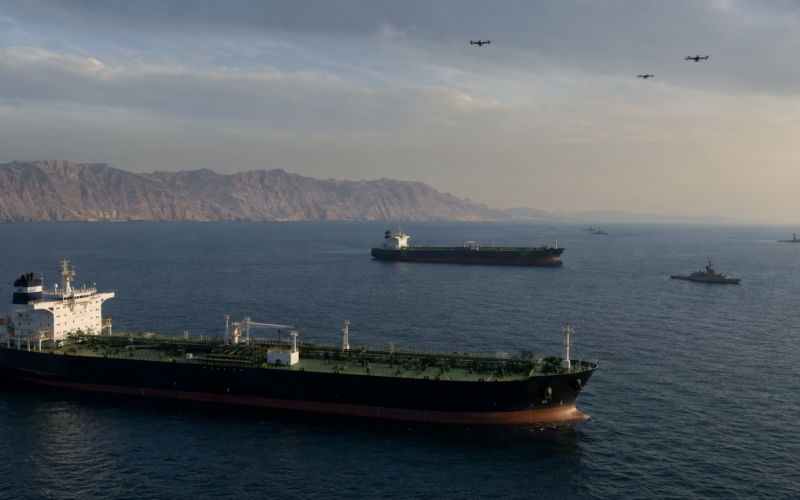
Qatar accused Iran of responsibility for a drone strike that hit the Qatari liquefied natural gas carrier Al Rekayyat in the Strait of Hormuz on July 7, 2026, causing an engine-room fire and forcing the crew to evacuate as maritime security teams assessed the risk of a wider explosion.
The Al Rekayyat was one of at least three commercial tankers reported hit or damaged in separate incidents around the Strait of Hormuz and nearby waters on July 7. A Saudi-flagged crude oil tanker believed to be the supertanker Wedyan was damaged off Oman, although the cause had not been established. Another tanker reported minor damage after being struck by a drone while transiting the waterway.
Qatar summoned Iran’s deputy ambassador and delivered a formal protest demanding urgent clarification and measures preventing another attack. Iran had not accepted responsibility, and no organisation had claimed the tanker strikes when the initial reports emerged.
The incidents occurred as foreign ministers from North Atlantic Treaty Organization countries and Bahrain, Kuwait, Qatar and the United Arab Emirates met in Ankara to discuss the Strait of Hormuz crisis. France and Britain were preparing to outline a multinational maritime mission intended to restore freedom of navigation, but Iran’s opposition to a foreign military presence continued to limit the plan’s prospects.
What happened to the Al Rekayyat and the other tankers struck near the Strait of Hormuz?
The Al Rekayyat reported being hit on the port side near the top of its engine room during an overnight transit through the Strait of Hormuz. The impact caused a fire and filled the engine-room area with smoke, leaving the crew initially unable to assess the full extent of the damage.
All crew members were reported safe and evacuation procedures began. Maritime security specialists warned that an uncontrolled engine-room fire aboard a liquefied natural gas carrier could become extremely dangerous because heat can damage machinery, electrical systems and equipment associated with the vessel’s cargo operations.
The initial reports did not establish that the Al Rekayyat’s cargo tanks had been breached. The risk of an explosion was therefore a maritime security assessment rather than confirmation that the liquefied natural gas cargo was already burning or leaking.
A Saudi-flagged tanker believed to be the Wedyan was also damaged in waters east of Oman. Maritime security sources did not immediately determine whether the vessel had been hit by a drone, missile or another weapon.
The United Kingdom Maritime Trade Operations agency separately reported that a tanker transiting the Strait of Hormuz had been struck by a drone. The vessel sustained minor damage but remained capable of sailing towards its next destination.
The available information did not initially establish whether every report referred to a separate vessel or whether some official accounts overlapped. United States officials said early indications suggested Iran had fired at three commercial ships, but Washington had not publicly released evidence proving responsibility for each incident.
The distinction is important because the July 7 events involved a confirmed attack, state accusations and preliminary security assessments developing at the same time. Qatar directly accused Iran over the Al Rekayyat strike, while responsibility for the other tanker incidents remained less clear.
Why has Qatar formally accused Iran when Tehran has not claimed responsibility for the attack?
Qatar’s accusation reflected the information available to its government about the attack on a nationally connected vessel, as well as the wider security environment established by Iran’s control measures around the Strait of Hormuz.
The Qatari Ministry of Foreign Affairs summoned Iran’s deputy ambassador and delivered a protest note describing the strike as an unacceptable attack on international navigation, global energy supplies and established principles of international law.
Qatar demanded urgent clarification from Iran and immediate action to prevent a recurrence. The diplomatic protest did not disclose the intelligence, tracking data or weapons analysis supporting the accusation.
Iran had not claimed responsibility. Iranian state media cited an unnamed official who said maritime traffic through the Strait of Hormuz was being conducted under Iranian arrangements and warned that any provocative action by the United States would receive an immediate response.
That statement reinforced Iran’s claim to operational authority over the waterway but did not directly address the Al Rekayyat attack. Establishing responsibility will require examination of drone fragments, flight paths, surveillance records, radar information and communications detected around the time of the strike.
The incident places Qatar in a difficult position. Doha has maintained working relations with Iran and has played a central role in negotiations between Tehran and Washington. Qatar also shares the world’s largest natural gas field with Iran, giving both governments strong reasons to avoid a prolonged confrontation.
However, Qatar cannot treat a suspected attack on one of its liquefied natural gas carriers as a minor diplomatic disagreement. The country’s economic security depends on safe maritime exports, and any perception that Qatari vessels can be targeted without consequences could affect insurance, shipping schedules and customer confidence.
Why is an attack on a Qatari LNG carrier especially serious for global energy markets?
Qatar is one of the world’s most important liquefied natural gas exporters, supplying consumers across Asia and Europe. Nearly all Qatari liquefied natural gas exports must leave the Persian Gulf through the Strait of Hormuz before entering the Gulf of Oman and international shipping routes.
Before the latest regional conflict, approximately one-fifth of global liquefied natural gas trade passed through the Strait of Hormuz, primarily through Qatari exports. China, India and South Korea were among the largest destinations for liquefied natural gas using the route.
An attack on a liquefied natural gas carrier is particularly sensitive because such vessels transport large quantities of gas cooled into liquid form. LNG carriers are designed with extensive safety systems, reinforced containment and specialised operating procedures, but major fires or structural damage can still create severe hazards.
Even an attack that does not damage the cargo can interrupt operations. A vessel may require towing, inspection and repairs, while nearby ships may delay transit until authorities establish whether additional drones or missiles remain active.
Insurance companies can respond quickly to increased risk. War-risk premiums may rise, coverage conditions may tighten and vessel operators may demand security guarantees before sending ships through the waterway.
The commercial effect can extend beyond the vessel that was hit. Buyers may seek substitute cargoes from the United States, Australia or other exporters, increasing competition for available supplies and pushing regional gas prices higher.
Oil prices rose after the July 7 incidents, demonstrating how rapidly energy markets react to evidence that the Strait of Hormuz remains vulnerable despite the interim United States-Iran agreement.
Could the tanker attacks derail the interim United States-Iran peace arrangement?
The United States and Iran signed an interim memorandum in June intended to pause the conflict, support the reopening of the Strait of Hormuz and provide a 60-day period for negotiations on a permanent settlement.
The agreement increased tanker movements and helped reduce oil prices from the extreme levels recorded during the effective closure of the waterway. However, normal and unrestricted navigation had not been fully restored before the July 7 attacks.
The tanker incidents expose a fundamental weakness in the interim arrangement. The parties may have paused direct large-scale military operations without reaching a detailed and enforceable system governing commercial passage, inspections, fees and the role of foreign naval forces.
United States President Donald Trump has threatened to resume military action if negotiations fail. Iran has responded that continuing threats violate the understanding behind the ceasefire and could prevent negotiations on a final agreement from beginning.
This exchange has made the maritime dispute harder to separate from the broader conflict. Iran views control over the Strait of Hormuz as negotiating leverage, while the United States argues that international vessels must retain freedom of navigation without unilateral Iranian restrictions.
The July 7 incidents could strengthen calls in Washington for a more forceful maritime response. They could also give Iranian officials another reason to oppose foreign deployments by arguing that additional warships would increase the danger of escalation.
Qatar’s diplomatic role becomes even more important under these conditions. Doha must press Iran for answers over the Al Rekayyat while continuing to support negotiations intended to prevent another United States-Iran war.
What would the proposed British and French Strait of Hormuz mission actually do?
France and Britain have been building support for a multinational military mission intended to protect commercial navigation and help restore confidence in shipping through the Strait of Hormuz.
The proposal is expected to involve warships, minehunters, surveillance systems, maritime patrols and support vessels contributed by participating countries. Several North Atlantic Treaty Organization members have already deployed naval assets to the surrounding region.
The operation is not currently designed as a formal North Atlantic Treaty Organization mission. European governments have sought to avoid drawing the alliance directly into the United States-Iran conflict while still coordinating with allies and Gulf Arab partners concerned about maritime security.
France and Britain have considered beginning operations in the Gulf of Oman, the body of water linking the Arabian Sea with the Strait of Hormuz. Oman has agreed to cooperate with France and Britain to protect navigation within Omani territorial waters.
An initial presence in the Gulf of Oman would allow naval forces to escort, monitor or assist ships approaching the strait without immediately placing a large foreign military mission inside waters where Iran maintains a strong naval and missile presence.
The July 7 tanker attacks strengthen the operational argument for the mission. Commercial vessels require warning information, surveillance and emergency support when drones, missiles or mines threaten established shipping lanes.
The attacks also reveal the mission’s central limitation. Naval escorts can deter some threats and respond after an attack, but they cannot guarantee that every drone or missile will be intercepted in a narrow and heavily militarised waterway.
Why does any durable Hormuz security arrangement still require Iranian consent?
Iran controls a long coastline on the northern side of the Strait of Hormuz and possesses naval forces, missiles, drones and surveillance systems capable of affecting shipping across the waterway.
A foreign maritime coalition can deploy vessels without Iranian approval in international waters, but operating indefinitely against active Iranian opposition would create a constant risk of confrontation.
Iran has repeatedly rejected a permanent foreign military presence and has used the maritime issue as leverage in negotiations with the United States. Tehran wants recognition of a greater role in managing passage and has explored arrangements involving registration or fees for vessels using the strait.
France, Britain and Gulf governments cannot create a stable commercial system if every escorted convoy risks interception or attack. A durable arrangement therefore requires either Iranian participation or an enforceable agreement under which Tehran accepts the rules governing transit.
Iranian consent does not require granting Iran unrestricted authority. A settlement could include notification mechanisms, defined navigation corridors, inspection procedures, emergency communication channels and commitments protecting commercial vessels from attack.
The challenge is building a framework that recognises Iran’s geographic and security interests without allowing Tehran to control one of the world’s most important international energy routes.
The Ankara discussions are therefore only an early stage. They can demonstrate political support for Gulf Arab governments and coordinate military contributions, but they cannot substitute for a negotiated maritime settlement involving Iran.
How exposed are India, China, Japan and South Korea to another Hormuz shipping disruption?
Asian economies face the greatest direct exposure because most crude oil, condensate and liquefied natural gas moving through the Strait of Hormuz is delivered to Asian markets.
Before the conflict, China, India, Japan and South Korea together accounted for a large majority of crude oil and condensate shipments passing through the waterway. China, India and South Korea were also among the leading destinations for Qatari liquefied natural gas.
A prolonged disruption can raise crude oil, transport fuel, electricity and industrial gas costs across Asia. Import-dependent countries may need to draw strategic reserves, negotiate substitute cargoes or reduce consumption.
India is particularly exposed because it imports substantial quantities of crude oil and liquefied natural gas from Gulf producers. Higher shipping and insurance costs can affect inflation even when physical cargoes continue arriving.
Some Gulf producers have pipelines capable of bypassing the Strait of Hormuz, including routes operated by Saudi Arabia and the United Arab Emirates. Their spare capacity is limited and cannot replace the full volume normally transported through the waterway.
Qatar has no comparable large-scale export route for most of its liquefied natural gas. That makes secure maritime transit essential not only to Qatar’s economy but also to Asian countries relying on Qatari gas for power generation, heating and industrial production.
What should governments and shipping companies watch after the July 7 tanker attacks?
The first issue is the condition of the Al Rekayyat. Confirmation that the fire has been extinguished and the cargo remains secure would reduce the immediate safety risk, while evidence of serious structural damage could prolong disruption.
The second issue is attribution. Physical evidence connecting the drone to Iranian forces or another organisation would determine the diplomatic and military response.
The third issue is whether additional attacks occur. A single night of incidents may represent a deliberate warning, an unauthorised operation or the beginning of a wider campaign against commercial shipping.
The fourth issue is Iran’s response to Qatar’s protest. Cooperation with an investigation could help contain the crisis, while denial without supporting information may deepen mistrust between Doha and Tehran.
The fifth issue is the structure of the French and British maritime mission. Governments will watch which countries contribute vessels, where the force operates and whether commercial ships receive escorts through the strait itself.
The final issue is the United States-Iran negotiating timetable. Without progress towards permanent rules for navigation, every tanker movement will remain exposed to renewed political pressure and military escalation.
What are the key takeaways from the July 7 Strait of Hormuz tanker attacks?
- Qatar accused Iran of responsibility for a July 7, 2026 drone strike on the liquefied natural gas carrier Al Rekayyat, which caused an engine-room fire and forced the safe evacuation of the ship’s crew.
- Qatar summoned Iran’s deputy ambassador and delivered a formal protest demanding clarification and immediate measures preventing further attacks, while Iran had not accepted responsibility or directly addressed the Al Rekayyat incident.
- A Saudi-flagged crude oil tanker believed to be the Wedyan was also damaged off Oman, while another tanker reported minor damage after being hit by a drone during transit through the Strait of Hormuz.
- The attacks occurred despite an interim United States-Iran agreement intended to reopen the Strait of Hormuz, reduce military tensions and create a 60-day negotiating period for a more permanent settlement.
- France and Britain are proposing a multinational maritime mission involving naval vessels, minehunters and surveillance capabilities, with an initial operating area potentially located in the Gulf of Oman.
- Iran opposes a permanent foreign military presence, meaning a naval coalition may protect some vessels but cannot create a durable navigation system without an agreement accepted by Tehran.
- The Strait of Hormuz previously carried approximately one-fifth of global oil consumption and one-fifth of global liquefied natural gas trade, leaving Qatar and major Asian importers highly exposed to further disruption.
- The next decisive developments will include the Al Rekayyat damage assessment, evidence identifying the drone’s operator, Iran’s diplomatic response and the operational details of the proposed Franco-British maritime coalition.
Discover more from Business-News-Today.com
Subscribe to get the latest posts sent to your email.