




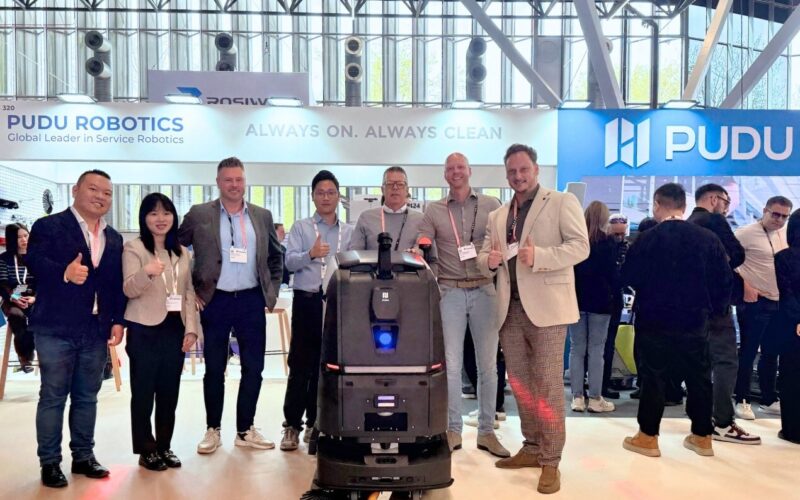
Pudu Robotics has entered a new phase of its European expansion through a strategic partnership with Gom Schoonhouden B.V., one of the Netherlands’ largest professional cleaning service providers, to deploy the PUDU BG1 series in what the companies describe as the first rollout of the platform in Europe. The agreement, facilitated by regional partner Fulin Robot Technologie B.V., matters because it moves Pudu Robotics from selling automation hardware into testing whether AI-native cleaning systems can operate credibly in a demanding European services environment. For the broader commercial cleaning market, this is less about one machine landing in one country and more about whether robotics vendors can prove that autonomous cleaning is becoming an operational model rather than a premium add-on. Europe, with its tighter labor markets, higher service expectations, and stronger compliance norms, is exactly the kind of place where that question gets answered the hard way.
Why does Pudu Robotics’ first PUDU BG1 deployment in Europe matter beyond a single customer win?
At face value, the partnership is a standard market-entry announcement. A robotics company has secured a first deployment, a local service provider has agreed to use the system, and a distribution partner is handling implementation. Beneath that surface, however, the deal signals something more consequential. Europe has been one of the tougher proving grounds for commercial service robotics because buyers tend to care less about gadget value and more about whether systems can hold up under real operational pressure. That means reliability, maintenance support, staff acceptance, and total cost of ownership all matter more than demo-floor theatrics.
For Pudu Robotics, securing Gom Schoonhouden B.V. as the first BG1 adopter in Europe offers validation with a buyer that is large enough to matter and practical enough not to fall for shiny-object syndrome. Cleaning contractors live and die by margins, labor utilization, and service consistency. If a company in that position adopts an AI-native scrubber-dryer robot, the meaningful question is not whether the technology looks advanced, but whether the math works in live environments. That is where many robotics narratives go from futuristic to awkwardly terrestrial.
The geography matters too. A launch in the Netherlands is strategically useful because it gives Pudu Robotics exposure to a mature commercial-services market with dense logistics, high labor costs, and a relatively innovation-friendly enterprise culture. If the BG1 performs well there, the case study can travel. If it struggles there, the problem is unlikely to vanish just because the brochure says “AI.”
How could Gom Schoonhouden use AI-native cleaning robotics to change service delivery economics?
For Gom Schoonhouden B.V., the appeal is likely less about replacing workers and more about redesigning how labor gets allocated. Commercial cleaning companies face a familiar squeeze. Customers want better consistency, buildings are becoming larger and more complex, and labor is both expensive and hard to retain. In that kind of environment, robotics becomes attractive when it can absorb repetitive floor-care tasks and free human staff for exception handling, detail work, and customer-facing responsibilities.
That shift matters because floor cleaning is one of the most standardized and time-intensive parts of facility services. If a robot can handle repeatable cleaning cycles with acceptable consistency, a contractor can rebalance labor toward work that remains difficult to automate. The strategic upside is not merely fewer labor hours on a given floor. It is the ability to preserve service levels without escalating headcount in line with contract growth.
There is also a quality-control angle. Large service providers have to manage performance across many sites, many shifts, and many worker teams. Even strong operators face variability. Robotics, when deployed properly, promises not perfection but standardization. A machine that delivers a consistent baseline result can reduce the quality spread between best-run and worst-run shifts. That is especially useful in sectors like healthcare, education, offices, and industrial sites, where service consistency is part of customer retention.
Still, labor economics is where reality will intervene. These deployments only scale if the total system, including acquisition, maintenance, software, integration, training, and support, produces a clear enough return. If the robot saves labor but adds complexity, buyers will notice quickly. Facility services is not known for charitable technology spending.
What does the PUDU BG1 platform reveal about where commercial cleaning robots are heading in 2026?
The BG1 pitch rests on the claim that cleaning robotics is moving from route-following automation to adaptive, AI-native execution. That distinction matters because many earlier cleaning robots were essentially disciplined repeaters. They could cover space, but they were limited in how well they responded to real-world variation. A system that can identify messes, adjust cleaning parameters, optimize resource use, and operate with less manual oversight offers a stronger value proposition, at least in theory.
If the BG1 can detect conditions in real time and modify its behavior accordingly, that pushes commercial cleaning closer to outcome-based automation rather than schedule-based automation. In practical terms, that could mean fewer wasted cleaning passes, better handling of irregular contamination patterns, and more efficient use of water, chemicals, and consumables. Those are small wins individually, but in high-frequency operations they compound fast.
The extendable edge-cleaning feature and integrated sweep-and-scrub system also point to a more mature product philosophy. One of the oldest problems in robotic cleaning has been the gap between lab claims and messy building realities. Corners, edges, debris mix, shelving layouts, and traffic patterns all expose those gaps. A platform designed to reduce blind spots and combine multiple cleaning functions in a single pass suggests Pudu Robotics understands that buyers do not purchase “AI.” They purchase fewer missed edges, fewer repeat tasks, and fewer complaints from site managers who are unimpressed by buzzwords.
What happens next across the sector will depend on whether rivals respond with similar claims or with different deployment models. Some will compete on intelligence. Others will compete on reliability, price, or service contracts. In commercial cleaning, the winner may not be the most futuristic machine. It may be the robot that causes the fewest operational headaches at 5 a.m. in a half-lit corridor.
Why is Europe becoming an increasingly important battleground for commercial cleaning automation vendors?
Europe offers the sort of market conditions that make automation both attractive and difficult. On one side are persistent labor shortages, rising wage pressure, sustainability targets, and large building portfolios that need efficient maintenance. On the other side are demanding regulatory expectations, strong worker protections, and customers who expect integration with existing service processes rather than technology theater.
That makes Europe a strategic proving ground. Vendors that succeed there can market themselves as enterprise-ready in a serious way. Vendors that fail there often discover that scaling robotics is not just a matter of shipping hardware. It requires local servicing capability, channel partnerships, compliance readiness, workforce training, and customer trust. Fulin Robot Technologie B.V.’s role in this partnership is important precisely because robotics adoption does not happen through boxes on a pallet. It happens through implementation and support.
The region also matters because a significant share of the addressable demand is concentrated in sectors where automation has practical appeal, including healthcare facilities, office campuses, hospitality sites, logistics environments, and public buildings. Those settings reward systems that can operate safely and predictably around people while generating measurable productivity improvements.
For Pudu Robotics, the stated strength of prior shipments in Europe and North America provides a useful base, but BG1 is a higher-stakes test because it is being positioned as a more intelligent operating model, not just another autonomous cleaning unit. That raises the bar. Once a company starts promising decision-making and continuous optimization, customers start expecting exactly that, not merely a robot that can move in a straight line without bumping into a plant.
Can Pudu Robotics turn strong shipment growth into durable infrastructure leadership in cleaning robotics?
Pudu Robotics is trying to make a larger claim than simple product momentum. It is positioning cleaning robotics as its main growth engine and framing its architecture as part of a broader intelligent robotics infrastructure play. That is strategically ambitious because it suggests the company wants to own more than device sales. It wants relevance in how service work gets structured.
The company’s shipment scale and prior market-share claims indicate real commercial traction. That matters because many robotics companies collect headlines more easily than deployments. Still, scale can be deceptive. Shipping units is not the same as building durable platform economics. The hard part is maintaining uptime, supporting fleets, improving software performance, and proving renewal value across geographies. Robotics companies do not become infrastructure players just because they have a good year. They become infrastructure players when customers begin treating their systems as embedded operational necessities.
There is also a concentration risk hidden inside growth narratives. If cleaning robotics now contributes the majority of revenue, then execution in that category becomes existential. Product issues, support failures, or slower-than-expected adoption in enterprise accounts would hit harder. The flip side is that success in cleaning could give Pudu Robotics a clearer path to recurring software and service revenue, better fleet data, and stronger ecosystem lock-in.
This is why the Gom Schoonhouden deployment matters. It is small in headline size but large in strategic meaning. It tests whether Pudu Robotics can turn product narrative into use-case credibility in a region where buyers are not likely to hand out trophies for effort.
What execution risks could still limit the commercial upside of AI-native cleaning robots in Europe?
The first risk is operational integration. Cleaning contractors and facility managers already run on tight schedules and layered workflows. Any robotic system that introduces friction, retraining burden, or maintenance unpredictability can quickly lose favor, even if the underlying technology is sound. Buyers want savings and consistency, not another digital transformation project disguised as a mop.
The second risk is workforce adoption. Robotics in cleaning is often framed publicly as augmentation rather than substitution, and that is usually the correct operational framing. Even so, adoption depends on supervisors and frontline teams accepting the machine as useful rather than intrusive. If staff perceive it as unreliable or awkward to work around, utilization drops and the business case weakens.
The third risk is competitive pressure. The European cleaning-automation market is not empty, and incumbent vendors are not likely to stand still while AI-native messaging gains attention. Competitors may respond with lower pricing, bundled services, or simpler systems that promise fewer headaches. Sometimes the most advanced product loses to the one that gives procurement fewer reasons to worry.
The fourth is proof. Announcements are easy, fleet performance data is harder. Pudu Robotics and its partners will eventually need to show whether the BG1 produces measurable gains in labor productivity, resource efficiency, service consistency, or contract profitability. Until then, the market will treat “AI-native” as an intriguing claim rather than a settled fact. Commercial buyers, unlike keynote audiences, tend to ask for numbers before applause.
What do key takeaways on Pudu Robotics, Gom Schoonhouden, and Europe’s cleaning market suggest for 2026?
- Pudu Robotics’ BG1 launch in the Netherlands is strategically important because Europe is a serious validation market, not a soft-entry geography.
- Gom Schoonhouden B.V.’s adoption suggests large cleaning contractors are now evaluating robotics as an operating model decision, not just a pilot-stage experiment.
- The biggest commercial question is not whether the robot works, but whether it improves service economics after support, training, and integration costs.
- AI-native positioning raises expectations for adaptive performance, meaning Pudu Robotics now has to prove intelligence in daily operations, not just product messaging.
- The Netherlands is a useful reference market because labor cost pressure and service-quality demands make automation value easier to test in real terms.
- Fulin Robot Technologie B.V.’s role highlights that local implementation and service capability remain central to robotics adoption in Europe.
- If the BG1 performs well, Pudu Robotics could strengthen its case for broader European expansion in healthcare, offices, logistics, and public facilities.
- If deployment friction or uptime issues emerge, competitors with simpler or cheaper automation models could exploit the gap quickly.
- The commercial cleaning robotics market is shifting from route automation toward outcome-based systems, but buyers will demand measurable proof before scaling fleets.
- This partnership is best read as an early field test of whether AI-native cleaning can become a durable enterprise category rather than a premium niche.
Discover more from Business-News-Today.com
Subscribe to get the latest posts sent to your email.