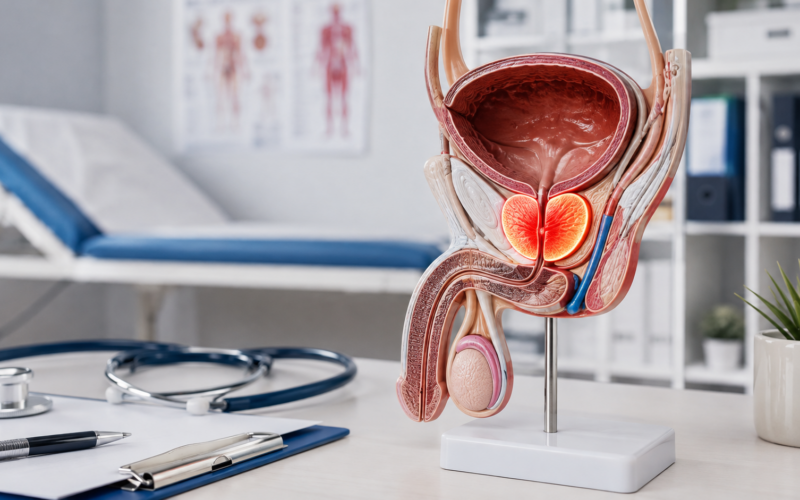
Prostatitis is a broad term used for conditions involving inflammation, infection, pain or functional problems affecting the prostate gland and the surrounding pelvic region. Although the name suggests a single disease, prostatitis actually includes several different clinical conditions, ranging from sudden bacterial infection requiring prompt treatment to long-lasting pelvic pain that may occur without any detectable bacterial infection.
The prostate is a small gland in the male reproductive system located below the urinary bladder and in front of the rectum. It surrounds part of the urethra, the tube through which urine leaves the body. Because of this position, inflammation or swelling involving the prostate can cause urinary symptoms such as painful urination, difficulty starting urine flow, increased urinary frequency and a feeling that the bladder has not emptied completely.
Prostatitis can affect adult men of different ages and should not be confused with prostate enlargement or prostate cancer. Some forms develop rapidly and may cause fever, chills and severe discomfort, while others produce persistent pelvic, urinary or sexual symptoms lasting for months.
Understanding the different types of prostatitis is important because treatment depends heavily on whether bacteria are causing the condition. Antibiotics can be essential in bacterial prostatitis, but they are not automatically useful for every person with chronic pelvic or prostate-related symptoms.
What is prostatitis and how does inflammation of the prostate gland affect urination and pelvic health?
Prostatitis refers to a group of disorders involving the prostate gland or the tissues and nerves surrounding it. In some cases, bacteria infect the prostate and produce clear inflammation. In others, patients experience chronic pain and urinary symptoms even though routine testing does not reveal a persistent bacterial infection.
The prostate contributes fluid to semen and lies close to several structures involved in urination and sexual function. When inflammation, infection or muscle dysfunction develops in this area, symptoms can therefore involve the urinary tract, pelvic region, genital area and sometimes sexual activity.
Prostate inflammation can make the urethral passage more sensitive or interfere with normal urine flow. Patients may experience burning during urination, urinary urgency or a need to urinate more often than usual. Some feel discomfort in the lower abdomen, groin, perineum or lower back.
The severity of prostatitis varies greatly. Acute bacterial prostatitis may develop suddenly and make a person significantly unwell, whereas chronic prostatitis or chronic pelvic pain syndrome can produce fluctuating symptoms over a much longer period.
What causes prostatitis and how can bacteria, urinary infections and pelvic dysfunction contribute to symptoms?
The causes of prostatitis depend on the particular form of the disorder. Bacterial prostatitis occurs when microorganisms infect the prostate gland. Bacteria commonly associated with urinary tract infections can sometimes travel through the urinary system and reach the prostate.
Infection may occasionally be associated with urinary procedures, catheter use or other circumstances that allow bacteria to enter the urinary tract. Certain sexually transmitted infections may produce urethral or genital symptoms that can overlap with prostatitis, although sexually transmitted infection is not the cause of most prostatitis cases.
Chronic pelvic pain syndrome is more complicated. In many patients with persistent prostatitis-like symptoms, doctors cannot identify an ongoing bacterial infection. Researchers believe several mechanisms may contribute, including pelvic floor muscle dysfunction, abnormal nerve signalling, inflammation, previous infection and heightened sensitivity within the nervous system.
Stress may worsen symptoms in some individuals because pelvic muscles can tighten and pain-processing pathways can become more sensitive. This does not mean that chronic pelvic pain is imaginary. Instead, it illustrates how muscles, nerves, inflammation and pain perception can interact in long-lasting pelvic disorders.
Injury or irritation involving the pelvic region may also contribute to symptoms in some people. Because different mechanisms can produce similar complaints, diagnosis often requires more than simply assuming that prostate pain is caused by bacteria.

What are the main classifications of prostatitis and why does the type determine the correct treatment?
Modern clinical classification generally separates prostatitis into acute bacterial prostatitis, chronic bacterial prostatitis, chronic prostatitis or chronic pelvic pain syndrome, and asymptomatic inflammatory prostatitis.
Acute bacterial prostatitis is a sudden bacterial infection of the prostate. Symptoms may develop quickly and can include fever, chills, painful urination, pelvic discomfort and difficulty passing urine. Because bacterial infection can occasionally spread into the bloodstream or cause urinary retention, acute prostatitis can require urgent medical treatment.
Chronic bacterial prostatitis occurs when bacterial infection persists or repeatedly returns over a longer period. Symptoms are often less dramatic than those seen with acute infection. Patients may experience recurrent urinary tract infections, pelvic discomfort, urinary problems or pain associated with ejaculation.
Chronic prostatitis or chronic pelvic pain syndrome is the most complex category and is frequently associated with pain lasting for at least several months. Bacteria may not be detected despite persistent symptoms. Treatment therefore often focuses on several possible contributing factors rather than relying exclusively on antibiotics.
Asymptomatic inflammatory prostatitis refers to inflammation detected during investigations performed for another reason even though the individual does not report typical prostatitis symptoms. It generally does not produce the same clinical problems as symptomatic forms.
What are the common symptoms of prostatitis and how can acute and chronic symptoms differ in men?
Symptoms of prostatitis depend on the underlying cause and the duration of the condition. Urinary discomfort is common because the prostate surrounds the urethra and sits directly below the bladder.
Some patients experience burning or pain while urinating. Others notice a frequent need to urinate, particularly at night, or a sudden strong urge to empty the bladder. Urine flow may become weak, interrupted or difficult to start.
Pain can occur in the lower abdomen, groin, perineum, penis, testicles, lower back or around the rectal area. Chronic prostatitis may produce discomfort that moves between different pelvic regions or changes in intensity over time.
Pain during or after ejaculation can occur, particularly in chronic prostatitis or chronic pelvic pain syndrome. Some men also report changes in sexual function, although these symptoms may arise from several interacting physical and psychological factors.
Acute bacterial prostatitis can produce more severe systemic symptoms. Fever, chills, fatigue, body aches and significant pelvic pain may develop alongside urinary symptoms. Difficulty passing urine may become pronounced.
Discharge from the penis is not considered a defining symptom of prostatitis and may suggest urethritis or a sexually transmitted infection. Anyone experiencing penile discharge should seek medical evaluation so the underlying cause can be identified correctly.
When can prostatitis symptoms become serious enough to require urgent medical assessment?
Certain symptoms associated with suspected prostatitis require prompt medical attention. A combination of high fever, chills, significant pelvic pain and painful urination may suggest acute bacterial prostatitis or another serious urinary infection.
Inability to pass urine is another important warning sign. Acute swelling and inflammation can occasionally obstruct urine flow, producing urinary retention that requires immediate medical care.
Severe weakness, confusion, rapid breathing, dizziness or other signs of systemic illness can indicate that an infection has become more serious. Bacteria originating in the urinary tract or prostate can occasionally enter the bloodstream and cause sepsis.
Blood in the urine, severe testicular pain or rapidly worsening symptoms also deserve medical assessment because conditions other than prostatitis may produce similar complaints.
Persistent urinary or pelvic symptoms should not be ignored even when they are mild. Prostate enlargement, urinary tract infection, bladder disorders, urethral disease and other conditions can overlap with prostatitis, making proper diagnosis important.
How do doctors diagnose prostatitis and distinguish bacterial infection from chronic pelvic pain syndrome?
Diagnosis usually begins with a detailed medical history. A doctor may ask when symptoms started, where pain occurs, whether urination has changed, whether fever is present and whether similar episodes have happened before.
A urine sample may be tested for signs of infection and bacteria. Urine culture can be especially useful when bacterial prostatitis is suspected because identifying the organism can help guide antibiotic selection.
Blood tests may be required in patients who appear systemically unwell. Depending on the clinical situation, doctors may also investigate sexually transmitted infections or other urinary conditions.
Physical examination can include assessment of the abdomen and external genital region. A clinician may perform a digital rectal examination to evaluate the prostate, although examination must be performed carefully when acute bacterial prostatitis is suspected because the gland can be very tender.
Additional investigations depend on the severity and pattern of symptoms. Persistent or recurrent problems may require evaluation by a urologist. Imaging or tests of urinary function can sometimes be used when obstruction, abscess formation, structural abnormalities or another diagnosis is suspected.
How is acute bacterial prostatitis treated and when are antibiotics medically necessary?
Acute bacterial prostatitis requires antibiotic treatment because bacteria are responsible for the infection. The specific medicine and duration depend on several factors, including the severity of illness, probable organism, urine culture results, local antibiotic resistance patterns and the patient’s medical history.
Patients who are otherwise stable may sometimes be treated with oral antibiotics under medical supervision. People who are severely unwell, vomiting, unable to pass urine or showing signs of systemic infection may need hospital care and intravenous antibiotics.
Treatment must also take into account whether an antibiotic can reach effective concentrations within prostate tissue. Antibiotic selection has therefore traditionally included medicines with suitable prostate penetration, but treatment recommendations continue to change as resistance patterns and drug-safety considerations evolve.
Fluoroquinolone antibiotics have historically been used in selected cases of bacterial prostatitis because of their prostate penetration, but they can cause important adverse effects and are not suitable for everyone. Their use should therefore be determined by a clinician rather than taken as a routine or self-directed treatment.
Trimethoprim-containing regimens may be considered in some bacterial infections when the organism is susceptible and the medicine is appropriate for the individual. Culture-guided therapy is particularly valuable because unnecessary or ineffective antibiotic use can contribute to antimicrobial resistance.
How is chronic bacterial prostatitis treated when urinary infections repeatedly return over time?
Chronic bacterial prostatitis often requires a longer course of appropriately selected antibiotic therapy than a simple bladder infection because bacteria can persist within prostate tissue.
Doctors usually try to identify the responsible bacteria through urine culture or other testing. Antibiotic choice should be based on susceptibility whenever possible, especially in patients who have already received several courses of antimicrobial treatment.
Recurrent urinary infections may prompt investigation for factors that allow infection to persist, such as urinary obstruction, stones or structural abnormalities.
Even after bacterial infection has been successfully treated, some patients may continue to experience pain or urinary symptoms. This can happen because inflammation, pelvic muscle tension or nerve sensitization may persist after the original infection has resolved.
For this reason, persistent symptoms do not necessarily mean that additional antibiotics are required. Reassessment is important before repeated courses of medication are prescribed.
How is chronic prostatitis or chronic pelvic pain syndrome treated when no infection is detected?
Chronic prostatitis or chronic pelvic pain syndrome usually requires a broader management strategy because no single cause explains every case.
Treatment may focus on urinary symptoms, pain, pelvic floor muscle dysfunction and other individual features. Medicines known as alpha blockers may sometimes be prescribed to relax muscles around the prostate and bladder outlet, potentially improving urine flow or discomfort in selected patients.
Pain-relieving or anti-inflammatory medicines may be used for symptom control when medically appropriate. Warm baths and strategies that reduce prolonged pelvic pressure may provide additional comfort for some individuals.
Pelvic floor physiotherapy has become increasingly relevant when abnormal muscle tension or coordination contributes to chronic pelvic pain. Treatment may involve relaxation techniques and targeted physical therapy rather than strengthening exercises alone.
Some patients require a combination of approaches because chronic pelvic pain involves several biological systems. Management can therefore include urology, pain medicine, pelvic physiotherapy and strategies for addressing sleep or stress-related symptom amplification.
The important principle is that long-lasting prostatitis symptoms should not automatically lead to repeated antibiotic treatment when bacterial infection has not been demonstrated.
Can prostatitis affect sexual function, fertility or quality of life over the long term?
Prostatitis can affect sexual wellbeing, particularly when pelvic discomfort becomes persistent. Pain during or following ejaculation is one of the better-recognized symptoms associated with chronic prostatitis and chronic pelvic pain syndrome.
Persistent pelvic pain may also affect sexual desire or erectile function indirectly through discomfort, anxiety, sleep disruption and concern about triggering symptoms.
The relationship between prostatitis and fertility is complicated. Inflammation or infection can potentially influence semen characteristics in some circumstances, but having prostatitis does not automatically mean that a man will become infertile.
Anyone experiencing fertility concerns alongside recurrent infection or chronic pelvic symptoms should discuss the issue with a healthcare professional rather than assuming that prostate inflammation is the cause.
Quality of life is often one of the most important aspects of chronic prostatitis. Symptoms can interfere with work, exercise, sleep, relationships and everyday activities, making long-term management as important as simply treating isolated episodes of pain.
What should men remember about prostatitis symptoms, bacterial infection and modern treatment options?
Prostatitis describes several different disorders rather than one single prostate disease. Acute and chronic bacterial prostatitis involve infection and usually require appropriately selected antibiotics, while chronic prostatitis or chronic pelvic pain syndrome frequently occurs without evidence of ongoing bacterial infection.
Symptoms can include painful or difficult urination, urinary frequency, pelvic discomfort, pain around the genital or perineal region and discomfort associated with ejaculation. Sudden fever, chills, severe pain or inability to urinate can indicate a more serious condition requiring urgent assessment.
Modern treatment therefore depends on accurate classification. Antibiotics have an essential role when bacterial infection is present, but repeated antibiotic courses are not an appropriate universal treatment for chronic pelvic symptoms without evidence of infection.
A detailed clinical assessment can help distinguish bacterial prostatitis from urinary tract disorders, sexually transmitted infections, prostate enlargement and chronic pelvic pain syndrome. Recognizing these differences allows treatment to target the actual cause of symptoms rather than simply treating every episode as a prostate infection.
Prostatitis also demonstrates how modern medicine increasingly approaches chronic symptoms through several interacting systems. Infection, inflammation, urinary function, pelvic muscles and nerve signalling can all influence the condition. Understanding these mechanisms can help patients and health-science students see why prostatitis management ranges from antibiotics in acute infection to multidisciplinary care for persistent pelvic pain.
Discover more from Business-News-Today.com
Subscribe to get the latest posts sent to your email.