


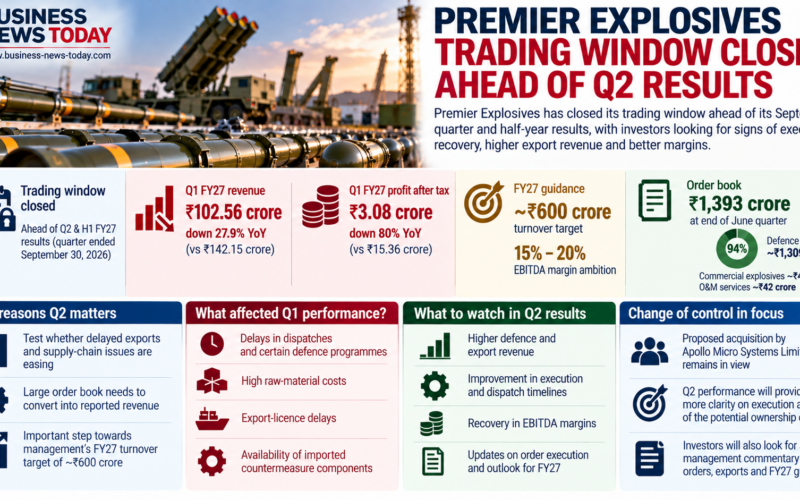
Premier Explosives Limited (NSE: PREMEXPLN), the Hyderabad-based manufacturer of high-energy materials, solid propellants, explosives and defence products, has informed the National Stock Exchange of India about closure of the trading window ahead of its financial results for the quarter and half-year ending September 30, 2026. The disclosure is procedural under insider-trading regulations, but the coming results carry substantially greater significance for the company after Q1 FY27 revenue fell nearly 28% year on year and consolidated profit after tax dropped about 80%. Management has been targeting a material improvement in execution during subsequent quarters, supported by a ₹1,393 crore order book that was 94% defence-related at the end of the June quarter. The September-quarter numbers will therefore test whether delayed exports, supply-chain problems and raw-material constraints are beginning to ease at the same time as Premier Explosives moves closer to a change of control under the proposed acquisition by Apollo Micro Systems Limited.
The latest filing does not itself announce the Q2 result date or provide new operating guidance. Its importance is that the September reporting period is nearing completion at a time when management has already set ambitious full-year expectations and identified Q2 as an important recovery period. Premier Explosives had indicated a fiscal 2027 turnover target of around ₹600 crore and an EBITDA margin ambition of roughly 15% to 20%, leaving the company with considerable execution work after generating only about ₹102.6 crore of revenue from operations in the first quarter.
Why are Premier Explosives Q2 FY27 results more important than a routine trading-window disclosure?
Premier Explosives entered fiscal 2027 with a large defence-led order book but produced a weak first-quarter financial performance. Consolidated revenue from operations fell to approximately ₹102.56 crore from ₹142.15 crore a year earlier, a decline of about 27.9%. Consolidated profit after tax dropped to roughly ₹3.08 crore from ₹15.36 crore, while earnings per share declined to ₹0.57 from ₹2.85.
Profitability weakened faster than revenue. Profit before tax fell about 77.9% year on year to approximately ₹4.16 crore, while operating profitability was pressured by execution timing, high raw-material costs and a less favourable mix. Management linked part of the deterioration to delays affecting dispatches and certain defence programmes rather than indicating that the underlying order pipeline had collapsed.
That makes Q2 an important operating test. A company carrying more than ₹1,300 crore of orders can still report volatile quarterly earnings if export licences, imported components, customer clearances or production schedules delay dispatches. Premier Explosives needs to demonstrate that its large backlog can increasingly convert into reported revenue while restoring the stronger margins visible in earlier periods.
The comparison is particularly demanding because management has continued to guide toward substantially higher full-year turnover. With only a little more than ₹100 crore generated in Q1, achieving approximately ₹600 crore for fiscal 2027 would require a pronounced acceleration across the remaining three quarters. Q2 will provide the first evidence of whether that acceleration has started.
Can Premier Explosives convert its ₹1,393 crore order book into faster revenue during Q2 FY27?
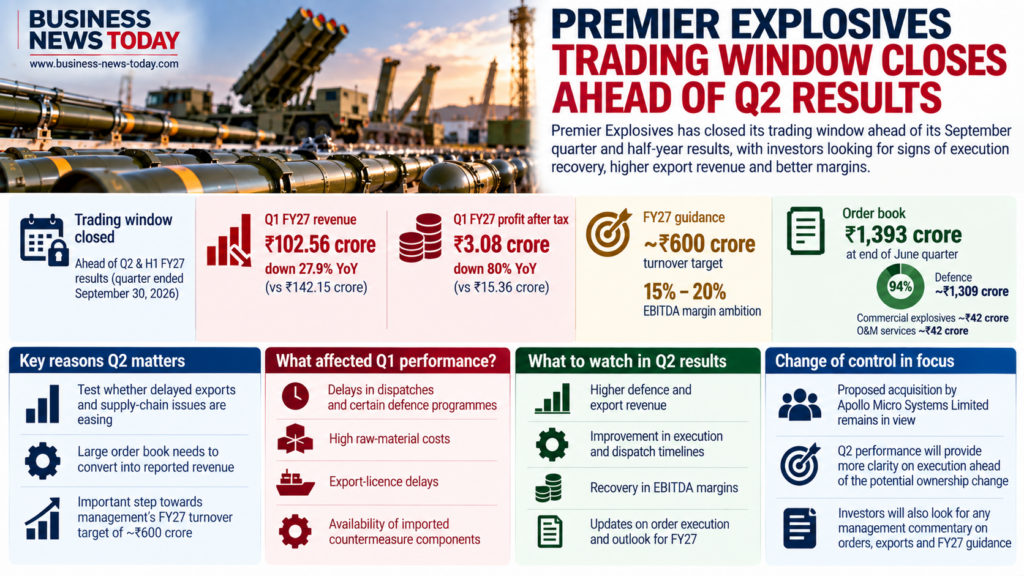
Premier Explosives reported an order book of approximately ₹1,393 crore at the time of its Q1 FY27 earnings discussion. Defence accounted for about ₹1,309 crore, or 94% of the total, while commercial explosives and operations and maintenance services contributed roughly ₹42 crore each. The backlog was therefore equivalent to more than three times fiscal 2026 revenue, giving the company considerable theoretical revenue visibility.
The difficulty is timing. Defence manufacturing contracts often involve qualification procedures, customer inspections, export licences, imported inputs and programme-specific production schedules that can shift revenue recognition between quarters. Premier Explosives experienced several of those constraints in Q1, with management indicating that export-licence delays and availability of imported countermeasure components had held back dispatches.
Management subsequently said several export licences had been received and materials had begun leaving factories. It also indicated that some business delayed from earlier periods should be executed during the September quarter. That makes actual Q2 defence and export revenue one of the clearest measures of whether the operational bottleneck is easing.
The order book also provides enough work to support growth beyond one quarter. Even if Premier Explosives does not produce a dramatic Q2 rebound, sustained conversion through fiscal 2027 and fiscal 2028 could still underpin a stronger revenue base. The more immediate issue is whether execution improves quickly enough to support management’s current fiscal 2027 ambitions rather than forcing another adjustment to the expected revenue trajectory.
Why could export revenue become the biggest swing factor in Premier Explosives’ September quarter?
Exports have become increasingly important as Premier Explosives seeks to expand beyond domestic defence procurement and participate in the international market for energetic materials and defence products. During its Q1 earnings discussion, management indicated that it was targeting approximately ₹150 crore to ₹200 crore of export revenue during the September quarter, subject to licences, dispatches and execution.
That range is substantial when compared with Q1 revenue from operations of ₹102.56 crore. Even delivery toward the lower end would represent a major contribution to quarterly sales, although the final reported revenue will depend on the timing of shipment and recognition. The comparison illustrates why export execution can create significant quarter-to-quarter volatility for a company of Premier Explosives’ current revenue scale.
Premier Explosives had already secured a major export order worth approximately ₹350.23 crore during April 2026 from international customers for defence products. Large export contracts can strengthen utilisation and diversify the customer base, but they also create dependence on government permissions, international logistics and customer delivery schedules. The September quarter should provide more evidence on how quickly the ₹350 crore-plus opportunity is moving from order book into revenue.
A stronger export contribution would also affect product mix. Defence and space activities generally carry different economics from conventional industrial explosives, and Premier Explosives’ improved fiscal 2026 profitability despite lower annual revenue illustrated how mix can influence margins. Q2 investors therefore need to consider not only the amount of revenue generated but also which programmes generated it.
What happened to Premier Explosives profitability after its strong fiscal 2026 performance?
The weak June quarter followed a fiscal year in which Premier Explosives actually improved earnings despite lower revenue. Fiscal 2026 revenue from operations fell approximately 7% to ₹388.34 crore, but profit after tax increased about 60.5% to ₹45.83 crore. EBIT rose roughly 42% to ₹69.28 crore, lifting the EBIT margin to approximately 17.8%.
Defence and space accounted for approximately ₹315.4 crore, or 81% of annual revenue, while commercial explosives contributed around ₹72.9 crore. That mix, together with other income and programme economics, helped Premier Explosives increase earnings even as the top line contracted. The performance demonstrated the potential profitability available when higher-value defence work is executed in a favourable mix.
Q1 FY27 produced almost the opposite outcome. Revenue declined sharply and profitability compressed as delays, raw-material costs and programme mix moved against the company. Consolidated profit after tax of roughly ₹3.08 crore represented a PAT margin of only about 3%, far below the fiscal 2026 level.
Management has continued to discuss a 15% to 20% EBITDA margin objective for fiscal 2027, meaning the remaining quarters need to compensate for the weak start if the company is to approach that range for the year. Q2 does not need to resolve every operational issue, but improvement in margins alongside higher revenue would give considerably more credibility to the full-year target.
How does the Apollo Micro Systems takeover change the backdrop for Premier Explosives Q2 results?
Premier Explosives is simultaneously moving through one of the most consequential ownership changes in its history. Apollo Micro Systems Limited signed a definitive agreement in July to acquire 2,22,21,735 Premier Explosives shares from the promoter AKS Family Trust, representing a 41.33% stake, for an aggregate cash consideration of approximately ₹1,550 crore.
The agreed transaction price works out at roughly ₹698 per Premier Explosives share. The change of control also triggered a mandatory open offer through which Apollo Micro Systems Limited has offered to acquire up to another 1,39,77,911 shares, representing 26% of Premier Explosives’ voting capital, at ₹698 per share. Full acceptance of that open offer would require approximately ₹975.66 crore in additional consideration.
The regulatory pathway advanced materially in September. The Competition Commission of India concluded that the proposed transaction did not constitute a notifiable combination under the applicable thresholds and therefore did not require its approval. That removed one of the conditions that had affected the open-offer timetable, with the remaining takeover and tender-offer procedures now able to progress.
The combination has an industrial rationale beyond ownership. Apollo Micro Systems Limited is active across defence electronics, avionics, weapon-system electronics and related technologies, while Premier Explosives brings capabilities in high-energy materials, solid propellants, pyrotechnics, rocket motors and ammunition-related products. The proposed transaction could therefore create a broader defence manufacturing platform if operational capabilities and customer relationships can be combined effectively after completion.
For Premier Explosives shareholders, however, Q2 remains relevant irrespective of the takeover. Apollo Micro Systems is acquiring a controlling stake in an operating business whose value ultimately depends on order execution, margins, capacity and cash generation. Stronger September-quarter performance would provide evidence that the underlying business is entering the ownership transition with improving momentum.
How does the ₹698 open-offer price compare with Premier Explosives’ latest market price?
Premier Explosives shares closed at approximately ₹680.35 on September 25, leaving the stock about 2.5% below the ₹698 open-offer price. The proximity means the market price is currently sitting relatively close to the announced transaction benchmark rather than trading at the much wider discount that can emerge when investors perceive substantial completion risk.
The stock remains well above its 52-week low of around ₹378.40 but below its 52-week high near ₹829.80. At the latest close, Premier Explosives had gained substantially from the bottom of its annual range while remaining roughly 18% below the 52-week peak.
The takeover price creates an unusual market backdrop for the coming results. Near-term share-price behaviour can reflect expectations around the open offer and transaction completion as well as earnings, meaning a quarterly result may not produce the same valuation response it would for a company without a pending control transaction. Investors will therefore need to separate operating performance from deal-related price anchoring.
The September quarter remains economically relevant because Apollo Micro Systems Limited’s proposed acquisition does not eliminate operating risk. Premier Explosives must still manufacture products, fulfil contracts, manage raw-material costs, complete capacity investments and meet customer schedules. The stronger those fundamentals become, the more strategically valuable the underlying business could be after the ownership transition.
Could Premier Explosives’ capacity expansion support the ₹600 crore fiscal 2027 revenue target?
Premier Explosives has been investing in manufacturing capability to support its larger defence order book. One important focus is the company’s Katepally facility in Telangana, where additional equipment and capacity for high-energy materials are being progressively commissioned. Management has indicated that some facilities were expected to be capitalised across the early part of fiscal 2027, with further equipment scheduled to move toward commissioning around the September quarter.
The company has also been working to increase capabilities related to RDX and HMX-based products, defence explosives, propellants and associated systems. These investments are important because a ₹1,393 crore order book has limited economic value if production capacity, supply chains or qualification bottlenecks restrict the rate at which contracts can be executed.
Capacity additions can also change fixed-cost absorption. Higher utilisation generally allows manufacturing overheads to be spread across larger production volumes, potentially supporting margin recovery if input costs and pricing remain manageable. The benefit will only become visible once new equipment reaches commercial production and contributes consistently to dispatches.
Premier Explosives therefore enters the September-quarter reporting period with both demand visibility and execution pressure. The backlog is substantial, but management’s ₹600 crore turnover target requires the business to convert that backlog considerably faster than it did during the June quarter.
What would constitute a genuinely strong Q2 FY27 result for Premier Explosives?
Revenue growth alone would be an incomplete measure because Q1 demonstrated how quickly margins can deteriorate when input costs and product mix turn unfavourable. A stronger Q2 would ideally combine accelerated revenue recognition with recovery in EBIT or EBITDA margins and a meaningful contribution from the defence and export portfolio.
Export execution will be particularly informative given management’s ₹150 crore to ₹200 crore September-quarter aspiration. If the company reports substantially higher overseas dispatches, that would indicate that some of the licensing and logistical constraints cited during Q1 have cleared. If exports remain materially below management’s earlier expectations, investors will need to determine whether the missing revenue has merely shifted into later quarters or reflects a more persistent constraint.
Order-book movement is another important indicator. Premier Explosives began Q1 with an exceptionally strong backlog and continued to pursue domestic and international defence opportunities. The combination of new order inflows and recognised revenue will reveal whether the backlog can remain elevated even as the company increases execution.
Margins provide the final test. Premier Explosives produced a fiscal 2026 EBIT margin approaching 18%, followed by a sharp contraction in Q1 FY27. Movement back toward management’s 15% to 20% annual EBITDA objective would suggest that product mix, raw-material sourcing and production utilisation are normalising.
The September 27 trading-window filing may be procedural, but the financial period it precedes is not. Premier Explosives is entering Q2 reporting with a ₹1,393 crore defence-heavy backlog, a ₹600 crore annual turnover ambition, a major export programme and a proposed ₹1,550 crore change-of-control transaction progressing toward completion. The next results will show whether those large strategic numbers are beginning to translate into a stronger quarterly income statement.
Key takeaways as Premier Explosives approaches its Q2 FY27 results
- Premier Explosives Limited has announced its trading-window closure ahead of the quarter and half-year ending September 30, 2026.
- The disclosure itself is procedural and does not announce the Q2 result date or new financial guidance.
- Q1 FY27 consolidated revenue from operations fell about 27.9% year on year to ₹102.56 crore.
- Consolidated profit after tax declined about 80% to ₹3.08 crore in the June quarter.
- Premier Explosives carried an approximately ₹1,393 crore order book at Q1, with defence accounting for about 94%.
- Management has discussed a fiscal 2027 turnover target of around ₹600 crore and an annual EBITDA margin goal of approximately 15% to 20%.
- Management had targeted approximately ₹150 crore to ₹200 crore of export revenue during the September quarter, making export execution an important Q2 indicator.
- Apollo Micro Systems Limited has agreed to acquire a 41.33% controlling stake in Premier Explosives for approximately ₹1,550 crore.
- The associated mandatory open offer covers another 26% of Premier Explosives at ₹698 per share, while the stock closed at about ₹680.35 on September 25.
- Revenue acceleration, export dispatches, margin recovery and order-book conversion will provide the clearest evidence of whether Premier Explosives is recovering from its weak Q1.
Discover more from Business-News-Today.com
Subscribe to get the latest posts sent to your email.