

Picard Medical, Inc. (NYSE American: PMI) will implement a 1-for-50 reverse stock split after shareholders authorised the board to select a ratio between 1-for-15 and 1-for-50. The split is expected to become effective at 5 p.m. Eastern Time on July 31, 2026, with split-adjusted trading scheduled to begin on August 3. PMI shares closed the July 21 regular session at $0.1205, down 4.14%, before the announcement was released, and overnight indications later placed the stock near $0.108. The consolidation is intended to increase the per-share price and support continued NYSE American listing compliance. The central tension is that a reverse split can change Picard Medical’s quoted share price, but it cannot independently repair its stockholders’ deficit, reduce cash consumption or improve the economics of the underlying medical-device business.
How will Picard Medical’s 1-for-50 reverse stock split change existing PMI shares?
Every 50 issued and outstanding Picard Medical shares will automatically be combined into one share for holders of record at the close of trading on July 31. The ticker will remain PMI, although the shares will trade under a new CUSIP number, 71953R 207.
Using the July 21 regular-session closing price purely as a reference, a proportionate adjustment would translate $0.1205 into approximately $6.03 per post-split share. That figure is not a target or guaranteed opening price. Market demand, liquidity and subsequent trading can cause the adjusted stock to open or trade above or below its mathematical equivalent.
Picard Medical reported 102,695,935 shares entitled to vote as of the June 26 annual-meeting record date. Applying the selected ratio to that figure would reduce the share count to approximately 2.05 million, subject to changes since the record date and the treatment of fractional interests.
No fractional shares will be issued. Any fractional entitlement will instead be rounded up to the nearest whole post-split share. Equity awards, warrants and other convertible securities will be adjusted proportionately, including the number of underlying shares and their applicable exercise or conversion prices.
Shareholders holding PMI electronically through a broker or in book-entry form are not expected to take any action. Continental Stock Transfer & Trust Company will act as the exchange agent.
Most importantly, the consolidation does not create economic value by itself. An investor’s number of shares will fall while the price per share should rise proportionately, leaving the initial value and percentage ownership broadly unchanged apart from fractional-share adjustments.
Does the Picard Medical reverse stock split resolve its NYSE American compliance problems?
The disclosed NYSE American notices concern Picard Medical’s stockholders’ equity rather than simply a conventional minimum bid-price deficiency. That distinction matters because raising the quoted share price does not increase total stockholders’ equity.
Picard Medical received its first notice on May 8 after reporting approximately $3.8 million in stockholders’ equity at December 31, 2025. That figure was below the $4 million required under Section 1003(a)(ii) of the NYSE American Company Guide for a company that has reported losses in three of its four most recent fiscal years.
A second notice followed on May 15 after Picard Medical reported a stockholders’ deficit of approximately $1.4 million at March 31, 2026. This placed the company below the $2 million equity threshold under Section 1003(a)(i), which applies when losses have been reported in two of the three most recent fiscal years.

Picard Medical subsequently submitted a compliance plan outlining how it intends to regain compliance by November 8, 2027. The notices did not immediately delist the shares or halt trading, although a “.BC” designation was added to indicate that the company was below compliance.
The reverse split can still help the broader listing effort. A higher nominal price may reduce the risk associated with abnormally low-priced trading, improve marketability and make PMI eligible for consideration by investors or counterparties with minimum-price restrictions. It may also make the stock appear less like a fraction-of-a-dollar security.
However, the accounting treatment is clear. The reverse split reduces the number of shares used to calculate per-share figures but does not increase total stockholders’ equity. Picard Medical must address the equity deficiency through operating improvement, additional capital, liability management or some combination of these measures.
Why has PMI stock sentiment remained weak despite Picard Medical’s commercial progress?
PMI’s market performance indicates that investors remain cautious about financing, listing compliance and execution. Picard Medical completed its initial public offering in August 2025 at $4 per share, meaning the July 21 close of $0.1205 represented a decline of approximately 97% from the offering price.
The stock has traded within a 52-week range of approximately $0.1077 to $13.68. Its July 21 close was therefore only about 12% above the 52-week low, while overnight trading indications brought it even closer to that level. PMI had also lost roughly 14% over the preceding five regular trading sessions and approximately 38% over one month.
Around 9.1 million shares changed hands during the July 21 session, below a recent average that has been elevated by several unusually active trading days. Such activity shows that PMI can attract bursts of speculative interest, but it does not establish that longer-term institutional demand has developed.
The timing of the announcement requires careful interpretation. Picard Medical released the reverse-split decision after the regular market had closed, so the 4.14% decline during regular trading cannot reasonably be attributed to that announcement. Overnight indications near $0.108, approximately 10% below the regular close, showed additional weakness after the release, although extended-hours prices can be volatile and less liquid.
The cautious reaction is understandable. Reverse splits are frequently interpreted as defensive corporate actions because they often follow a prolonged share-price decline. Picard Medical can challenge that perception only by retaining a meaningful portion of the adjusted price and pairing the consolidation with stronger financial results.
Can Picard Medical’s revenue growth and debt reduction close the underlying equity gap?
Picard Medical reported encouraging operating progress during the first quarter of 2026. Revenue increased 85% to $1.15 million from $620,000 a year earlier, supported by greater utilization of the SynCardia Total Artificial Heart and higher Freedom Driver rental income.
Gross profit improved to approximately $300,000, producing a 24% gross margin. That compared with a gross loss of roughly $400,000 and a negative 58% margin during the first quarter of 2025. The movement into positive gross profit is strategically important because it suggests that higher commercial activity and manufacturing efficiency can improve product economics.
The improvement has not yet reached the bottom line. Picard Medical recorded a first-quarter net loss of $7.62 million, compared with $5.56 million a year earlier. The latest loss included non-cash charges associated with debt settlement and fair-value adjustments, but operating cash usage still rose to $3.8 million from $2.24 million.
Cash and cash equivalents stood at only $121,000 at March 31, down from $7.45 million at the end of 2025. Much of that decline reflected deliberate debt repayment. During the quarter, Picard Medical repaid approximately $7.4 million of senior secured debt in cash, settled another $2.1 million through the issuance of 1.4 million shares and repaid about $900,000 of related-party debt.
After the quarter ended, the company raised approximately $5 million in gross proceeds through a public offering. It also reduced the remaining senior secured note balance to approximately $1.3 million and exchanged seven million existing warrants carrying a $2.675 exercise price for ten million warrants with a $0.35 exercise price.
These transactions reduced leverage and provided additional liquidity, but they also illustrate the company’s continuing dependence on external capital. Picard Medical’s filings have identified substantial doubt about its ability to continue as a going concern because of recurring losses, negative operating cash flow and future funding requirements.
The decisive financial test is therefore not the post-split price. It is whether commercial growth and future financing can rebuild stockholders’ equity faster than operating losses consume it.
Can SynCardia and the Emperor artificial heart program strengthen the PMI investment case?
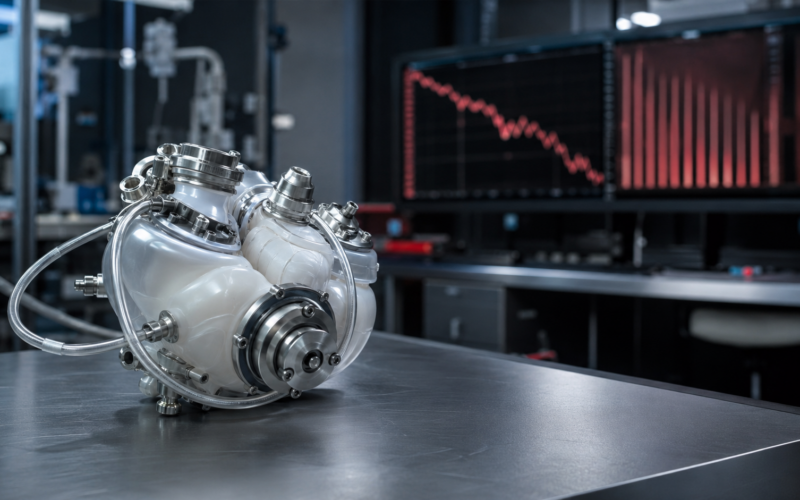
Picard Medical’s operating value is concentrated in SynCardia Systems, its wholly owned artificial-heart subsidiary. SynCardia manufactures the SynCardia Total Artificial Heart, which is commercially available in the United States and Canada for eligible patients with end-stage biventricular heart failure.
The installed clinical history provides Picard Medical with a genuine commercial foundation. The company reports that more than 2,100 SynCardia devices have been implanted across 27 countries. Its current strategy focuses on increasing utilization at transplant centres, expanding clinical training and growing the Freedom Driver rental programme.
Rental revenue reached approximately $207,000 in the first quarter, compared with just $7,000 a year earlier. Although still modest, recurring driver rentals could make revenue less dependent on individual device sales if the installed patient base expands.
Customer concentration remains a material execution factor. One customer represented 68% of first-quarter revenue, while two other customers accounted for 17% and 15%, respectively. All first-quarter revenue came from the United States. At Picard Medical’s present scale, changes in activity at a small number of transplant centres can have an outsized effect on quarterly performance.
The company is also developing the Emperor Total Artificial Heart, a fully implantable and driverless next-generation system. Management is targeting a clinical-study launch in 2028, subject to continued development, financing and regulatory progress. Emperor may broaden the long-term opportunity, but it will require sustained research and development spending before it can become a commercial contributor.
Execution is taking place during a leadership transition. Richard Fang became interim chief executive officer and remained chairman after Patrick Schnegelsberg stepped down in June. Fang has said the company will prioritise SynCardia adoption, manufacturing optimisation and continued Emperor development while the board searches for a permanent chief executive.
What evidence would show that Picard Medical’s reverse stock split is working?
The first measurable test will be whether PMI can retain a meaningful proportion of its split-adjusted price after August 3. A mechanical move from roughly $0.12 to around $6 per share would be cosmetic if continued selling quickly drives the adjusted price lower.
The next quarterly report will provide the more important evidence. Investors will need to see whether revenue growth remains strong, the positive gross margin is sustained and operating cash consumption begins to moderate. Updated cash, equity and financing figures will also show how much benefit remained from the May capital raise after subsequent spending.
Progress under the NYSE American compliance plan is another critical indicator. The reverse split may support the stock’s marketability, but the company must still demonstrate that it can restore stockholders’ equity and meet the exchange’s requirements by November 8, 2027.
Commercially, higher SynCardia utilization, broader transplant-centre participation and continued Freedom Driver rental growth would strengthen the operating thesis. Reduced customer concentration would make that growth more durable. For Emperor, clearly funded development milestones and credible progress toward the planned 2028 clinical study would support the longer-term opportunity.
The reverse split gives Picard Medical a cleaner quoted price and potentially more time to execute. What remains unresolved is whether the company can convert improving revenue and gross margins into lower cash burn, positive stockholders’ equity and a sustainable capital structure. The next financial filings, rather than the first post-split trade, will provide the clearest test.
What are the key investor takeaways from Picard Medical’s 1-for-50 reverse stock split?
- Picard Medical will combine every 50 PMI shares into one share, effective July 31.
- Split-adjusted trading is expected to begin on August 3 under the existing PMI ticker.
- The consolidation should raise the quoted price but does not create economic value by itself.
- Picard Medical’s disclosed NYSE American deficiencies concern stockholders’ equity.
- The company must regain compliance with the applicable listing standards by November 8, 2027.
- PMI closed July 21 at $0.1205, down 4.14%, before weakening further in overnight indications.
- First-quarter revenue rose 85%, while gross margin improved to a positive 24%.
- Net losses, operating cash consumption and the stockholders’ deficit remain the central financial risks.
- SynCardia utilization, Freedom Driver rentals and customer diversification are the key commercial indicators.
- Sustaining the post-split price will depend on operating evidence, liquidity and equity improvement.
Discover more from Business-News-Today.com
Subscribe to get the latest posts sent to your email.