

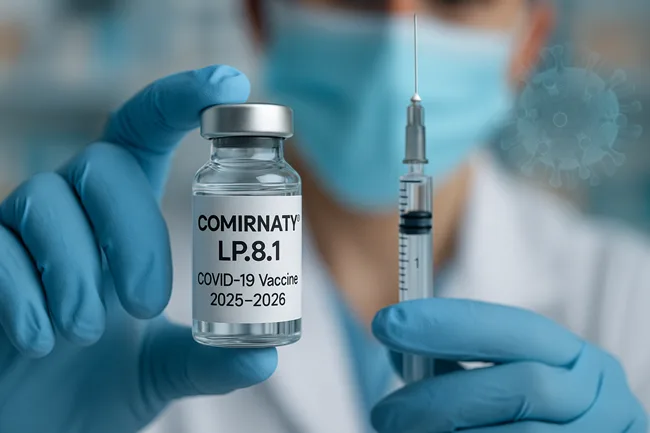
Pfizer Inc. (NYSE: PFE) and BioNTech SE (Nasdaq: BNTX) have received U.S. Food and Drug Administration (FDA) approval for their updated monovalent COVID-19 vaccine—COMIRNATY LP.8.1—designed to target the LP.8.1 sublineage of SARS-CoV-2. The authorization covers adults aged 65 and older, as well as individuals between 5 and 64 with underlying conditions that increase the risk of severe COVID-19 outcomes.
This regulatory milestone allows immediate shipment of the reformulated vaccine to pharmacies, clinics, and hospitals across the United States for the 2025–2026 respiratory season, reinforcing the dual push for preparedness and accessibility as sublineage-driven mutations continue to circulate.
What does FDA approval of COMIRNATY LP.8.1 mean for high-risk COVID-19 populations in 2025?
The supplemental Biologics License Application (sBLA) approval for COMIRNATY LP.8.1 is built on a robust and multi-dimensional evidence package, combining data from randomized clinical trials, extensive preclinical evaluations, and real-world observational studies. The FDA placed significant weight on safety and immunogenicity data, particularly from pediatric cohorts aged 5 to 11 years, where the LP.8.1-adapted vaccine demonstrated a favorable risk–benefit profile.
In addition to human clinical data, the application featured compelling results from animal model studies, which showed that the LP.8.1-specific monovalent formulation elicited stronger neutralizing antibody responses than earlier JN.1- and KP.2-adapted COVID-19 vaccines. These enhanced immune responses were observed across multiple circulating SARS-CoV-2 sublineages, suggesting broader cross-protection and greater alignment with the FDA’s directive to target currently dominant variants. This dataset reinforces the scientific rationale for selecting LP.8.1 as the strain for the 2025–2026 U.S. COVID-19 vaccine formulation and supports the vaccine’s use in high-risk populations, including older adults and individuals with comorbidities.
U.S. regulators had earlier recommended that fall 2025 vaccinations prioritize the LP.8.1 sublineage—identified as a more representative offshoot of the JN.1 lineage—given its rising prevalence and immune evasion patterns. Pfizer and BioNTech’s quick alignment with these regulatory cues demonstrates agility in mRNA platform adaptation, a hallmark of both companies’ pandemic-era development strategies.
How does COMIRNATY LP.8.1 compare to earlier Pfizer-BioNTech COVID-19 vaccines in effectiveness?
Data included in the sBLA submission indicated that the LP.8.1-adapted formulation outperformed previous iterations of the COMIRNATY vaccine—specifically those targeting the JN.1 and KP.2 sublineages—when tested against a panel of contemporary SARS-CoV-2 variants. The vaccine exhibited higher immune response titers against LP.8.1, XFG, and NB.1.8.1, among other sublineages.
Institutional sentiment has been cautiously positive, viewing the data as a sign that Pfizer and BioNTech can maintain relevance in the COVID-19 immunization landscape amid waning public demand and rising variant complexity. However, analysts also noted that commercial uptake will depend heavily on public health messaging and payer reimbursement strategies.
What does this approval signal about the mRNA platform’s future in infectious disease preparedness?
This FDA nod affirms continued regulatory confidence in the adaptability of mRNA-based vaccine technology. The COMIRNATY LP.8.1 shot, like its predecessors, was built using BioNTech’s proprietary mRNA platform, jointly developed and commercialized with Pfizer. The platform allows for rapid antigen updates with robust data collection pipelines, making it a template for future respiratory pathogen preparedness.
As of 2025, over 5 billion doses of the Pfizer-BioNTech COVID-19 vaccine have been administered globally. The formulation has been continuously supported by post-marketing pharmacovigilance data, along with clinical and manufacturing updates, reinforcing its safety and efficacy profile even as the virus evolves.
BioNTech remains the Marketing Authorization Holder for COMIRNATY and its lineage-adapted variants across key jurisdictions, including the United States, European Union, United Kingdom, and several other regions with emergency use or conditional approvals still in place.
How are Pfizer and BioNTech planning U.S. distribution for the 2025–2026 vaccine rollout?
Shipping of the newly approved vaccine has already begun, with both companies coordinating a national logistics campaign aimed at preemptive availability ahead of fall respiratory virus season. Initial supply will be routed to retail pharmacies, public health clinics, and hospital networks, with a focus on ensuring early access for older adults and at-risk groups.
While both firms did not disclose inventory volumes or specific state-level allocations, internal sources suggest a robust stockpile has been readied in parallel with the FDA’s anticipated guidance. The distribution process will leverage pre-existing cold chain infrastructure that was scaled during the pandemic years.
Public health officials expect that this year’s formulation may also serve as a stress test for renewed vaccination campaigns amid continued vaccine hesitancy and pandemic fatigue, particularly in younger, less vulnerable populations.
What is the current investor sentiment surrounding Pfizer and BioNTech’s COVID-19 franchise?
Pfizer Inc. (NYSE: PFE) and BioNTech SE (Nasdaq: BNTX) have faced continued pressure in public markets due to steep revenue declines in their COVID-19 vaccine and therapeutic segments. Institutional investors have largely recalibrated their expectations, shifting attention from pandemic-era windfalls to long-term mRNA portfolio diversification.
While the latest approval is not expected to significantly move revenue projections in the short term, it may help stabilize sentiment around Pfizer’s infectious disease business unit, which is navigating margin compression from generic erosion and post-COVID normalization. For BioNTech, the move aligns with its broader ambitions to deploy mRNA in oncology and rare diseases, where platform validation still depends on recurring commercial success.
Analysts have largely maintained neutral to cautious “hold” ratings on both stocks in the past quarter, citing a need for more durable pipeline contributions outside of COVID-19.
What are the broader implications for COVID-19 public health policy in the United States?
The 2025–2026 vaccine season marks a shift from reactive to predictive public health strategy. The LP.8.1-adapted vaccine—approved well in advance of peak transmission—mirrors seasonal flu model timelines and reflects the U.S. FDA’s pivot to a more regularized, strain-specific approach for SARS-CoV-2.
Experts believe the reauthorization of a tailored COMIRNATY formulation could encourage broader adoption of strain-matching standards globally, especially in markets where updated vaccines have lagged regulatory approval or face distribution bottlenecks. In parallel, this may help the Biden administration reinforce its pandemic exit strategy and future-proof emergency response infrastructure.
Still, questions remain about funding mechanisms for uninsured populations, especially after the sunset of federal procurement subsidies. The commercial payor environment will likely influence uptake rates—an area both Pfizer and BioNTech are closely monitoring.
Discover more from Business-News-Today.com
Subscribe to get the latest posts sent to your email.