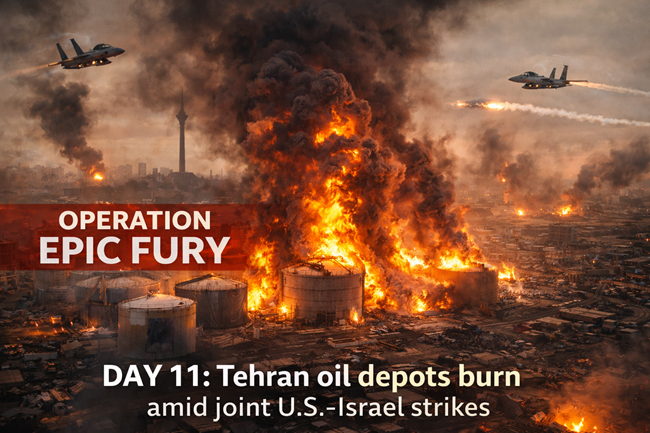
The United States and Israel have intensified their military campaign against Iran on the eleventh day of the conflict, with United States Defense Secretary Pete Hegseth declaring on Tuesday the most intense day of strikes yet under the joint operation known as Operation Epic Fury. The announcement came as joint United States-Israeli air strikes on Iranian oil storage and fuel distribution infrastructure marked what senior Iranian officials described as a new phase in the war, and as global energy markets continued to deteriorate amid sustained disruption across the Middle East and Gulf region.
Hegseth, speaking at a press conference at the Pentagon alongside General Dan Caine, the chairman of the Joint Chiefs of Staff, stated that Iran was badly losing on day ten of Operation Epic Fury and that the United States would not relent until the enemy was totally and decisively defeated. He said that President Donald Trump controlled the pace of operations and would determine when objectives had been achieved, adding that the administration would not pursue what he called nation-building efforts of the kind undertaken in Iraq and Afghanistan. Trump posted on Truth Social that if Iran took any action to stop oil flowing through the Strait of Hormuz, it would be struck twenty times harder by the United States than it had been struck so far.
Trump, in a phone call with CBS News on Monday, described the war as very complete, pretty much, while separately telling Republican lawmakers that the United States still needed to achieve ultimate victory. The contradictory characterisations reflected an ongoing ambiguity within the Trump administration regarding both the timeline and ultimate objectives of Operation Epic Fury, which United States officials have described at various points as being aimed at destroying Iran’s missile capabilities, preventing Iran from acquiring a nuclear weapon, and achieving regime change.
How did US and Israeli strikes on Tehran oil facilities escalate the Iran conflict on day nine?
Joint United States-Israeli air strikes on the night of Saturday, March 7 hit four oil storage facilities and an oil transfer and production centre in Tehran and the neighbouring Alborz province. Iran’s oil distribution company said four of its employees were killed. Large fires broke out across the targeted sites, thick plumes of smoke rose over the Iranian capital, and a dark haze hung over Tehran on Sunday as the smell of burning oil lingered in the air.
The targeted facilities included the Aghdasieh oil warehouse in northeast Tehran, the Tehran refinery in the south, and the Shahran oil depot in the west. Witnesses reported that oil from the Shahran depot had leaked into nearby streets. Iran’s Ministry of Oil confirmed that multiple oil storage depots in the provinces of Tehran and Alborz had been struck.
The Israeli military confirmed it had struck fuel storage and energy complexes in Tehran, stating the facilities were being used by Iran’s armed forces and describing the operation as a significant strike aimed at dismantling the government’s military infrastructure. Israeli Prime Minister Benjamin Netanyahu said his government would press on with the assault and strike Iran’s rulers without mercy, adding that his government had many more targets.
Reporting from Tehran characterised the scale of attacks on civil industrial fuel facilities as unprecedented within the current conflict, noting that prior strikes on fuel depots during the June 2025 twelve-day war between Iran and Israel had not reached comparable levels of disruption. A senior Iranian official told CNN that the attacks on oil and fuel depots had pushed the war into a new phase and threatened retaliatory strikes on energy infrastructure across the region. Iran’s Foreign Ministry spokesperson stated that Tehran had no interest in negotiations while it remained under attack.
Iran’s Islamic Revolutionary Guard Corps spokesperson Ali Mohammed Naini told Iranian state media that Iran, not the United States, would determine when the war ends. Iranian Foreign Minister Abbas Araghchi said in an interview that negotiations with the United States would not return to the table, citing what he described as a very bitter experience of indirect nuclear talks that had collapsed once the fighting began.
What are the consequences of the Iran war for global oil prices and the Strait of Hormuz?
Brent crude oil surged past $100 per barrel when energy markets opened on Sunday, the first time prices had reached triple digits since Russia’s full-scale invasion of Ukraine in 2022. The price briefly approached $120 before retreating. In the week following the start of the conflict, Brent crude recorded a 27 percent weekly gain, the largest single-week increase since the COVID-19 pandemic in 2020.
The Strait of Hormuz, which Iran controls on its northern side, is described by the United States Energy Information Administration as a critical oil chokepoint through which approximately 20 million barrels of oil and liquefied natural gas pass daily, representing about 20 percent of global supply. Major crude-exporting nations including Saudi Arabia and Kuwait rely on the strait as their primary export route.
Following the Islamic Revolutionary Guard Corps’ declaration that the Strait of Hormuz was closed and attacks on several tankers in the region, shipowners became hesitant to risk the passage and insurance costs for vessels transiting the strait rose sharply. Iraq, Kuwait, and Bahrain halted production in some oil fields due to the absence of viable export routes. Amena Bakr, head of OPEC+ and Middle East Insights at the trade intelligence group Kpler, said the only development that could materially turn around the situation in oil markets was the reopening of the Strait of Hormuz.
The average gasoline price in the United States rose by approximately 50 cents in the space of one week, reaching $3.45 per gallon according to the American Automobile Association. Brent crude briefly exceeded $114 per barrel at its highest point, reaching levels not seen since the COVID-19 pandemic. Analysts warned that if high prices persisted, the disruption could contribute to a worldwide economic recession.
How has Iran’s retaliation against Gulf states disrupted regional energy production and liquefied natural gas supply?
Refineries and liquefied natural gas facilities in Bahrain, Kuwait, Qatar, Saudi Arabia, and the United Arab Emirates have been targeted in attacks largely attributed to Iran. Qatar’s state-owned energy company QatarEnergy shut down production at the Ras Laffan industrial complex following drone strikes on the facility. Qatar accounts for roughly one-fifth of global liquefied natural gas supply, and the suspension of Ras Laffan production represented a significant disruption to global gas markets.
Natural gas prices in Europe rose more than 60 percent from the start of the war, while prices in Asia increased more than 40 percent. Robin Mills, chief executive of Qamar Energy, an energy advisory company based in Dubai, said there was no precedent for a region-wide conflict with energy facilities coming under attack from multiple methods, across a wide geographic area, and across all types of facilities at essentially the same time.
On Tuesday, authorities in Abu Dhabi confirmed that an Iranian drone strike had ignited a fire at the oil refinery in the Ruwais Industrial Complex, with no immediate reports of injuries. Iran defended its strikes on Gulf states by characterising United States military assets in neighbouring countries as legitimate targets, but Gulf states told CNBC the attacks had created a huge trust gap that would last for years. The Gulf Cooperation Council issued statements condemning the attacks as treacherous and heinous and said member states would take all necessary measures to defend their security.
What is Iran’s Kharg Island and why is it at the centre of strategic calculations in the Iran war?
Kharg Island, a small coral island in the northern Persian Gulf, accounts for approximately 90 percent of Iran’s crude oil exports and has so far not been targeted by United States or Israeli forces during the current conflict. Analysts noted that with shipping through the Strait of Hormuz effectively halted, Iran cannot sell its oil regardless of the status of Kharg Island, but that any future seizure of the island would give the United States significant leverage during post-conflict negotiations with whatever government comes to power in Iran.
A research fellow at the Royal United Services Institute, a London-based defense think tank, said seizing Kharg Island would cut off Iran’s oil lifeline and provide the United States with leverage during negotiations, but added that any such operation would require ground troops, an option the Trump administration has so far appeared reluctant to pursue.
What did the US National Intelligence Council find about the prospects of regime change in Iran?
A report by the United States National Intelligence Council found that a large-scale United States-led assault on Iran was unlikely to topple the Iranian government. The report also described the prospect of Iran’s fragmented political opposition taking control of the country as unlikely, according to The Washington Post. The assessment underscored a gap between stated United States objectives and the institutional assessment of what the military campaign could realistically achieve, even following the killing of Supreme Leader Ayatollah Ali Khamenei in the opening strikes of February 28.
A top Iranian official told CNN the government was prepared for a prolonged war with the United States and signalled willingness to continue striking Arab countries along the Persian Gulf. Kamal Kharazi, a foreign policy adviser to the office of the supreme leader, ruled out diplomacy and said the war would end only through economic pain.
More than 1,200 people have been killed in Iran and nearly 500 in Lebanon according to health officials from both countries. About a dozen people have been killed in Israel. Seven United States soldiers have died in the conflict to date, the Pentagon confirmed. Human Rights Watch called for an investigation into the attack on a primary school in southern Iran that killed at least 160 people, many of them schoolchildren, saying the strike should be examined as a possible war crime.
What the US-Israel escalation in Iran means for energy markets, Gulf security, and the global economy
- Joint United States-Israeli air strikes on March 7 and 8 struck five oil storage and fuel distribution facilities in Tehran and Alborz province, killing four Iranian oil workers, in what the Israeli military described as a significant strike against military infrastructure and what Iranian officials characterised as a new phase of the war.
- Brent crude oil prices surged past $100 per barrel for the first time since 2022, at one point approaching $120, following attacks on Iranian oil infrastructure and an effective halt to tanker traffic through the Strait of Hormuz, which carries approximately 20 percent of global oil and liquefied natural gas supply daily.
- Qatar’s state-owned energy company QatarEnergy suspended production at the Ras Laffan liquefied natural gas complex following Iranian drone strikes, contributing to a rise of more than 60 percent in European natural gas prices and more than 40 percent in Asian natural gas prices since the start of the conflict.
- A United States National Intelligence Council report found that a large-scale United States-led assault on Iran was unlikely to topple the Iranian government and that Iran’s political opposition taking control of the country was also assessed as unlikely.
- United States Defense Secretary Pete Hegseth declared Tuesday the most intense day of strikes on Iran yet, while Iran’s Islamic Revolutionary Guard Corps and Foreign Ministry both rejected any prospect of negotiations and said Iran would determine when the war ends.
Discover more from Business-News-Today.com
Subscribe to get the latest posts sent to your email.