




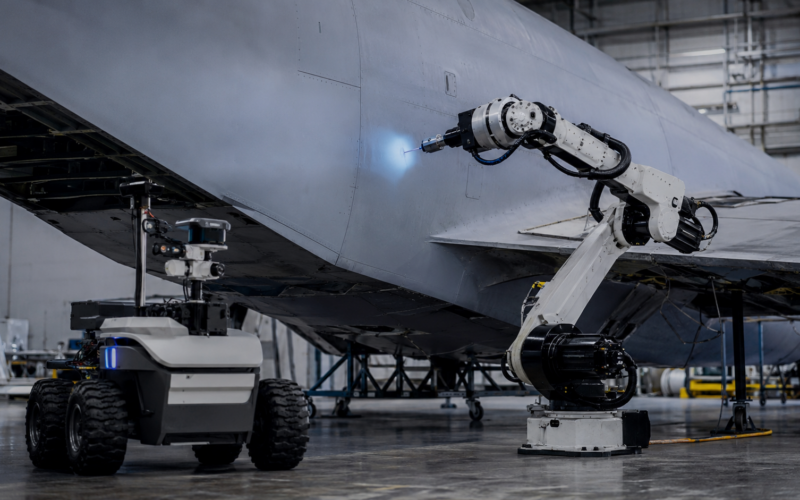
Palladyne AI Corp. (NASDAQ: PDYN) has secured another $2.9 million for its autonomous robotics programme after the United States Air Force exercised an option under the company’s Strategic Funding Increase contract. The option increases the programme’s announced award value to more than $10.6 million and funds further demonstrations of the Palladyne IQ embodied artificial intelligence architecture. The expansion is strategically important because it follows earlier technical milestones and represents a repeat funding decision by an existing defence customer, rather than an untested initial award. However, the central question for Palladyne AI remains whether successful demonstrations can lead to larger operational procurements, repeatable software revenue and a more sustainable financial model. Palladyne AI announced the option exercise on July 22, 2026.
The newly obligated funding will support human-guided machine learning on physical robotic platforms, mixed-reality teleoperation and autonomous task execution in Air Force-relevant scenarios. Palladyne AI said its technology can train robots to perform complex manipulation tasks using as few as one to five human demonstrations, adapt the learned behaviour to changing conditions and operate without continuous cloud connectivity.
Those capabilities address a practical defence requirement. Robots used for aircraft maintenance, hazardous surface preparation and other variable tasks cannot always depend on rigid programming or uninterrupted communications. A system capable of learning locally and adjusting to changing objects, surfaces and mission conditions could reduce the amount of specialist programming required for each new task.
Why is the exercised Air Force option more significant than the original contract ceiling?
The distinction between a contract’s potential value and money committed through an exercised option is important for investors. An announced ceiling may indicate the maximum opportunity, but an option does not become equally bankable simply because it appears in the original contract structure.
The programme originated in September 2023, when Palladyne AI was still known as Sarcos Technology and Robotics Corporation. The company’s announcement at that time described a four-year, $13.8 million contract with Warner Robins Air Logistics Complex at Robins Air Force Base in Georgia. The work was intended to develop, integrate and validate an artificial intelligence and machine-learning framework for robotic systems. The original programme covered military utility assessments and technology development over four years.
The apparent difference between that original $13.8 million description and the latest total of more than $10.6 million highlights how government contract accounting can separate estimated potential value from exercised and funded work. Palladyne AI previously defined backlog as remaining obligations under exercised contracts, while its total estimated contract value also included potential value from unexercised options.
The latest $2.9 million is therefore more meaningful than an unchanged contract ceiling. The Air Force has actively elected to fund another phase after reviewing progress. It does not guarantee that every remaining potential option will be exercised, but it reduces one layer of uncertainty and extends the programme’s funded development runway.
Palladyne AI President and Chief Executive Officer Ben Wolff described the decision as evidence that the Air Force had seen sufficient performance to commit additional capital. That interpretation is reasonable as a customer-validation signal, although an option exercise remains different from a large-scale production order.

What will Palladyne IQ need to demonstrate under the expanded Air Force programme?
The next milestones move the programme deeper into demonstrations on real robotic platforms. Human-guided machine learning is intended to allow operators to show a robot how to complete a task without building an extensive training dataset or manually programming every possible variation.
Mixed-reality teleoperation adds another layer. It could allow an operator at the worksite to collaborate with a remote subject-matter expert while controlling or supervising a robotic system. For the Air Force, that model could distribute scarce technical expertise across multiple locations without requiring every specialist to travel with the equipment.
The autonomous task-execution element is the more consequential commercial test. A robot that performs reliably only during a prepared demonstration has limited operational value. Palladyne IQ must maintain accuracy when surfaces, components, tooling positions and environmental conditions vary. It must also operate within safety constraints and generate results that compare favourably with human-led or conventionally automated processes.
The company said Palladyne IQ is hardware-agnostic and can integrate with different robotic platforms and sensor suites. Earlier milestones included autonomous engineered-media blasting on aircraft components and teleoperated and automated sanding using commercially available robots. Palladyne AI completed the first programme phase in October 2024 and announced further funding and military utility assessment progress in 2025.
This sequence demonstrates technical continuity, but it does not yet establish the economics of scaled adoption. The decisive evidence would include repeatable performance across different Air Force facilities, measurable labour or maintenance-time savings, lower deployment costs and follow-on procurement beyond the demonstration programme.
How does the Air Force contract reinforce Palladyne AI’s wider defence strategy?
Palladyne AI has changed substantially since the STRATFI programme began. The company renamed itself in 2024 and expanded in November 2025 through the acquisitions of GuideTech, Warnke Precision Machining and MKR Fabricators. Those transactions added advanced avionics, engineering services, manufacturing capabilities and defence hardware exposure to the company’s original autonomy software business.
The Air Force option validates the software side of that expanded portfolio. It also arrives alongside separate defence programmes involving Palladyne AI’s SwarmOS collaborative-autonomy platform and GuideTech’s BRAIN flight computer. In July, the company executed another $4.2 million Air Force Research Laboratory contract involving coordination across satellite, aerial and ground systems. GuideTech also recently won a $2.3 million contract to supply its BRAIN flight computer for a counter-uncrewed-aircraft system.
These programmes should not be treated as one combined contract. Palladyne IQ focuses on embodied autonomy for robotic tasks, while SwarmOS is positioned for coordination among multiple autonomous systems. GuideTech contributes avionics and embedded computing. Strategically, however, the contracts illustrate Palladyne AI’s attempt to sell multiple layers of the autonomy stack, from software and sensors to engineering and manufacturing.
That broader capability may improve the company’s ability to compete for programmes requiring an integrated supplier. It also creates execution complexity. Palladyne AI must develop software, fulfil engineering contracts, manage manufacturing operations and pursue autonomous-system opportunities without allowing programme costs to grow faster than revenue.
How could the $2.9 million option affect Palladyne AI’s revenue and backlog outlook?
Palladyne AI reported preliminary second-quarter 2026 revenue of approximately $5.8 million, representing growth of about 480% from the prior-year period and 66% from the first quarter. Backlog increased from $17.3 million at March 31 to approximately $24 million at June 30, while cash, cash equivalents and marketable securities remained near $44 million. The company expects most of the June backlog to convert into revenue within 12 to 18 months. The figures remain preliminary until Palladyne AI completes its quarter-end reporting process.
The new Air Force option equals roughly 12% of Palladyne AI’s reported June 30 backlog and about 11% to 12% of its full-year revenue guidance of $24 million to $27 million. Those comparisons illustrate the contract’s scale relative to the company, but they should not be interpreted as evidence that the entire $2.9 million will be recognized during 2026.
Palladyne AI did not disclose the option’s performance period, milestone-payment schedule, expected margin or quarterly revenue-recognition profile. Because the option was exercised after the June quarter ended, the latest announcement also did not provide a revised company-wide backlog figure.
Based on first-quarter revenue of $3.5 million and preliminary second-quarter revenue of $5.8 million, Palladyne AI generated approximately $9.3 million during the first half. Reaching the existing full-year guidance would require another $14.7 million to $17.7 million in the second half, equivalent to average quarterly revenue of approximately $7.3 million to $8.8 million.
The Air Force funding strengthens revenue visibility, but it does not remove the need for a substantial second-half acceleration. Investors will need the full second-quarter results to assess gross margins, operating expenditure, working capital and the timing of backlog conversion.
That financial discipline matters because Palladyne AI reported a $12.6 million net loss in the first quarter and previously projected average quarterly operating cash usage of approximately $8 million to $9 million during 2026. The preliminary second-quarter cash balance remaining near $44 million is encouraging, but the full cash-flow statement will be required to explain the quarter’s movements and the contribution from customer payments or other sources.
Why has Palladyne AI stock remained cautious despite rising defence contract activity?
Palladyne AI shares closed at $5.25 on July 21 and traded around $5.30 before the July 22 market open, an indicated gain of approximately 0.95% following the contract announcement. The prior closing price was about 1.7% below its level five trading sessions earlier and approximately 22.5% below the June 22 close of $6.77.
The stock’s 52-week range stood at approximately $4.14 to $10.74. At the latest closing price, Palladyne AI remained about 27% above the yearly low but roughly 51% below the high. Its market capitalisation was approximately $237 million. Historical prices show that recent contract announcements have not prevented a broader one-month pullback.
This market pattern suggests investors distinguish between contract momentum and mature commercial economics. The company is generating faster revenue growth and increasing backlog, yet it remains loss-making and must demonstrate that acquisitions, software programmes and government contracts can produce improving margins and lower cash consumption.
The latest Air Force option supports a more constructive operational interpretation because an existing customer has committed further funding. A sustained valuation improvement, however, would likely require evidence that Palladyne AI can progress from funded development to recurring deployments while keeping its balance sheet adequately funded.
What measurable milestones could turn Air Force validation into scalable revenue?
The immediate operational milestones are the advanced demonstrations funded by the new option. Palladyne AI must show that robots can learn manipulation tasks from limited human instruction, perform them under realistic Air Force conditions and maintain reliable results across changing environments.
The next commercial step would be a procurement or deployment decision that moves beyond research, development and assessment work. An order covering multiple systems, facilities or recurring software licences would provide stronger evidence of commercial adoption than another demonstration milestone alone.
Financially, the full second-quarter report should clarify margins, cash use and the composition of the $24 million backlog. Subsequent quarters must then show whether revenue can rise toward the level required to achieve the $24 million to $27 million annual target without operating expenses and cash consumption increasing at the same pace.
What has improved is the credibility of Palladyne IQ as an Air Force-supported autonomy platform and the visibility created by another $2.9 million of committed work. What remains unresolved is the transition from technology validation to repeatable procurement economics. The thesis would strengthen with successful multi-platform demonstrations, additional exercised options, scaled deployments and improving gross margins. It would weaken if milestones are delayed, backlog conversion slips or the company’s cash requirements remain high relative to revenue growth.
Key takeaways from Palladyne AI’s $2.9 million Air Force contract expansion
- The United States Air Force exercised a $2.9 million STRATFI contract option with Palladyne AI.
- The additional funding increases the programme’s announced award value to more than $10.6 million.
- The option supports human-guided machine learning, mixed-reality teleoperation and autonomous robotic task execution.
- Palladyne IQ is designed to learn tasks from limited demonstrations and operate without continuous cloud connectivity.
- An exercised option provides stronger revenue visibility than an unexercised contract ceiling.
- The award reinforces Palladyne AI’s broader strategy across embodied artificial intelligence, avionics and defence autonomy.
- Preliminary second-quarter revenue reached approximately $5.8 million, while June backlog stood near $24 million.
- Palladyne AI still requires significant second-half growth to achieve its $24 million to $27 million 2026 revenue guidance.
- Scaled Air Force deployments, margin improvement and lower cash consumption remain the most important proof points.
Discover more from Business-News-Today.com
Subscribe to get the latest posts sent to your email.



