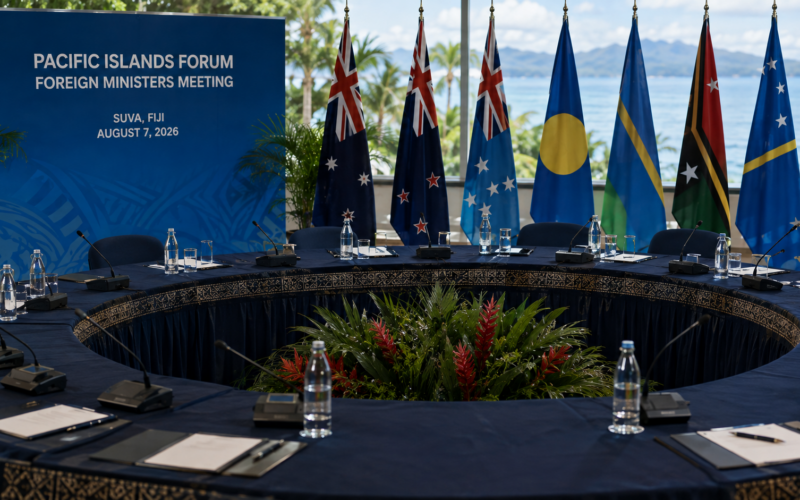
Pacific Island governments face a consequential diplomatic decision on Friday, August 7, 2026, as foreign ministers meeting in Suva consider whether to issue a joint statement responding to China’s recent test of a nuclear-capable ballistic missile deep into the Pacific Ocean.
New Zealand is pushing for a collective Pacific Islands Forum response to the July 6 launch, but Foreign Minister Winston Peters has acknowledged that disagreement among member states could prevent the group from reaching consensus. The debate provides an unusually visible test of whether Pacific governments can maintain a common security position as competition between China, Australia, the United States and other powers intensifies across the region.
China launched the missile from a nuclear-powered ballistic missile submarine on July 6. The weapon carried a dummy warhead and landed in international waters in the southern Pacific. China described the exercise as routine annual military training that was not aimed at any country, while the United States characterised the weapon as an unarmed intercontinental-range ballistic missile.
Australia, New Zealand, Japan, the United States and Taiwan criticised aspects of the test, particularly the limited advance notification. Solomon Islands Prime Minister Matthew Wale, despite his country’s close relations with Beijing, also protested against the launch and argued that the Pacific should not become a testing ground for intercontinental ballistic missiles from China, the United States or any other military power.
The controversy has now reached the Pacific Islands Forum at a sensitive moment. Forum leaders endorsed the Blue Pacific Ocean of Peace Declaration in 2025, promising to manage strategic competition through dialogue, regional solidarity, sovereignty and restraint. Failure to agree even on a statement about a nuclear-capable missile flying into the region would expose the difficulty of turning that declaration into practical security policy.
What exactly did China launch into the Pacific on July 6 and why did it alarm neighbouring governments?
China’s official Xinhua news agency said a People’s Liberation Army Navy strategic missile submarine launched a missile carrying a dummy warhead towards international waters in the Pacific at 12:01 p.m. Chinese officials did not publicly identify the missile type or disclose the precise launch position.
Chinese state-linked commentary indicated that the weapon was likely the JL-3, Beijing’s most advanced submarine-launched ballistic missile. The JL-3 is believed to have a range of approximately 10,000 kilometres and is designed to give China’s ballistic missile submarines the ability to threaten distant targets, including parts of the United States, while operating much closer to Chinese-controlled waters.
The United States said the missile was an unarmed intercontinental-range weapon and landed in the southern Pacific. Analysts told Reuters that the launch appeared to involve one of China’s Type-094 nuclear-powered ballistic missile submarines, although Beijing did not formally identify the submarine class.
The significance therefore extends beyond a conventional weapons test. Ballistic missile submarines form one element of a nuclear triad because they provide a country with the ability to retaliate even if its land-based nuclear forces are destroyed in a first strike.
For China, developing submarines capable of remaining hidden while carrying long-range ballistic missiles strengthens what strategists call second-strike capability. That makes the July test important not only for Pacific security but also for the nuclear balance between Beijing and Washington.
China insisted that the exercise was conducted safely and professionally and urged governments not to overinterpret the launch. Beijing has maintained that its nuclear modernisation is defensive and intended to preserve strategic stability.
Pacific governments are examining the event through a different lens. Their concern is not simply whether the missile carried an active nuclear warhead. The test brought an intercontinental-range strategic weapon into a region with a painful historical relationship with nuclear testing and an explicit political ambition to resist militarisation.

Why did the limited warning before China’s missile launch become such a major regional issue?
The controversy intensified after governments disclosed how little notice they received.
The United States said China provided Washington with only a few hours of advance warning and insufficient information about the launch. A State Department official argued that the notification fell considerably short of standards followed by other permanent members of the United Nations Security Council recognised as nuclear-weapon states under the Nuclear Non-Proliferation Treaty.
Australia also said the customary level of warning associated with such a launch was not provided. Prime Minister Anthony Albanese argued that the concern was amplified because the missile originated from a nuclear-powered submarine rather than a conventional land-based test site.
Advance notification matters because missile launches can be misinterpreted by neighbouring militaries. Early-warning systems may initially detect a ballistic trajectory without knowing whether the weapon is part of an exercise, whether it carries a live warhead or where it will land.
Strategic nuclear powers therefore have strong incentives to communicate about tests to reduce the possibility of accidental escalation.
China countered that the launch followed international law and normal practice and accused Washington of applying double standards given the United States’ own strategic missile testing programme. Beijing has also resisted United States pressure for expanded nuclear-arms talks, arguing that Washington possesses a considerably larger nuclear arsenal.
The argument is unlikely to reassure smaller Pacific states. Their central concern is less about which major power possesses the larger arsenal and more about whether the ocean surrounding their countries is becoming an arena for strategic weapons demonstrations.
Why is New Zealand pushing the Pacific Islands Forum to issue a collective statement on China?
New Zealand Foreign Minister Winston Peters has been among the strongest advocates for a unified Forum response.
Peters described China’s launch in July as an unwelcome and concerning development and argued that Pacific countries have no interest in seeing the South Pacific used as a testing ground for missile capabilities.
At the August meeting in Suva, Peters confirmed that New Zealand had been seeking a collective statement but indicated that some governments held positions that could make consensus difficult. He declined to publicly identify which Forum members were resisting or questioning the proposal.
That disagreement is important because the Pacific Islands Forum traditionally operates through consensus. A statement carrying the Forum’s name consequently requires members with very different foreign-policy relationships to agree on common wording.
Some Pacific states have close defence relationships with Australia, New Zealand and the United States. Others depend heavily on Chinese investment, infrastructure financing, trade and development assistance. Several attempt to maintain relationships with all major powers while refusing to align themselves exclusively with either strategic camp.
Peters’ challenge is therefore not simply convincing governments that a missile test is undesirable. He must find language that condemns or expresses concern about the activity without turning the Forum into an instrument of wider United States-China rivalry.
The debate also tests New Zealand’s own regional influence. Wellington presents itself as a Pacific country with longstanding diplomatic, cultural and security connections across the region. Securing a collective statement would demonstrate that its concerns resonate beyond traditional Western allies.
Failure would expose the limits of that influence and demonstrate that individual Pacific governments increasingly intend to set their China policies independently.
Why are Solomon Islands and other Pacific states especially important to the China missile dispute?
The Solomon Islands occupies a particularly revealing position because it has developed some of the Pacific’s closest political and security relations with China.
Yet Prime Minister Matthew Wale publicly criticised the July missile launch, saying China could remain a friend without threatening the region. He argued that the objection applied equally to China, the United States or any other country testing intercontinental ballistic missiles in Pacific waters.
That position demonstrates why the Pacific debate cannot be reduced neatly to governments that are “pro-China” or “pro-Western.”
Pacific leaders regularly argue that their countries should determine regional priorities rather than becoming extensions of strategic competition between larger states. Their preferred formulation is often cooperation with multiple partners without surrendering political autonomy.
Solomon Islands Foreign Minister Rick Houenipwela, chairing the Suva meeting, reinforced that message by saying the Pacific agenda should be conceived, shaped and owned by Pacific countries themselves. He also argued that increasing strategic complexity should produce regional solidarity rather than fragmentation.
The challenge is that strategic competition increasingly reaches into areas where neutrality becomes difficult. Security agreements, military access, telecommunications infrastructure, policing cooperation, undersea cables and port projects can all carry geopolitical implications even when governments describe them as ordinary development partnerships.
The missile launch brings that tension into unusually stark focus. A country can maintain strong economic relations with China while opposing strategic missile testing near its waters. Likewise, it can cooperate militarily with Australia or the United States while rejecting attempts to turn the Pacific into a forward operating zone against Beijing.
How does the China missile controversy challenge the Pacific’s Ocean of Peace Declaration?
Pacific Islands Forum leaders endorsed the Blue Pacific Ocean of Peace Declaration in 2025 as a political framework for preserving regional stability amid intensifying competition among larger powers.
The declaration emphasises sovereignty, peaceful dialogue, cooperation, respect for international law and the need to prevent strategic competition from undermining regional unity. It also reflects the long-standing Pacific argument that security should be defined broadly and should include climate change, human security and economic resilience rather than military competition alone.
The missile test therefore provides one of the clearest early tests of the declaration.
If an intercontinental-range missile launched from a nuclear-powered submarine into the South Pacific does not produce a common Forum position, critics may question what types of military activities would actually trigger a collective response.
However, the Ocean of Peace concept was deliberately designed around dialogue and consensus rather than confrontation. Its supporters may argue that disagreement does not invalidate the framework and that maintaining communication with China is itself consistent with the declaration.
The Pacific’s historical experience makes the issue particularly sensitive. The region hosted extensive nuclear testing by major powers during the twentieth century, leaving long-lasting environmental, health and political consequences.
The South Pacific Nuclear Free Zone Treaty, commonly known as the Treaty of Rarotonga, opened for signature in 1985 and entered into force in 1986. It established a regional nuclear-free zone and remains an important part of Pacific security identity.
China’s July missile carried a dummy warhead and was therefore not a nuclear weapons test. Even so, the presence of a nuclear-capable strategic delivery system in Pacific waters carries powerful symbolism for countries whose diplomatic identity is deeply tied to nuclear restraint.
Could China’s missile test accelerate new defence agreements between Australia and Pacific nations?
The timing of the July launch attracted attention because it coincided with a new Australia-Fiji security agreement.
Australia and Fiji announced an elevated military partnership containing a mutual-defence obligation, significantly deepening the two countries’ security relationship. Chinese officials said their missile exercise was routine, and there is no evidence demonstrating that the launch was ordered as a direct response to the agreement.
Nevertheless, the missile test may strengthen arguments within Australia that Canberra needs deeper security relationships across the Pacific.
Australia has been pursuing defence, policing and strategic agreements with several island countries as it attempts to prevent any permanent foreign military presence that could alter the regional balance.
The Solomon Islands’ 2022 security agreement with China intensified those concerns because Western governments feared it could eventually facilitate Chinese military access. Beijing and Honiara denied that the arrangement was intended to establish a Chinese base.
Wale has said his government would review the existing China agreement while also seeking a broader treaty with Australia. This illustrates the complicated diplomacy now shaping the Pacific, where countries may deepen relations with competing powers simultaneously rather than choosing one camp.
China’s missile test could inadvertently accelerate precisely the security partnerships Beijing views with suspicion. Governments concerned about missile launches and military expansion may become more receptive to Australian radar, maritime surveillance, defence training and intelligence cooperation.
At the same time, aggressive Western efforts to capitalise on the controversy could backfire if Pacific leaders conclude that their concerns are being used to advance another power’s geopolitical agenda.
What does the missile launch reveal about China’s rapidly expanding nuclear deterrent?
China’s nuclear arsenal remains smaller than those of the United States and Russia, but Beijing is expanding its strategic capabilities at a pace that has attracted increasing scrutiny.
The submarine-launched component is especially significant because it provides survivability. Land-based missile silos can be located and targeted, while ballistic missile submarines are designed to disappear into the ocean and preserve a retaliatory capability.
China operates Type-094 ballistic missile submarines and is developing a quieter successor. The effectiveness of those vessels depends not only on missile range but on whether submarines can evade United States and allied anti-submarine surveillance networks.
A missile believed to be the JL-3 could reduce that vulnerability because its range may allow Chinese submarines to threaten distant targets without travelling as far into waters where United States, Japanese or Australian forces could track them.
The July test therefore allowed China to demonstrate more than missile performance. It potentially tested communications, command systems, launch procedures and submarine operations associated with maintaining a credible sea-based nuclear deterrent.
That capability is likely to receive increasing attention from Australia, Japan and the United States. Expanded Chinese submarine patrols could produce more anti-submarine aircraft flights, underwater surveillance networks and naval deployments throughout the western and central Pacific.
For small Pacific countries, that is precisely the escalation they want to avoid. The danger is that one Chinese missile test generates stronger allied surveillance, which encourages China to deploy more naval assets, which then produces additional Western military activity.
The Pacific can become militarised incrementally even when no government explicitly intends to turn it into a frontline.
What are the key takeaways from the Pacific Islands Forum debate over China’s missile test?
- Pacific Island foreign ministers meeting in Suva on August 7 are considering whether to issue a collective statement concerning China’s July 6 submarine-launched ballistic missile test, with New Zealand pressing for a unified response despite signs of disagreement among Forum members.
- China launched the nuclear-capable but unarmed missile from a nuclear-powered strategic submarine into international waters in the southern Pacific and described the exercise as routine annual military training that was not directed against any particular country.
- Chinese authorities did not identify the missile, although state-linked commentary and independent analysts indicated that it was likely the JL-3, an advanced submarine-launched ballistic missile believed to have a range of around 10,000 kilometres.
- The United States said China supplied only a few hours of advance warning and insufficient detail, while Australia, New Zealand, Japan and other governments criticised the limited transparency surrounding the launch.
- Solomon Islands Prime Minister Matthew Wale publicly objected despite his country’s close ties with Beijing, arguing that the Pacific should not be used by China, the United States or any other power for intercontinental ballistic missile testing.
- The dispute represents an important test of the Blue Pacific Ocean of Peace Declaration endorsed by Forum leaders in 2025, which calls for regional solidarity, sovereignty, dialogue and restraint amid intensifying geopolitical competition.
- The missile test may encourage Australia and other partners to accelerate regional security agreements, maritime surveillance and defence cooperation, potentially producing the further militarisation that many Pacific governments want to prevent.
- A failure to agree on a Forum statement would not necessarily amount to support for China, but it would reveal how difficult collective Pacific diplomacy has become when national relationships with Beijing, Canberra and Washington diverge.
Why the August 7 decision could shape how the Pacific handles future great-power confrontations
The importance of Friday’s debate goes beyond the wording of a diplomatic statement. Pacific governments are confronting a fundamental question about who sets the security rules in their region.
China views itself as a major nuclear power entitled to conduct legitimate strategic training. The United States and its allies possess their own powerful military forces throughout the Indo-Pacific and conduct extensive exercises. Pacific governments increasingly object to being told that one major power’s deployments are stabilising while another’s are inherently threatening.
That explains the appeal of the Ocean of Peace framework. It gives Pacific countries a language for judging military behaviour according to regional interests rather than the geopolitical preferences of Beijing, Washington or Canberra.
The difficulty is translating that principle into collective action.
A carefully constructed statement could reinforce regional opposition to strategic missile testing without turning the Forum against China. It could demand greater notification, consultation and transparency from every military power operating in the Pacific.
Such an approach would also strengthen the Forum’s credibility. The region could argue that the same standards should apply regardless of whether the weapons belong to China, the United States or another nuclear state.
If ministers cannot reach consensus, the consequence will be equally revealing. It would show that economic relationships, bilateral security agreements and strategic competition are increasingly fragmenting Pacific diplomacy.
The July 6 missile has already demonstrated China’s expanding military capabilities. August 7 will reveal something different: whether Pacific Island states can collectively influence how those capabilities are exercised in their own region.
Discover more from Business-News-Today.com
Subscribe to get the latest posts sent to your email.