


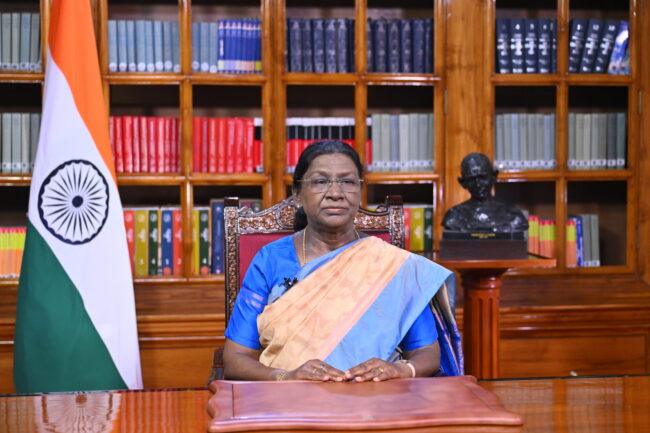
President of India Droupadi Murmu’s address to the nation on January 25, 2026, ahead of the country’s 77th Republic Day, marked a continuation of India’s focus on inclusive governance, constitutional nationalism, and defense self-reliance. Her remarks served not only as a retrospective of recent policy initiatives but also as a reaffirmation of India’s evolving self-image—internally cohesive, economically assertive, and globally consequential.
The speech came amid a period of steady economic growth, political consolidation, and elevated global visibility for India’s leadership on climate action, digital payments, and counterterrorism strategy. As the third year of her presidency progresses, the messaging reflected both institutional continuity and an aspirational roadmap shaped by social equity, technological advancement, and national security priorities.

How India’s constitutional identity and civilizational legacy were intertwined in the president’s remarks
President Murmu’s opening remarks underscored the symbolic weight of Republic Day—marking the full enforcement of the Constitution of India on January 26, 1950—as a milestone of sovereignty and democratic agency. Framing the country as the “birthplace of democracy,” she placed the constitutional ideals of justice, liberty, equality, and fraternity at the heart of India’s national self-conception.
The invocation of Sardar Vallabhbhai Patel’s role in national integration and Netaji Subhas Chandra Bose’s “Jai Hind” slogan aligned the speech with longstanding traditions of freedom movement symbolism. Murmu’s references to the 150th anniversary of “Vande Mataram” and its linguistic adaptations by poets such as Subramanya Bharati and Sri Aurobindo further situated India’s republican ethos within a civilizational and linguistic continuum.
By weaving in spiritual figures like Sree Narayana Guru and cultural initiatives like the “Gyan Bharatam Mission,” the speech emphasized that constitutional modernity and ancient philosophical traditions are not seen as oppositional but mutually reinforcing in the Indian policy imagination.
What institutional themes dominated the speech—women-led development, tribal empowerment, and grassroots delivery
Several institutional pillars of the Indian government’s recent policy direction were prominently featured. Murmu gave extended focus to women’s empowerment, both symbolically and through programmatic achievements. She highlighted the participation of over 10 crore women in self-help groups, the expansion of financial inclusion under the “Pradhan Mantri Jan Dhan Yojana,” and women’s success in sports, governance, and defense.
She emphasized the potential impact of the “Nari Shakti Vandan Adhiniyam,” a recently passed constitutional amendment reserving one-third of seats in the Lok Sabha and State Assemblies for women. This was framed as a structural step toward inclusive democracy and “women-led development,” a key phrase in recent Indian policy language.
Tribal welfare was given equal weight, with mentions of the “PM-JANMAN Yojana,” “Dharti Aaba Janajatiya Gram Utkarsh Abhiyan,” and the Eklavya Model Residential Schools. These were framed not only as social justice initiatives but as nation-building tools that integrate historically excluded communities into the mainstream of governance, education, and health.
The references to the digital payment revolution, labor code rationalization, and GST reform served to reinforce the narrative of a leaner, more responsive state that prioritizes “ease of living” and fiscal integration. India’s use of technology to deliver direct benefits to citizens was subtly presented as a model of “good governance” consistent with both democratic accountability and digital modernization.
Why youth and economic self-reliance were framed as pillars of India’s development roadmap
In aligning her speech with India’s demographic dividend, the President placed strong emphasis on the role of youth, referencing the “Mera Yuva Bharat” initiative as a vehicle for skill development, civic engagement, and entrepreneurship. The framing of youth as “flag bearers of national development” and architects of “Viksit Bharat 2047” echoed earlier calls to make India a developed country within the 100th year of independence.
Murmu linked economic resilience to infrastructure development, labor reform, and the principles of Atmanirbharta (self-reliance) and Swadeshi (indigenous production). These were reiterated in the context of India’s aim to become the third-largest global economy. She also referenced the integration of India’s fragmented tax markets under the Goods and Services Tax and labor rationalization through four new labor codes—framing them as instruments of formalization, compliance simplification, and economic integration.
The broader economic message was assertive: despite global volatility, India is sustaining growth and investing in scalable infrastructure, and is preparing its institutional ecosystem to accommodate both capital formation and inclusive development.
How the defense message signaled military readiness and strategic self-sufficiency
One of the most significant segments of the speech was the detailed reference to “Operation Sindoor,” a military operation conducted in 2025 targeting terror infrastructure. Although specific details remain classified, Murmu stated that India launched precision strikes, neutralized terror networks, and relied on domestically developed defense capabilities. The reference to this operation was notable given India’s traditional reluctance to publicly confirm cross-border military engagements.
Her direct engagement with India’s tri-services—mentioning her visits to the Siachen Base Camp, sorties in Rafale and Sukhoi aircraft, and observations aboard INS Vikrant and INS Vaghsheer—was positioned as evidence of institutional confidence in military preparedness and indigenous capabilities.
This segment of the speech aligned with India’s defense procurement pivot toward domestic production under the “Make in India” and “Atmanirbhar Bharat” umbrellas, and reflected a broader geopolitical stance of assertive deterrence and sovereign capability-building.
What global themes emerged—climate leadership, peace diplomacy, and spiritual pluralism
President Murmu’s remarks concluded with broader messages tied to India’s global role. She framed environmental protection as both a national cultural tradition and a planetary imperative, invoking the “LiFE” (Lifestyle for Environment) initiative promoted by India at COP summits. This was presented not only as climate messaging but as a soft-power narrative based on sustainable living.
In a global environment marked by rising conflicts, Murmu emphasized India’s traditional message of world peace and spiritual fraternity. By citing universalist elements from Indian poetry and philosophical traditions, she implicitly framed India’s diplomacy as a civilizational contribution to global order rather than a transactional participant in geopolitical blocs.
This framing was consistent with India’s positioning in forums like the G20, BRICS, and the United Nations, where it seeks to act as a bridge between the Global South and established powers, leveraging its civilizational narrative as diplomatic currency.
Key takeaways on what the 2026 Republic Day Eve address reveals about India’s policy direction and institutional priorities
- President Droupadi Murmu’s Republic Day 2026 Eve address reaffirmed the central role of the Constitution of India in shaping national unity, democratic governance, and the republic’s long-term institutional stability.
- The address placed strong emphasis on inclusive development, with specific focus on women-led growth, tribal empowerment, youth participation, and grassroots delivery of welfare and financial inclusion schemes across India.
- References to Operation Sindoor and visits to key defense assets underlined India’s emphasis on military preparedness, indigenous defense capability, and strategic self-reliance in national security matters.
- Economic messaging highlighted India’s status as the fastest-growing major economy, with continued focus on infrastructure investment, Goods and Services Tax reforms, labor code implementation, and the principles of Atmanirbhar Bharat and Swadeshi.
- The speech framed India’s global posture around climate leadership, digital public infrastructure, peace diplomacy, and civilizational values, positioning the country as an increasingly influential actor in multilateral and global policy forums.
Discover more from Business-News-Today.com
Subscribe to get the latest posts sent to your email.