




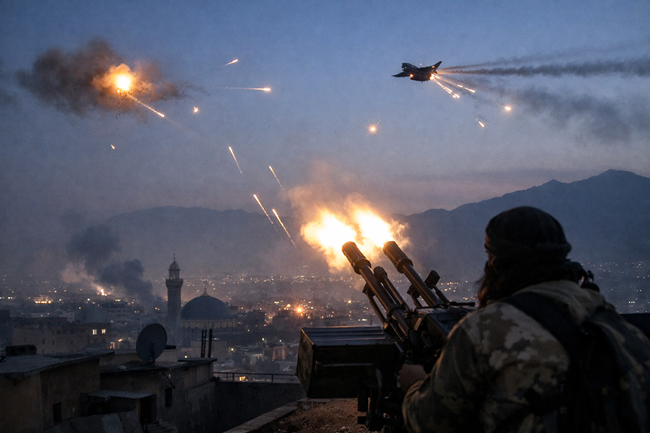
Afghanistan’s Taliban-led government confirmed on Sunday, 1 March 2026, that Afghan air defence units had engaged Pakistani military aircraft flying over Kabul after explosions and bursts of gunfire were reported across the Afghan capital before sunrise. Taliban administration spokesperson Zabihullah Mujahid confirmed that air defence attacks had been carried out in Kabul against Pakistani aircraft and stated that Kabul residents should not be concerned. The precise targets of the overnight exchange were not immediately established, and casualty information was not available at the time of reporting. Pakistan’s prime minister’s office, Pakistan’s information ministry, and Pakistan’s military did not respond to requests for comment.
The overnight confrontation marked the latest escalation in what Pakistan Defence Minister Khawaja Muhammad Asif had publicly characterised as open war between Pakistan and Afghanistan. The Taliban-governed Islamic Emirate of Afghanistan had suffered a series of Pakistani air strikes against government installations over the preceding week. Pakistan justified those operations as targeting militant infrastructure, specifically camps and hideouts attributed to the Tehreek-e-Taliban Pakistan and affiliated armed groups operating from Afghan territory. The Taliban administration rejected those accusations, asserting that Afghan territory is not permitted to be used against neighbouring countries and that Pakistan’s internal security challenges are not the responsibility of the Afghan government.
What triggered the Pakistan-Afghanistan military confrontation in February and March 2026 and what role did TTP play?
Pakistan’s military operations against targets inside Afghanistan began with airstrikes on 22 February 2026 and continued with a second wave on 26 February 2026, targeting locations in Nangarhar and Paktika provinces in eastern Afghanistan. Pakistan described those strikes as intelligence-based, selective operations against seven camps and hideouts attributed to the Tehreek-e-Taliban Pakistan, affiliated armed factions, and the Islamic State Khorasan Province. Pakistan stated that the operations constituted a retributive response to a series of suicide bombings carried out inside Pakistani territory, including the 6 February 2026 bombing of a Shia mosque in Islamabad that killed 31 worshippers and subsequent attacks in the Bajaur and Bannu districts of Khyber Pakhtunkhwa province during the early days of Ramadan 2026. The February 2026 airstrikes represented the seventh documented instance of Pakistan conducting airstrikes inside Afghanistan since the Afghan Taliban assumed control of Kabul in August 2021.
The Tehreek-e-Taliban Pakistan is a separate organisation from the Afghan Taliban but shares ideological roots and has conducted sustained insurgent operations inside Pakistani territory for over a decade. Pakistan has consistently held the Afghan Taliban government responsible for providing sanctuary to Tehreek-e-Taliban Pakistan commanders and fighters. The Afghan Taliban administration has repeatedly denied those allegations. No independent verification of the militant infrastructure attributed to Tehreek-e-Taliban Pakistan on Afghan soil has been confirmed by international observers.
How did the Afghan Taliban respond to Pakistani airstrikes and what does Operation Ghazab Lil Haq entail?
Following the Pakistani airstrikes of 22 and 26 February 2026, Afghan forces launched retaliatory operations along the shared 2,600-kilometre border between Afghanistan and Pakistan. In response to those Afghan retaliatory operations, Pakistani security sources confirmed that Pakistan had initiated Operation Ghazab Lil Haq, an Arabic phrase meaning Wrath for the Truth, under which Pakistani forces reported destroying Afghan border posts and militant camps. Both the Pakistani government and the Taliban administration in Kabul issued casualty figures attributing losses to the opposing side. Neither set of figures could be independently verified by international journalists or monitors present in the region.
Afghanistan Interior Minister Sirajuddin Haqqani stated that the conflict would be very costly for Pakistan and confirmed that only front-line Afghan forces had been engaged in the fighting to that point, indicating that the Taliban administration retained the capacity to escalate further. Pakistan Defence Minister Khawaja Muhammad Asif’s characterisation of the situation as open war marked a significant shift in the public framing of Pakistan-Afghanistan hostilities, which had previously been described by Pakistani officials in more contained terms even during periods of elevated tension.
What is the history of ceasefire efforts between Pakistan and Afghanistan since the Taliban took power in 2021?
The current escalation built upon a sustained pattern of deteriorating bilateral relations. A fragile ceasefire had been agreed in October 2025 following the deadliest cross-border clashes between Pakistan and Afghanistan recorded since the Taliban’s return to power. That ceasefire was brokered through Qatari mediation. Subsequent negotiations between Islamabad and Kabul failed to produce a durable and enforceable agreement, and low-level cross-border incidents continued through late 2025 and into the early weeks of 2026. A separate Saudi Arabia-mediated process following the October 2025 clashes had resulted in the release of three Pakistani soldiers captured during those confrontations, a development that briefly raised expectations for renewed dialogue without producing a sustained diplomatic track.
Pakistan Defence Minister Khawaja Muhammad Asif had issued a public warning on 11 February 2026 that Pakistan reserved the right to take action against militant sanctuaries in Afghanistan before the end of the pre-Ramadan period if conditions on Pakistan’s border did not improve. The February airstrikes followed that warning by less than two weeks.
How does the simultaneous military crisis involving Iran, Israel, and the United States affect Pakistan-Afghanistan conflict dynamics?
The Pakistan-Afghanistan military confrontation is escalating simultaneously with a broader regional crisis of significant severity. Iran, which shares land borders with both Afghanistan and Pakistan and had actively offered to facilitate dialogue between Kabul and Islamabad, came under military attack on Saturday, 28 February 2026. Israeli and United States military forces struck Iranian targets in an operation described as aimed at diminishing Iran’s military capability. Iranian retaliatory attacks against United States military assets in Gulf states followed, compounding instability across a broad arc of territory stretching from the Persian Gulf to the Afghanistan-Pakistan border region.
Iran’s position as a potential diplomatic interlocutor between Pakistan and Afghanistan has been effectively neutralised by the military crisis Iran is now managing domestically. Tehran had maintained functional working relations with both the Taliban administration in Kabul and the government in Islamabad and had served as a communication channel during earlier periods of bilateral tension. The simultaneous onset of the Iran-Israel-United States confrontation and the Pakistan-Afghanistan escalation has created conditions in which multiple regional mediation channels are unavailable or severely constrained at the same time.
Which governments and international institutions have called for restraint in the Pakistan-Afghanistan conflict in March 2026?
International diplomatic pressure mounted rapidly as the military situation deteriorated. Saudi Arabia, Qatar, Russia, China, the European Union, and the United Nations issued public calls for restraint and urged both the government of Pakistan and the Taliban administration of Afghanistan to pursue diplomatic dialogue. Qatar and Saudi Arabia specifically offered to facilitate ceasefire mediation. The United States government stated that it supports Pakistan’s right to defend itself, a formulation that aligned Washington with Islamabad’s framing of the conflict without explicitly endorsing specific Pakistani military operations inside Afghan territory.
The breadth of the international response, encompassing Gulf states, major powers, the European Union, and the United Nations simultaneously, reflects the extent to which the Pakistan-Afghanistan escalation is being assessed as a destabilising event with implications well beyond the bilateral relationship between the two countries.
What the Pakistan-Afghanistan conflict escalation of March 2026 means for regional stability and international diplomacy
- The Taliban-governed Islamic Emirate of Afghanistan confirmed air defence engagements against Pakistani military aircraft over Kabul on 1 March 2026, marking a significant intensification of hostilities that Pakistan Defence Minister Khawaja Muhammad Asif has described as open war.
- Pakistan’s Operation Ghazab Lil Haq followed Afghan retaliatory operations triggered by Pakistani airstrikes on 22 and 26 February 2026 against targets in Nangarhar and Paktika provinces, which Islamabad attributed to Tehreek-e-Taliban Pakistan and Islamic State Khorasan Province infrastructure.
- Iran’s neutralisation as a regional mediator, following Israeli and United States military strikes against Iranian targets on 28 February 2026, has removed one potential diplomatic channel at a critical stage of the Pakistan-Afghanistan escalation.
- Saudi Arabia, Qatar, Russia, China, the European Union, and the United Nations have all called for restraint, while the United States has stated support for Pakistan’s right to defend itself, reflecting a divided international posture toward the conflict.
- Afghanistan Interior Minister Sirajuddin Haqqani’s statement that the country has yet to fully deploy its military signals that the Taliban administration retains significant capacity for further escalation if diplomatic efforts fail to produce a ceasefire.
Discover more from Business-News-Today.com
Subscribe to get the latest posts sent to your email.
