




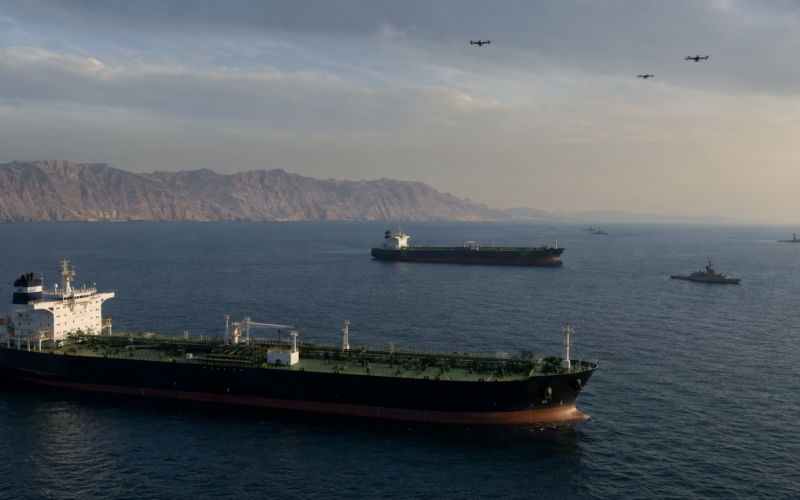
Oil prices climbed sharply in Asian trading on July 13, 2026, after renewed United States and Iranian attacks raised fresh doubts about commercial shipping through the Strait of Hormuz. Brent crude advanced as much as 4.1% to $79.11 a barrel, while United States West Texas Intermediate crude reached $74.37 a barrel. Iran maintained that the waterway had been closed after a vessel travelled through an unapproved route, while the United States maintained that the strait remained open and that its forces were prepared to protect navigation. The conflicting positions have returned the world’s most important energy chokepoint to the centre of inflation, shipping and supply-security calculations.
The latest escalation followed missile and drone attacks exchanged during the July 11–12 weekend. Iran expanded its attacks across Gulf states, including Qatar and the United Arab Emirates, while the United States conducted further strikes against Iranian military targets. The fighting has placed additional pressure on an interim United States-Iran arrangement that had supported a partial recovery in tanker traffic and Gulf energy production during June.
Actual shipping activity nevertheless remained limited. Ship-tracking data showed that only six vessels crossed the Strait of Hormuz on July 12, the lowest number in five weeks, even as United States officials indicated that approximately 20 vessels had been escorted through the waterway during the preceding 24 hours. The difference underlines the difficulty of treating a military declaration that the strait is open as evidence that normal commercial movement has resumed.
Energy markets are consequently responding to two risks at once. The first is the immediate possibility of vessel attacks, delayed cargoes and higher insurance costs. The second is that repeated episodes of fighting could prevent Gulf producers and refiners from restoring the output lost since the conflict began, leaving the world with less protection against another disruption later in 2026.
Why did Brent crude rise above $79 after the latest United States-Iran attacks?
Brent crude’s move above $79 represented a rapid reversal from its recent trough of $70.14 a barrel. Prices had fallen during June as improving tanker movements encouraged expectations that crude accumulated in Gulf storage could return to international markets. The July 11–12 escalation weakened that assumption because the recovery depended on uninterrupted navigation and continued implementation of the interim political arrangement.
The size of the increase was significant but remained smaller than the extreme movements recorded during earlier stages of the conflict. That suggests the oil market had not yet priced in a complete and prolonged shutdown of the Strait of Hormuz. Traders were instead attaching a higher risk premium to the possibility of interrupted shipments while waiting to see whether the latest attacks would continue.
This distinction matters because crude oil prices respond not only to the quantity of oil currently moving but also to expectations about future availability. A small number of successful crossings can prevent the market from pricing a total blockade, but sporadic vessel movements cannot support the volume required for normal Gulf exports. Commercial operators must also consider crew safety, insurance coverage, naval coordination, port availability and the possibility that a vessel permitted to cross one day could be targeted the next.
The latest price rise also arrived after Brent crude had already gained approximately 5.5% during the previous week. Renewed conflict has therefore interrupted a period in which markets were beginning to focus on the possibility of excess global supply in 2027. Geopolitical risk has again moved ahead of longer-term supply calculations, at least until the direction of Hormuz traffic becomes clearer.
Is the Strait of Hormuz open when Iran and the United States make opposing claims?
The disagreement over whether the Strait of Hormuz is open contains a political claim, a military claim and a commercial reality. Iran has asserted control over passage and maintained that it closed the waterway after a vessel used a route that had not received Iranian approval. United States Central Command has rejected that position and stated that United States forces are positioned to ensure freedom of navigation.
Neither statement, by itself, establishes whether shipping has returned to commercially normal conditions. An oil tanker can technically cross a waterway while the route remains operationally restricted by military threats, escort requirements, unavailable insurance or company-level risk controls. The low number of observed crossings on July 12 suggests that many operators continued to treat the strait as a high-risk environment.
The reported escort of approximately 20 vessels provides evidence that some managed traffic is continuing. However, escorted passage is not equivalent to the predictable, high-volume transit system required by global oil and liquefied natural gas markets. Naval protection also has practical limits because vessels move at different speeds, load from several ports and require coordination across a congested maritime area.
The difference between legal openness and practical accessibility is consequently central to the oil-price outlook. Markets will watch confirmed cargo departures, completed crossings and port loadings more closely than official declarations. A durable recovery would require sustained vessel movement over several days, fewer military incidents and confidence among insurers and shipping companies that cargoes can complete their journeys without interruption.
The Strait of Hormuz carried around one-fifth of global oil and gas supplies before the conflict. Even partial restrictions therefore affect far more than Iranian exports. Producers in Saudi Arabia, Iraq, Kuwait, Qatar and the United Arab Emirates depend on the surrounding Gulf shipping network, although some volumes can move through alternative pipelines and terminals.
How vulnerable is the partial recovery in global oil supply achieved during June 2026?
The International Energy Agency’s July Oil Market Report showed how much production returned during the June improvement and how much remains missing. Global oil supply increased by 4.1 million barrels per day in June to 98.8 million barrels per day as improved passage through the Strait of Hormuz enabled a partial recovery in Gulf output. Global production nevertheless remained approximately 9.4 million barrels per day below pre-war levels.
Gulf oil exports, including volumes transported through routes that bypass the strait, increased by approximately 6.5 million barrels per day in June to 16.1 million barrels per day. That was a substantial monthly recovery, but it remained well below the pre-war average of approximately 24 million barrels per day. The figures show that the market entered the latest escalation without having completed its earlier recovery.
The composition of that recovery is equally important. Crude oil and condensate shipments returned faster than exports of refined fuels and liquefied petroleum gas. Several major Gulf export refineries had not resumed normal loadings, while attacks on Russian refining infrastructure were placing additional pressure on international product supplies.
That imbalance helps explain why gasoline and diesel markets have remained tight even when crude oil prices appeared relatively contained. Refinery margins reached four-year highs in early July because additional crude availability did not immediately translate into equivalent supplies of finished fuels. Another interruption in Hormuz traffic could prolong that mismatch.
Global observed inventories increased by 21 million barrels in June, but the improvement was concentrated in oil held on water. Onshore stocks continued to decline, including government reserves used to compensate for disrupted commercial supply. Emergency stock releases can soften the immediate shock, but repeated withdrawals reduce the buffer available if the conflict produces another extended disruption.
The International Energy Agency’s expectation that the market could move towards a surplus rests heavily on transit volumes continuing to improve. Renewed hostilities do not automatically invalidate that outlook, but they weaken its most important operational assumption. The critical question is no longer whether global producers possess sufficient resources. It is whether those resources can be produced, refined, loaded, insured and delivered consistently.
Why does the renewed Strait of Hormuz disruption matter particularly for India?
India faces a direct transmission channel from the Strait of Hormuz to inflation, the rupee, government finances and corporate costs. The country is one of the world’s largest oil importers, meaning that higher dollar-denominated crude prices can widen the trade deficit and increase demand for United States dollars from domestic refiners.
The Indian rupee was expected to open near 95.55 to 95.60 against the United States dollar on July 13 after closing at 95.3250 on July 10. The renewed pressure reflected the combination of higher crude prices and a stronger United States dollar, both of which can increase India’s effective energy-import bill.
Indian equities were also positioned for a weaker opening after Brent crude moved above $79. Energy-intensive industries, transport companies, airlines, paint manufacturers, chemical producers and other businesses dependent on petroleum inputs face the possibility of renewed margin pressure. Oil and gas producers may receive stronger price support, but the broader market must contend with higher costs and potentially tighter financial conditions.
The inflation consequences extend beyond petrol and diesel. Higher freight charges and fuel costs can work through food distribution, manufacturing, construction and consumer goods. The effect depends on how long elevated prices persist and how much of the increase is absorbed by refiners, retailers or government tax adjustments.
India’s strategic petroleum reserve policy has become more important in this environment. Oil and Natural Gas Corporation’s separate plan for a new 1.75-million-tonne reserve in Mangalore illustrates how the Hormuz crisis is accelerating government and corporate interest in emergency storage. Storage cannot replace secure long-term supply routes, but it can provide additional time for policymakers and refiners to respond when maritime flows are interrupted.
What developments would show whether the latest oil-price surge will persist?
The first indicator will be the number of vessels completing confirmed passages through the Strait of Hormuz. A sustained increase across several days would carry more weight than isolated escorted movements. Conversely, continued low traffic would demonstrate that commercial caution remains stronger than official assurances.
The second indicator will be whether attacks remain confined to military targets or continue to affect commercial shipping and energy infrastructure. Direct threats to tankers, export terminals, refineries or ports would increase the probability of longer delays and higher insurance costs. An absence of additional incidents would give shipping companies greater confidence to restore scheduled movements.
The third indicator will be implementation of the interim United States-Iran arrangement. The arrangement was intended to support reopening of the strait and create space for further negotiations. Repeated attacks reduce the credibility of that framework even if neither side formally declares it terminated.
Energy markets will also monitor Gulf production, export loadings and refinery restarts. The June recovery proved that output can rebound quickly when shipping conditions improve. It also showed that refined-fuel supply takes longer to normalise than crude exports, leaving consumers exposed to high gasoline and diesel prices even after crude availability increases.
The immediate market reaction therefore reflects more than fear generated by another exchange of strikes. It reflects uncertainty over whether June’s energy recovery can survive July’s renewed confrontation. Until commercial traffic becomes consistently visible, the Strait of Hormuz will remain technically contested, operationally constrained and capable of moving global markets within hours.
What are the key takeaways from the July 13 Strait of Hormuz oil-price escalation?
- Brent crude rose as much as 4.1% to $79.11 a barrel on July 13, 2026, while West Texas Intermediate reached $74.37 as renewed United States-Iran attacks revived concern about Gulf energy shipments.
- Iran maintained that it had closed the Strait of Hormuz after a vessel travelled through an unapproved route, while United States Central Command maintained that the waterway remained open and that its forces could protect navigation.
- Only six vessels were observed crossing the Strait of Hormuz on July 12, the lowest number in five weeks, demonstrating that formal claims of openness had not yet restored normal commercial shipping confidence.
- Global oil supply recovered by 4.1 million barrels per day in June to 98.8 million barrels per day, but production remained approximately 9.4 million barrels per day below pre-war levels.
- Gulf oil exports increased to 16.1 million barrels per day during June, including volumes using bypass routes, but remained substantially below the pre-war average of approximately 24 million barrels per day.
- Refined-fuel supply has recovered more slowly than crude exports, contributing to four-year highs in refinery margins and leaving gasoline and diesel markets vulnerable to another interruption in Gulf shipping.
- India remains particularly exposed because higher oil prices can weaken the rupee, widen the trade deficit, increase domestic inflation and place new cost pressure on transport, manufacturing and other petroleum-dependent industries.
Discover more from Business-News-Today.com
Subscribe to get the latest posts sent to your email.