


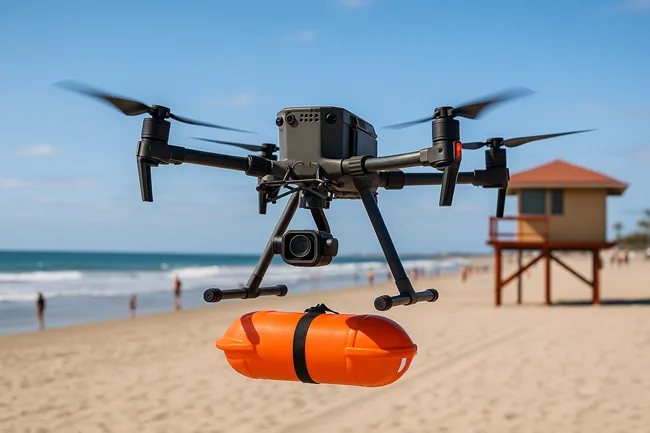
The New York Police Department (NYPD) has officially launched a drone-assisted beach rescue program this Memorial Day weekend, unveiling new unmanned aerial vehicles equipped with flotation devices designed to assist swimmers in distress. Announced by Mayor Eric Adams on Saturday, the initiative places high-tech drones at the frontline of beach safety across New York City’s most visited shorelines as summer begins.
The drones, which will be monitored and controlled by trained NYPD officers, are equipped with emergency flotation rafts, real-time video systems, and loudspeakers to deliver immediate assistance in water emergencies. The initiative is currently being rolled out at Coney Island, Rockaway Beach, and Orchard Beach — three of the city’s most crowded waterfronts.
What Prompted the Launch of NYPD’s Drone Beach Patrol?
The NYPD’s decision comes amid a growing number of water-related emergencies at city beaches over the past two years. According to internal safety reports reviewed by the NYC Office of Emergency Management, over 200 rescue operations were conducted during the 2023 beach season, with several cases involving delayed response times due to distance and visibility limitations.
In response, the city greenlit the drone deployment plan through a multi-agency effort, drawing from NYPD innovation grants and emergency modernization budgets. The drones, equipped with lightweight rescue pods, can now respond in under two minutes — significantly faster than traditional in-person rescues.
Mayor Adams described the drones as “a 21st-century solution to a timeless public safety challenge,” adding that “when a life is on the line, seconds matter — and these drones can help us win those seconds.”
How Will the Rescue Drones Work at New York Beaches?
Each drone is built with a high-definition camera feed, long-range loudspeaker, and a compact emergency flotation raft. In the event of a swimmer struggling or being pulled by a rip current, drone pilots stationed at ground-level command posts will deploy the vehicle directly above the target. The drone will then release the flotation device, offering immediate buoyancy while lifeguards or EMTs prepare for full rescue.
According to NYPD Deputy Commissioner of Operations Jeffrey Maddrey, the drones will operate during official beach hours and in conjunction with on-site lifeguards. They are designed to supplement, not replace, human responders — particularly in scenarios where physical access is delayed by crowds, current strength, or beach distance.
The devices have been tested for high wind conditions, with reinforced rotors and GPS-based stabilization ensuring accuracy. NYPD said all drone operators must pass FAA certification and complete a three-week emergency response training module specific to aquatic rescues.
Are There Privacy or Safety Concerns?
While the program has been praised for its life-saving potential, civil liberties groups have raised flags around potential privacy encroachments. The New York Civil Liberties Union (NYCLU), in statements made through local press, emphasized the need for transparency in how footage is stored, how long it is retained, and whether data might be used for non-emergency purposes.
In response, Mayor Adams’ office clarified that all video feeds from the drones will be strictly limited to rescue operations and that no surveillance-related data collection will occur during deployment. “This isn’t about watching people,” said NYPD Commissioner Edward Caban in a press interaction. “This is about saving lives when it counts.”
Officials have also stated that all footage will be deleted within 30 days unless it is flagged for review in a formal emergency incident report.
Have Drones Been Used for Rescues Elsewhere?
The concept of drone-based beach rescue is not new globally. In 2018, Australian lifeguards at Lennox Head Beach successfully used a drone to drop a rescue pod to two swimmers caught in a riptide. Similar initiatives have been piloted in Spain and southern California.
In New York City, drones have so far been deployed primarily for security, disaster response, and crowd management. This marks the city’s first structured use of drones for a pre-emptive public safety program during leisure activities.
“This is a major evolution,” said public safety researcher Dr. Alan Rowe, who tracks urban drone deployments. “By combining public trust with life-critical deployment, NYPD is entering a use case that’s extremely visible and emotionally resonant — if the tech performs well, the public will embrace it.”
What Does This Mean for Summer 2025?
With the city expecting record turnout at beaches due to rising temperatures, pent-up travel demand, and Fleet Week festivities, the drone program is timed for maximum impact. NYC Parks Department projects beach traffic to increase by 12% over 2024 levels, with peak weekends drawing nearly 400,000 people across all boroughs.
The drone deployment will be monitored closely by both emergency response leaders and City Council committees overseeing technology and public safety. Metrics such as response time, rescue success rates, and drone reliability under pressure will feed into decisions on whether to expand the initiative to other waterfront areas — including ferry terminals, piers, and even Central Park’s boating lake.
NYPD officials are already exploring the use of thermal imaging for nighttime response scenarios, as well as AI-assisted tracking for crowd-size estimation and missing-person alerts near aquatic zones.
The Bigger Picture: NYC’s Push for Tech-Enabled Public Safety
Mayor Eric Adams’ administration has made no secret of its ambitions to turn New York into a global benchmark for smart urban safety. The drone beach rescue program complements a growing portfolio of AI-backed public systems, including automated traffic enforcement cameras, AI criminal detection pilots in select precincts, and predictive fire hazard mapping in coordination with FDNY.
Critics warn of technology outpacing regulation, but supporters argue that urban innovation in the public safety space must evolve to address population density, climate challenges, and staffing limitations. The drone initiative, while limited in scope for now, may serve as a model for similar deployments in heatwave response, fire zone mapping, or school safety.
Discover more from Business-News-Today.com
Subscribe to get the latest posts sent to your email.