




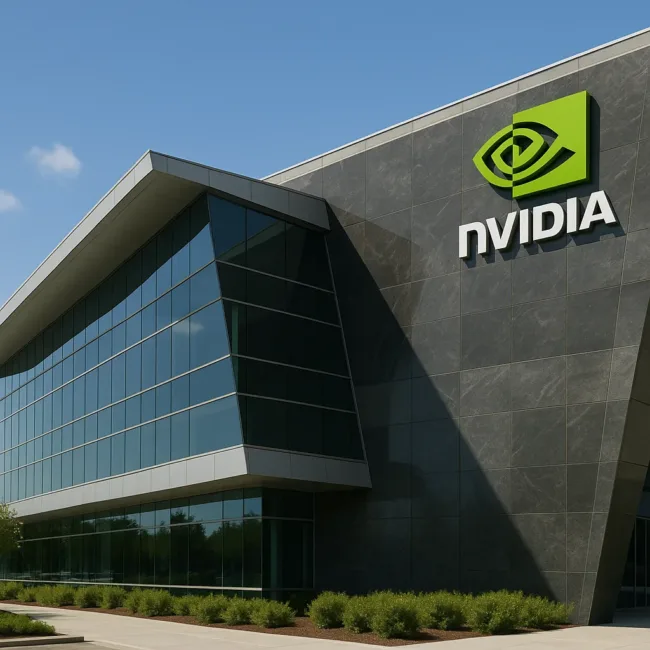
NVIDIA Corporation is edging closer to an unprecedented $5 trillion market capitalisation following a keynote by Chief Executive Officer Jensen Huang at GTC 2025 that reinforced the company’s position at the center of the artificial intelligence (AI) infrastructure wave.
The company has visibility into approximately $500 billion worth of AI-related chip bookings, according to statements made during the conference, a figure that has stoked bullish sentiment across equity markets.
The announcement of seven new supercomputing projects in partnership with the United States Department of Energy marked a clear pivot toward national AI infrastructure leadership and domestic manufacturing of its Blackwell chips.
The stock price of NVIDIA Corporation has surged more than 50 percent in 2025 so far, fueled by enthusiasm around AI systems and high-performance computing contracts.
While investor sentiment is overwhelmingly positive, analysts are closely monitoring execution timelines, geopolitical tensions, and how quickly the bookings pipeline converts into recognised revenue.
How did Jensen Huang’s GTC announcements reshape NVIDIA’s long-term outlook?
At the 2025 edition of the GPU Technology Conference (GTC), Chief Executive Officer Jensen Huang presented what many investors interpreted as a strategic blueprint for scaling NVIDIA Corporation into the $5 trillion club. His keynote focused on the next phase of AI compute infrastructure and signalled the company’s evolution from a chipmaker to a vertically integrated systems supplier with national and commercial AI applications.
Most notably, Huang disclosed that NVIDIA Corporation has visibility into $500 billion worth of AI processor bookings. These are not vague projections, but rather what the company characterised as booked or committed orders—many of them from hyperscalers, sovereign governments, and industrial players deploying Blackwell or Grace Hopper platforms.
Another significant announcement was the development of seven new supercomputers in partnership with the United States Department of Energy. These supercomputers will be built using NVIDIA Corporation’s Blackwell architecture and represent a national infrastructure investment in AI capabilities. The projects underscore the shift from speculative AI adoption to mission-critical deployments across energy modelling, defense analytics, climate forecasting, and fusion research.
Huang also revealed that these chips would be manufactured in Arizona, marking a deepening of the company’s alignment with the Biden administration’s “Made in America” manufacturing push. By localising production, NVIDIA Corporation aims to reduce dependency on foreign fabrication, mitigate export control risks, and bolster its role in sovereign AI capability building.
Why is investor sentiment turning so bullish on NVIDIA’s valuation path?
The excitement around NVIDIA Corporation is not simply a reaction to impressive product launches, but rather a growing belief that the company has positioned itself as the dominant player in a long-term AI infrastructure cycle.
The bookings pipeline of $500 billion gives investors a concrete anchor to model future revenue. Analysts view this as validation that the demand for graphics processing units (GPUs), networking platforms, and AI-accelerated compute is not only sustained but scaling. Some financial institutions have revised their long-term valuation models to reflect a higher terminal growth rate, assuming that data center AI buildouts remain the dominant capital expenditure theme through at least 2028.
Moreover, the company’s moves to secure Department of Energy projects and expand into full-system design have drawn comparisons with earlier government-anchored tech expansions, such as the rise of Intel Corporation in the 1980s during the early personal computer era. Market watchers believe that national infrastructure contracts offer NVIDIA Corporation more resilience during cyclical downturns and open the door to policy-protected AI leadership.
Despite high absolute valuations, many buy-side institutions view NVIDIA Corporation as the only truly irreplaceable player in the AI compute stack, particularly in sectors where latency, throughput, and interconnect speeds are mission-critical.
What are the biggest risks to NVIDIA’s $5 trillion trajectory?
Although the market narrative around NVIDIA Corporation remains overwhelmingly positive, analysts have flagged several risks that could slow or derail the company’s trajectory toward a $5 trillion valuation.
The first is geopolitical exposure, particularly in relation to export controls and technology restrictions involving China. Any fresh enforcement of the United States Bureau of Industry and Security’s rules around advanced semiconductor exports could constrain NVIDIA Corporation’s access to one of its largest commercial markets. While bookings visibility looks strong, realising those bookings depends on regulatory clearance and cross-border stability.
The second risk is execution complexity. NVIDIA Corporation is no longer just a semiconductor firm. It is evolving into a full-stack AI systems provider, which entails integrating software, systems, networking, and packaging—all while managing hyperscale customer relationships. Scaling this operation efficiently without margin erosion or project overruns will be a key determinant of sustained investor confidence.
Lastly, market watchers are cautious about valuation compression if the macro environment turns. With NVIDIA Corporation’s price-to-earnings ratio already stretching historic norms, even a minor earnings miss or guidance downgrade could spark multiple contraction.
How do NVIDIA’s competitors compare in the AI infrastructure race?
The GTC announcements also reignited debate over how NVIDIA Corporation compares with competitors such as Advanced Micro Devices, Inc., Intel Corporation, and various custom silicon providers like Tenstorrent and Cerebras Systems.
Advanced Micro Devices, Inc. has made inroads with its MI300 series, but lacks the comprehensive ecosystem advantage that NVIDIA Corporation has built with CUDA, DGX systems, and NVLink interconnects. Intel Corporation continues to struggle with data center turnaround efforts, while its Gaudi accelerators are yet to show competitive momentum at scale.
Meanwhile, hyperscalers such as Google, Microsoft Corporation, and Amazon Web Services are ramping up in-house chip development to reduce reliance on external GPU vendors. However, most are still deploying NVIDIA Corporation systems at scale because of maturity, ecosystem breadth, and developer loyalty.
This positioning has led some analysts to describe NVIDIA Corporation as the “AI infrastructure layer zero,” meaning that it occupies a position so foundational that displacement requires more than just a better chip—it requires ecosystem rewiring.
What upcoming catalysts could push NVIDIA’s market cap past the $5 trillion milestone?
Looking ahead, the most important short-term catalysts include the next quarterly earnings report from NVIDIA Corporation, where investors will want clarity on how much of the bookings pipeline is converting into actual revenue.
Investors will also be watching for rollout progress on the Department of Energy supercomputers, particularly in terms of timelines, partner announcements, and early performance benchmarks. Any material slippage or budgetary pushback could weigh on the valuation narrative.
On the international front, updates regarding export licenses and geopolitical commentary involving China will be critical. Even marginal regulatory tightening could change the forward revenue mix for Blackwell chips.
Finally, the upcoming COP climate summit and AI-specific global forums may shine a spotlight on NVIDIA Corporation’s role in sustainable compute, especially as global energy use from data centers becomes a political concern.
Is NVIDIA’s $5 trillion valuation the ceiling—or the start of a new AI infrastructure supercycle?
NVIDIA Corporation’s near-$5 trillion valuation may appear outsized in historical context, but the company’s structural position in the AI economy arguably justifies the market’s conviction. With a $500 billion pipeline, sovereign partnerships, and a defensible technological moat, NVIDIA Corporation is not just surfing the AI wave—it is building the shoreline.
The road ahead will require flawless execution, regulatory agility, and continued ecosystem loyalty. But if even half the bookings visibility translates into recurring revenue over the next 24 months, investors may begin asking a different question altogether: what comes after $5 trillion?
What are the key takeaways from NVIDIA’s $5 trillion valuation push and GTC 2025 announcements?
- NVIDIA Corporation is approaching a $5 trillion market capitalisation, driven by investor confidence in its dominance across the artificial intelligence hardware and infrastructure space.
- At GTC 2025, Chief Executive Officer Jensen Huang announced that the company has visibility into approximately $500 billion worth of AI processor bookings, signaling strong long-term demand.
- The company revealed plans to build seven AI supercomputers in collaboration with the United States Department of Energy, powered by its next-generation Blackwell architecture.
- NVIDIA Corporation is shifting chip manufacturing to Arizona, aligning with United States domestic production policy and mitigating future export restrictions.
- The stock has gained more than 50 percent in 2025 to date, reflecting both earnings strength and bullish institutional sentiment around sovereign infrastructure deals.
- Analysts believe NVIDIA Corporation’s position as a full-stack systems integrator gives it a durable competitive moat, although export control and execution risk remain in focus.
- Upcoming catalysts include quarterly earnings, supercomputer rollout progress, China-related policy developments, and further updates on Blackwell and Vera Rubin platform deployments.
- The company’s trajectory raises questions about whether the $5 trillion mark represents a cyclical peak or merely a checkpoint in a much larger artificial intelligence infrastructure expansion cycle.
Discover more from Business-News-Today.com
Subscribe to get the latest posts sent to your email.
