



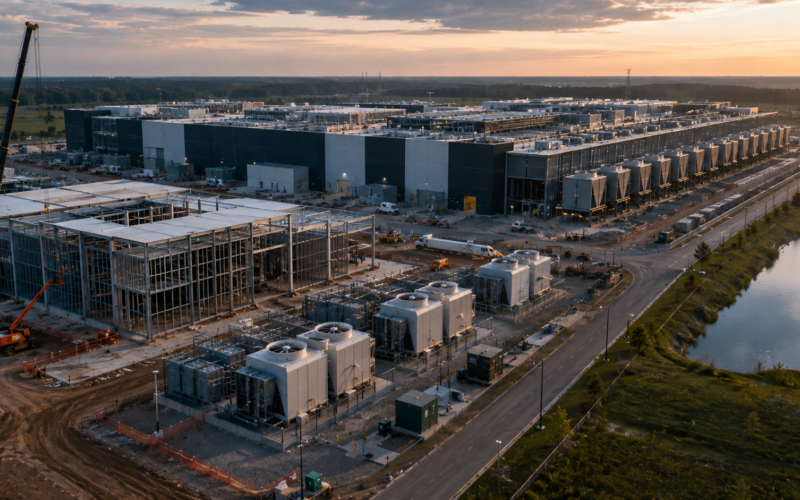
NVIDIA Corporation (NASDAQ: NVDA) has made a minority investment in Cloverleaf Infrastructure LLC and formed a strategic partnership aimed at accelerating development of artificial intelligence data centres across the United States, extending the chipmaker’s influence deeper into the physical infrastructure required to build large AI factories. Financial terms and the size of NVIDIA’s ownership position were not disclosed. Under the partnership, Cloverleaf plans to use the NVIDIA DSX Platform during development of its data-centre pipeline, bringing decisions around sites, power, cooling, computing and facility architecture together earlier in the design process. The transaction is significant because NVIDIA is increasingly addressing the constraints surrounding AI compute, rather than relying solely on demand for its accelerators to drive the next phase of infrastructure expansion.
Cloverleaf was founded in 2024 with initial backing from Sandbrook Capital and NGP Energy Capital and has been assembling a North American development pipeline that includes multiple projects designed at gigawatt scale. The company focuses on securing sites, electricity and infrastructure for large data-centre customers, placing it directly within one of the most constrained parts of the AI value chain. NVIDIA’s investment therefore gives it exposure to a developer working upstream of server deployment, where access to power, transmission capacity, permitting and construction-ready land can determine when expensive computing equipment can actually enter service.
Why is NVIDIA investing in powered data-centre sites instead of only selling GPUs?
The economics of artificial intelligence infrastructure have changed as computing clusters have become larger and more power intensive. NVIDIA can sell accelerators only when customers have facilities capable of housing, powering, cooling and networking them, which means delays in electricity interconnections or site construction can indirectly constrain semiconductor demand. By partnering with infrastructure developers such as Cloverleaf, NVIDIA can help align future compute requirements with the facilities that will eventually accommodate those systems.
This represents a broader strategic expansion by NVIDIA into what might be described as the constraint stack surrounding AI factories. The company has recently emphasized land, power and data-centre shells as critical components of artificial intelligence infrastructure, while also participating in financing arrangements designed to mobilize vastly larger amounts of third-party capital. Earlier in August, NVIDIA announced partnerships with Apollo Global Management, BlackRock, Blackstone, Brookfield Asset Management, Goldman Sachs and KKR aimed at creating independent compute-financing platforms that could eventually mobilize more than $500 billion of third-party capital for AI infrastructure.
That $500 billion figure is an objective for capital mobilization over time, not a committed NVIDIA expenditure. Nevertheless, it illustrates the size of the financing requirement surrounding the next generation of AI systems. NVIDIA’s economic interest is straightforward: a larger and more predictable pipeline of financeable, powered data-centre capacity expands the environment into which its GPUs, networking products and software can be deployed.

What does NVIDIA DSX change in Cloverleaf’s data-centre development process?
The NVIDIA DSX Platform is intended to connect decisions that have traditionally been made by separate groups at different stages of data-centre development. Cloverleaf can use the platform while evaluating power availability, cooling architecture, facility design and compute requirements, potentially reducing the risk that a site is designed around assumptions that later prove incompatible with the hardware a customer intends to install. Once a facility becomes operational, NVIDIA says DSX infrastructure and software can also help optimize energy consumption and computing capacity.
This matters particularly for AI facilities because power density and cooling requirements can change rapidly between hardware generations. A conventional data-centre project may spend years moving from site acquisition through interconnection, permitting and construction, while the accelerator architecture expected to occupy the facility can evolve much faster. Bringing compute specifications into the infrastructure-design process earlier could reduce redesign work and improve the probability that a site remains commercially useful when it reaches operation.
The partnership also creates another route for Cloverleaf customers to engage with NVIDIA across accelerated computing, high-performance networking, infrastructure software and platform technology. That does not guarantee those customers will purchase NVIDIA systems, but it embeds NVIDIA closer to infrastructure decisions before procurement reaches the server stage. For a company already dominant in AI accelerators, influencing the design environment surrounding future clusters can reinforce its ecosystem position without requiring ownership of the entire data-centre stack.
How does Cloverleaf fit into NVIDIA’s wider AI infrastructure investment strategy?
Cloverleaf is not an isolated infrastructure investment. NVIDIA said on August 17 that it would invest $1.5 billion in SB Energy and become the exclusive AI compute infrastructure provider for the initial development at SB Energy’s PORTS-Pike Technology Campus in Ohio. That project contemplates an initial 4.25 IT-gigawatts of land, power and shell capacity, with an option covering another 3.75 IT-gigawatts, while OpenAI is expected to be the customer for the planned 8 IT-gigawatts. Initial phases are planned to begin in 2028.
Taken together, the Cloverleaf investment, SB Energy relationship and compute-financing initiative point toward a strategy that reaches from silicon into site development and capital formation. NVIDIA does not need to become a conventional data-centre owner for this approach to matter. Minority investments and infrastructure partnerships can instead help create capacity, shape technical standards and connect developers with customers while preserving NVIDIA’s focus on computing platforms.
There is also a defensive element. If electricity, construction capacity or financing becomes the binding constraint on AI deployment, competitors do not need to displace NVIDIA technologically for its growth to slow. Supporting the infrastructure around customers therefore reduces bottlenecks that could otherwise limit the pace at which new accelerator generations are absorbed.
What are the biggest execution risks behind NVIDIA and Cloverleaf’s AI factory strategy?
Cloverleaf still has to convert its development pipeline into operating assets, and gigawatt-scale data centres face substantial hurdles before servers arrive. Grid interconnection queues, electricity-generation availability, transmission construction, permitting, water requirements, community opposition and rapidly changing equipment specifications can all affect project schedules. A strategic relationship with NVIDIA can improve technical coordination, but it cannot remove those infrastructure risks.
The economics also depend on customer commitments. Developers can secure land and pursue power long before final computing customers sign binding contracts, creating exposure if demand, financing conditions or AI hardware economics change during development. Cloverleaf has described an advanced pipeline and previous delivery of multiple gigawatt-scale projects, but the NVIDIA announcement did not disclose a specific number of sites, megawatts, construction budget or committed customers associated with the new partnership.
For NVIDIA investors, the partnership arrives just before another important test. NVIDIA shares closed at $214.77 on August 21, down 0.96% for the session after several weaker trading days, compared with $225.01 on August 17. The stock remained within a 52-week range of $164.07 to $236.54 as investors awaited the company’s August 26 earnings report amid renewed concern about long-term bond yields and the enormous financing requirements of the AI infrastructure cycle.
The Cloverleaf investment is unlikely to be financially material to NVIDIA by itself, especially because the amount has not been disclosed. Its strategic importance is that NVIDIA appears increasingly unwilling to treat powered land, capital and facility architecture as somebody else’s problem. As AI clusters become larger, controlling the pace at which the surrounding infrastructure develops may become almost as important to NVIDIA’s growth as producing faster chips.
Discover more from Business-News-Today.com
Subscribe to get the latest posts sent to your email.

