

The challenge of managing nuclear waste remains one of the most complex and debated aspects of the global energy transition. Every nuclear reactor, from large pressurised water plants to emerging small modular reactors, produces radioactive materials that must be handled with extreme care. While low-level waste (LLW) can often be managed in shallow facilities after relatively short storage periods, high-level waste (HLW)—primarily spent reactor fuel—remains hazardous for tens of thousands of years. This enduring hazard has frequently been portrayed as the Achilles’ heel of nuclear energy. Yet, scientific innovation, policy coordination, and community engagement are combining to transform nuclear waste management into a highly engineered and internationally coordinated discipline.
Institutional observers note that the ability to demonstrate credible, long-term waste strategies is not only a matter of public safety but also a competitive differentiator for countries and companies seeking to expand nuclear power in the age of decarbonisation.
What types of nuclear waste exist, and why does high-level waste require the most complex solutions?
Radioactive waste is classified into three broad categories. Low-level waste includes protective clothing, filters, and other items with low radioactivity, which are typically disposed of in near-surface facilities after treatment. Intermediate-level waste, such as reactor components and contaminated tools, contains higher concentrations of radioactivity and requires shielding during handling and transport. High-level waste, mainly in the form of spent nuclear fuel, contains over 95% of the total radioactivity generated by nuclear power operations.
For HLW, a multi-stage approach is employed. Spent fuel is first stored in water-filled cooling pools for several years, reducing both heat and radioactivity. The fuel can then be transferred to dry cask storage—robust steel-and-concrete containers designed to resist earthquakes, flooding, and even aircraft impacts. These casks provide a secure interim solution, buying time for countries to establish permanent disposal pathways.
Why are deep geological repositories considered the most secure long-term solution for radioactive waste worldwide?
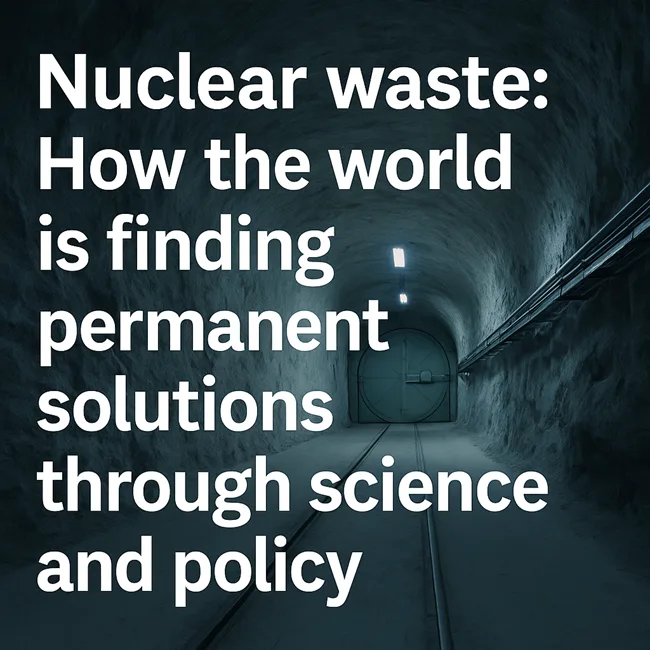
The scientific consensus, supported by decades of research and international peer review, is that deep geological repositories offer the most secure and durable method for isolating HLW from the biosphere. These facilities are located hundreds of metres underground in stable geological formations such as granite, clay, or salt deposits. The engineered design typically involves multiple containment barriers—robust waste canisters, protective backfill materials, and the surrounding rock mass—to ensure radionuclides remain immobilised until their radioactivity decays to safe levels.
Finland is leading global implementation with its Onkalo repository, which is set to become the first operational spent fuel repository. Sweden, France, Canada, and the United Kingdom are advancing similar projects. The Organisation for Economic Co-operation and Development’s Nuclear Energy Agency (OECD NEA) and the International Atomic Energy Agency (IAEA) play pivotal roles in facilitating cross-border technical cooperation, safety assessment exchanges, and public engagement strategies.
How can recycling and transmutation technologies reduce the volume and toxicity of long-lived nuclear waste?
While repositories provide the final destination for HLW, advanced nuclear fuel cycle technologies are being developed to reduce both the amount and the hazard of material requiring disposal. Reprocessing—already practised in countries such as France and Russia—separates usable uranium and plutonium from spent fuel for recycling in new fuel assemblies. This process can lower the volume of high-level waste, although it raises concerns over proliferation risks and economic feasibility.
Another frontier is transmutation, where long-lived isotopes are converted into shorter-lived forms by neutron bombardment. Advanced reactors, including fast neutron reactors and molten salt systems, have the potential to “burn” long-lived actinides, potentially shortening the hazardous lifespan of waste from hundreds of thousands of years to mere centuries. Sector analysts suggest that while such technologies are still scaling, they could reshape waste management economics and reduce repository capacity requirements in the long term.
In what ways are new reactor designs helping to minimise radioactive waste from the outset?
Reactor design plays a direct role in determining the quantity and composition of waste generated. Small modular reactors (SMRs) and Generation IV designs are being engineered for higher fuel efficiency, longer operating cycles, and, in some cases, the ability to consume certain waste isotopes as fuel. Even current Generation III pressurised water reactors are adopting accident-tolerant fuels, enabling higher burn-up rates that extract more energy from the same quantity of uranium, thereby leaving less waste behind.
Industry observers argue that integrating waste minimisation into reactor design is essential to making nuclear power both economically competitive and socially acceptable in the long run.
How do international cooperation and public engagement determine the success of nuclear waste projects?
Countries with the most advanced waste disposal programs have achieved success through long-term public engagement and transparency. Finland’s acceptance of the Onkalo repository was the result of decades of dialogue with local communities, backed by guarantees of economic benefits and environmental monitoring. Similarly, Sweden’s Svensk Kärnbränslehantering AB (SKB) and Canada’s Nuclear Waste Management Organization (NWMO) have implemented multi-year consultation processes that include site visits, public hearings, and independent safety reviews.
The IAEA supports this cooperative approach through its Integrated Nuclear Infrastructure Review (INIR) missions, which help countries assess their readiness for both nuclear power deployment and waste management planning. Sector experts emphasise that without community consent, even the most technically sound projects face significant political and regulatory delays.
What is the investment and market sentiment toward companies specialising in nuclear waste management?
The nuclear waste sector is dominated by government-backed entities and private engineering contractors operating under long-term service agreements. Firms such as Sweden’s SKB and France’s Orano specialise in disposal and fuel cycle services, while engineering and construction companies like Jacobs Solutions and Bechtel secure multi-year contracts for repository construction, site remediation, and plant decommissioning.
Investor sentiment toward these companies is generally neutral to positive, reflecting the stable, regulated nature of the business. Because waste management is a mandated public safety function, revenue streams are less susceptible to commodity price swings and more closely linked to government funding cycles and contract wins. In capital markets, share price movements tend to correlate with major contract announcements rather than broader trends in the energy sector.
What is the institutional and market outlook for the nuclear waste sector over the next decade?
Institutional investors tend to view nuclear waste management as a defensive, infrastructure-class investment opportunity rather than a cyclical energy play. The sector’s revenues are often underpinned by multi-year government appropriations, making cash flows relatively predictable. Large engineering contractors involved in repository construction, decommissioning, and site remediation are expected to benefit from steady demand as nuclear capacity expands globally.
Private equity interest in the sector has been limited compared with other areas of energy infrastructure, largely due to the high regulatory barriers, specialised expertise requirements, and long project timelines. However, sovereign wealth funds and infrastructure-focused asset managers are showing increasing interest in partnering on large-scale disposal projects, particularly in Europe and North America, where repository development is accelerating.
Market analysts expect the next decade to see a rise in public–private partnerships for waste management facilities, especially as smaller nuclear nations seek shared disposal solutions. For publicly traded contractors like Jacobs Solutions, upside potential lies in securing long-duration service agreements tied to new repository developments and international consulting contracts. Given the essential nature of waste management, downside risk is generally limited to execution challenges or political delays, rather than demand fluctuations.
What is the long-term outlook for nuclear waste management as nuclear energy expands worldwide?
As nuclear power gains renewed interest as a low-carbon energy source, the volume of waste will inevitably grow. Analysts expect accelerated repository development in Europe, North America, and parts of Asia over the next two decades. At the same time, breakthroughs in recycling, transmutation, and reactor fuel design could reduce future disposal requirements.
The prevailing expert view is that nations that invest early in robust, transparent, and technologically advanced waste management systems will enjoy strategic advantages. These may include reduced public opposition to nuclear expansion, the ability to export waste management technologies, and the potential to host multinational disposal facilities serving multiple smaller nuclear programs.
Discover more from Business-News-Today.com
Subscribe to get the latest posts sent to your email.