




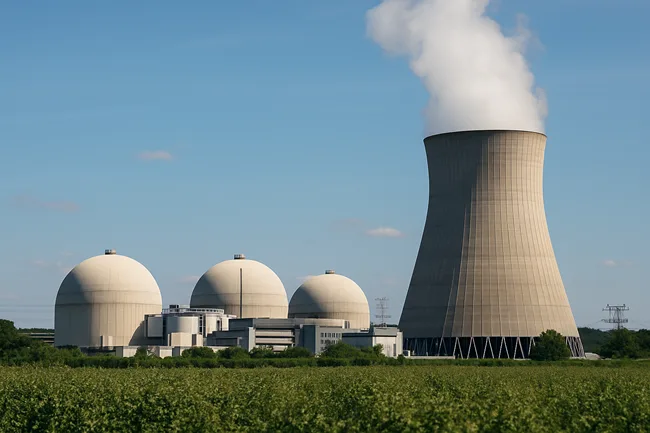
As climate change accelerates and energy security crises fuel anxiety, nuclear energy is staging a global comeback. Nuclear power currently generates about 10% of the world’s electricity and nearly 20% in advanced economies. This established baseload capacity, free of carbon emissions, is poised to expand as many governments now see atomic reactors as a critical pillar in the race toward net-zero emissions. Calls to triple global nuclear capacity by mid-century were endorsed at COP28 and again at the 2025 International Day of Clean Energy. A new wave of project announcements, financial incentives, and national commitments signals that nuclear power is no longer seen as a relic of the past—but a key enabler of tomorrow’s clean energy grid.
Why nuclear energy is being rebranded as a zero-carbon solution to secure global baseload power
The most urgent driver behind this shift is the realization that decarbonisation cannot be achieved with intermittent renewables alone. Unlike wind and solar, nuclear power provides dispatchable energy—able to ramp up or down depending on real-time demand. This reliability anchors grid stability while supporting fluctuating renewables. Nuclear’s resurgence also reflects lessons learned from geopolitical shocks. The energy crisis triggered by Russia’s invasion of Ukraine exposed how overreliance on imported gas and coal can imperil national security.
In response, countries such as France, Belgium, Japan, South Korea, and the United States have moved to extend reactor lifetimes, restart dormant facilities, and commission new units. High energy prices, inflation concerns, and fears of winter blackouts have made the political argument for nuclear power more palatable. As a result, instead of shutting down aging fleets, governments are pushing to operate them for 60 years or more—while simultaneously investing in next-generation builds.
How climate targets and geopolitical energy shocks are reshaping the case for nuclear energy in 2025
Policymakers now frame nuclear energy as a bridge between climate action and energy sovereignty. In 2025, this argument gained more traction than ever. Decarbonisation goals set by the European Union, United States, China, and others have proven difficult to meet using only solar, wind, and storage. Nuclear offers a zero-emissions option with a much higher capacity factor—often above 90%—that can directly displace coal and gas. This makes it especially attractive for large industrial loads, manufacturing, and critical infrastructure that cannot tolerate power interruptions.
Furthermore, the war in Ukraine accelerated interest in domestically controlled, resilient energy systems. Countries once planning phase-outs—such as Belgium and Japan—have reversed their decisions and begun modifying legislation to extend operating lifespans or approve new projects. In the United States, the Inflation Reduction Act created production tax credits for existing nuclear plants and incentives for future builds, tilting the economic case further in nuclear’s favor.
Which new nuclear policies, funding programs, and projects are defining the sector’s second wind in 2025
A dramatic shift in nuclear policy support is evident across the globe. More than 60 reactors are under construction worldwide, with China leading the expansion with over 20 builds. India, the United Arab Emirates, Egypt, Türkiye, and other emerging economies are joining the effort. France has pledged to construct six large reactors and may add eight more. The United Kingdom has set a 24-gigawatt nuclear capacity target for 2050, while Belgium has delayed the closure of two key reactors to 2035. Japan is also amending legal frameworks to allow nuclear plants to operate beyond previous regulatory caps.
In North America, private capital is flowing in alongside government support. Investors are eyeing modular reactor developers, supply chain revitalization, and workforce expansion. Policymakers are attempting to correct the cost and timeline failures of the 2010s through standardized reactor designs, enhanced regulatory coordination, and public-private financing models.
Why big tech and data center operators are turning to nuclear power to meet 24/7 clean energy needs
Beyond national strategies, corporate buyers are emerging as new drivers of nuclear demand. In 2024 and 2025, several artificial intelligence companies and data center operators began exploring long-term power purchase agreements with nuclear suppliers. These firms are in search of reliable, zero-carbon electricity to run digital infrastructure that must operate 24/7 without interruption.
The nuclear industry is responding by promoting advanced designs such as small modular reactors (SMRs), which are more scalable and quicker to deploy than traditional gigawatt-scale plants. Analysts note that tech firms are increasingly willing to invest in or partner with nuclear developers, seeing it as essential to decarbonising their own operations while ensuring power continuity.
Can nuclear power compete with renewables on cost while still offering unmatched decarbonisation benefits?
Advocates of nuclear energy emphasize its track record in preventing emissions. Over the last 50 years, nuclear power has helped avoid an estimated 70 gigatonnes of carbon dioxide emissions. Even today, it is responsible for avoiding more than 1 gigatonne annually. Without nuclear, advanced economies would have emitted up to 60 gigatonnes more CO₂.
Yet critics remain concerned about the economic hurdles. Nuclear projects have historically suffered from long construction timelines, budget overruns, and complex regulatory environments. Solar and wind, by contrast, continue to see falling costs and rapid deployment. That said, new nuclear projects are increasingly backed by financial incentives, modular construction techniques, and stricter project management protocols.
From a long-term perspective, nuclear plants can operate for up to 80 years, offering consistent returns and emissions reductions over generations. If the next wave of projects meets construction milestones and avoids past mistakes, the cost advantage may tilt in nuclear’s favor.
Why nuclear power deserves its comeback story—an expert take on climate urgency and global energy security
As a business journalist covering the energy transition, I believe the growing media and investor attention on nuclear power is justified. The stakes are extraordinarily high. Climate goals are slipping beyond reach, and global energy systems remain fragile in the face of supply chain disruptions and volatile commodity prices.
In this context, nuclear energy’s ability to deliver large-scale, around-the-clock, carbon-free electricity is not just relevant—it is necessary. Countries that prematurely shut down reactors have seen emissions rise and fossil fuel use rebound. At the same time, emerging economies are prioritizing energy independence and economic growth. Nuclear power uniquely offers both.
Technological innovations—such as accident-tolerant fuels, passive safety systems, and modular construction—may help reduce build times and increase public trust. But the real test will be delivery: Can industry and governments collaborate to complete new plants on time and within budget? Can they communicate safety measures transparently and manage waste responsibly? If yes, nuclear power could become one of the most powerful tools in the global clean energy arsenal.
How nuclear energy stocks and SMR developers are reacting to policy support and investor optimism in 2025
Equity markets have taken note. Publicly traded nuclear developers—especially those focused on small modular reactors—have seen sharp stock price increases in 2025. NuScale Power, one of the most closely watched SMR players, has benefited from investor expectations that U.S. tax credits and federal procurement will accelerate its commercial rollout.
Still, analysts remain cautious. While investor sentiment is currently bullish, the first commercial SMRs are not expected to go live before the end of the decade. Until then, developers will need to navigate permitting, construction, and supply chain risks. Yet for long-term investors, the upside case for nuclear innovation appears to be building momentum.
Discover more from Business-News-Today.com
Subscribe to get the latest posts sent to your email.
